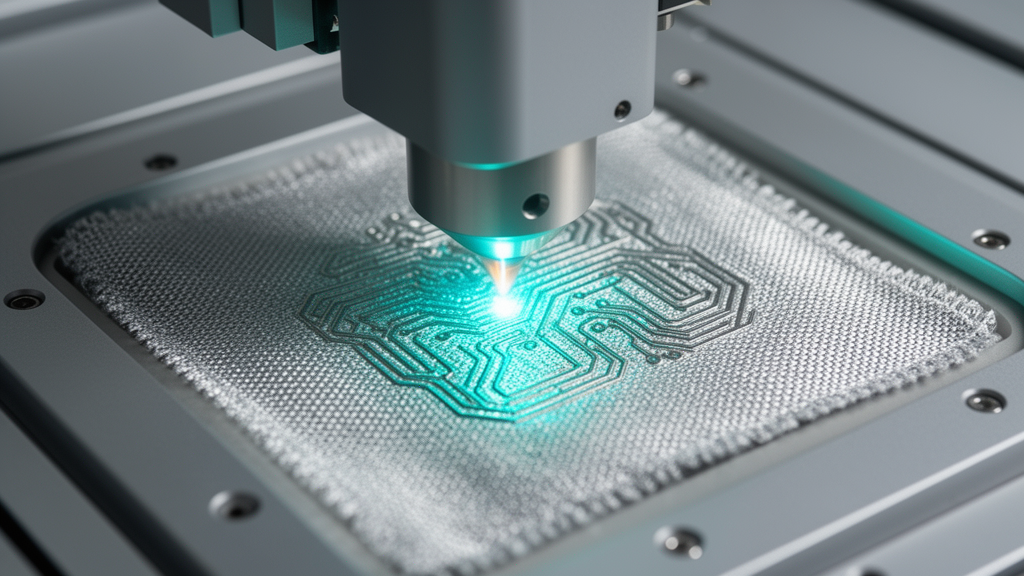
In a study published in Advanced Fiber Materials, researchers led by Muhammad Masud Rana, Sotoudeh Sedaghat, and Rahim Rahimi reported a selective laser-assisted ablation technique to fabricate durable, high-resolution electronic circuits directly on woven metallized fabrics. Wearable electronic textiles offer substantial promise for continuous, noninvasive physiological monitoring in everyday healthcare and wellness applications. However, translating wearable sensors into practical garments has been hindered by the difficulty of creating conductive pathways that combine fine spatial resolution with long-term mechanical stability and resistance to repeated domestic laundering. The research team overcame this barrier by using a focused laser beam to selectively vaporize conductive silver fibers from a commercially available electromagnetic shielding fabric. This subtractive, mask-free, and chemical-free fabrication process defines intricate electrical traces directly on the fabric while preserving the structural integrity, flexibility, and natural breathability of the supporting textile matrix.
Existing manufacturing approaches for e-textile interconnects have consistently struggled to balance electrical conductivity, mechanical durability, and user comfort. Additive printing technologies, such as screen printing and inkjet printing, deposit metallic particle inks mixed with polymeric binders onto fabric surfaces. These printed conductive traces rely on percolative particle networks that frequently suffer from binder degradation, oxidative aging, cracking, and severe delamination during routine wear and washing, often requiring complex encapsulation layers that impair textile softness. A second common strategy integrates conductive threads or metal wires using embroidery, knitting, or weaving. While thread-based pathways preserve fabric deformability and provide bulk electrical transport, they are prone to flexural fatigue, fiber breakage, connector failure, and unraveling at trimmed edges, while typically providing coarse, millimeter-scale patterning resolution. Direct textile microfabrication using photolithography can achieve sub-hundred-micrometer features, but it demands complex, multistep chemical etching and metallization sequences that drastically elevate manufacturing costs and compromise fabric air permeability.
To establish a more robust circuit architecture, the researchers utilized a commercially manufactured dual-layer metallized fabric procured from EMR Shielding Solutions. The substrate comprises a nonconductive base layer of tightly woven polyester fibers and a single-sided conductive surface layer formed by interwoven pure silver multifilament yarns. Each conductive yarn consists of a multi-stranded bundle containing 25 pure silver filaments, with individual filament diameters averaging approximately 25 micrometers, resulting in an overall yarn bundle diameter of 140 to 150 micrometers. The conductive yarns are arranged at a density of 60 ends per inch in the warp direction, while the underlying polyester yarns are spaced at 50 picks per inch in the weft direction. The resulting textile exhibits an overall thickness of approximately 0.35 millimeters, an areal density of 150 grams per square meter, an initial sheet resistance of approximately 2 milliohms per square, and high air permeability ranging from 220 to 250 millimeters per second under a 100-pascal pressure differential.
Laser patterning was performed using a nanosecond-pulsed neodymium-doped yttrium aluminum garnet laser operating at a 1.06-micrometer wavelength, a repetition frequency of 30 kilohertz, and a Q-pulse setting of 200. Because metallic silver absorbs near-infrared radiation far more efficiently than synthetic polymers, the laser selectively vaporizes conductive yarns without damaging the underlying polyester substrate. To define optimal operating boundaries, the team executed a parametric study by varying laser power and scanning speed across a 10 by 10 matrix comprising 100 distinct conditions along warp and weft directions. The analysis revealed four distinct interaction regimes: low energy densities below 1.75 joules per square centimeter caused no observable ablation; intermediate exposures between 1.8 and 7.5 joules per square centimeter produced partial melting and incomplete electrical isolation; excessive densities between 27 and 40 joules per square centimeter charred the polyester fibers; and an optimal window between 8 and 26.5 joules per square centimeter achieved complete, selective silver ablation while preserving the textile scaffold.
Microscopic and elemental analyses confirmed that operating within the optimal 10 joules per square centimeter regime cleanly removed the conductive silver layer without damaging the supporting polyester. Scanning electron microscopy verified that exposed polyester fibers retained their original morphology without melting or structural collapse. Crucially, localized laser heating produced an advantageous edge-sealing phenomenon: the exposed ends of adjacent silver yarns melted and fused together along cut boundaries, forming smooth metallic caps that suppressed fraying and reinforced circuit edges. Energy-dispersive X-ray spectroscopy verified near-complete silver elimination within irradiated regions. Pristine fabric exhibited an elemental composition of approximately 58 weight percent silver, 32 weight percent carbon, and 7 weight percent oxygen. Following optimal ablation, silver concentration dropped below 3 weight percent—falling to roughly 1 weight percent at higher energies—while carbon and oxygen rose to 76 and 20 weight percent, respectively. The silver-to-carbon ratio plummeted from 1.80 in pristine fabric to 0.03 in the optimal ablation window.
Electrical measurements conducted with a four-point probe setup showed that sheet resistance increased monotonically with laser energy density across both warp and weft scanning directions. Pristine fabric registered a low baseline sheet resistance of approximately 2 milliohms per square. Sub-threshold exposures maintained resistances between 3.7 and 100 ohms per square, while intermediate energy densities caused resistances to rise from 0.1 to 95 kilohms per square as conductive paths fragmented. Within the optimal 8 to 26.5 joules per square centimeter window, sheet resistance exceeded 1 megaohm per square, confirming complete electrical insulation between circuit traces. To evaluate manufacturing reproducibility, the team patterned a 10 by 10 checkerboard array of 100 square-centimeter features across four independent fabric specimens. Statistical analysis using one-way analysis of variance revealed F-statistics with a median of 0.34 and a maximum of 3.57, well below the critical significance threshold of 10.13 (p > 0.05). Furthermore, testing out-of-plane variations on tilted samples showed that complete ablation was maintained within a vertical defocus tolerance of 0 to 0.6 millimeters.
The investigators evaluated patterning resolution, mechanical tensile behavior, breathability, and chemical safety to assess wearable practicality. Utilizing a 30-micrometer laser spot size, selective removal of silver yarns via four to five raster passes enabled reproducible fabrication of circuit traces with line widths of 400 plus or minus 20 micrometers. Tensile testing adapted from ASTM D5035 revealed that pristine fabric exhibited ultimate tensile strengths of 25 megapascals in the warp direction and 24.5 megapascals in the weft direction, with Young’s moduli of roughly 110 megapascals. Following optimal ablation at 10 joules per square centimeter, ultimate tensile strength decreased by only 1.8 megapascals in warp and 1.1 megapascals in weft orientations, while Young’s modulus dropped by less than 12 megapascals across the entire selective window, proving that the polyester structure remained mechanically ductile. Concurrently, airflow resistance measurements under ASTM D737 showed a 50 to 55 percent decrease relative to pristine fabric (1.5 kilopascal-seconds per meter), substantially enhancing breathability. Drape testing revealed only a 7 percent increase in drape coefficient, and volatile organic compound monitoring confirmed that emissions of alcohols, nitrogen oxides, ammonia, and toluene remained below 1 part per million.
The durability of the laser-patterned metallized fabric was benchmarked directly against conventional screen-printed silver conductors. Test traces measuring 100 millimeters by 2 millimeters were subjected to domestic laundering under ISO 6330 standards with mechanical detergent agitation at 400 revolutions per minute. The laser-ablated conductors maintained sharply defined geometries and exhibited less than a 5 percent variation in electrical resistance after 20 washing cycles, showing no cracking, peeling, or delamination under optical microscopy. In contrast, screen-printed control traces fabricated with commercial silver paste suffered extensive binder swelling, interfacial debonding, and severe cracking, causing their resistance to increase 50-fold after 8 washes and exceed 250 times the baseline value after 20 washes. Furthermore, during cyclic mechanical bending tests over 10,000 cycles at a displacement of plus or minus 25 millimeters, laser-patterned traces experienced only a 6 percent total resistance increase—retaining over 94 percent of initial conductivity both before and after 20 wash cycles—whereas screen-printed traces exhibited a 400 percent resistance increase due to microcrack propagation.
As a proof of concept, the researchers fabricated a 16-electrode electrical impedance tomography array directly on the metallized fabric and integrated it into a compression garment for real-time respiratory monitoring. The multilayer construction incorporated the skin-facing patterned electrode layer, a breathable cotton passivation layer with laser-cut openings exposing only electrode contact regions, and an outer textile layer with snap buttons connecting to a portable reader module. The acquisition hardware comprised an AD9833 waveform generator, an RLC filter, an instrumentation amplifier, a modified Howland current pump, and an ADS1115 analog-to-digital converter coordinated by an ESP32-S2 microcontroller. Operating at 50 kilohertz with alternating currents between 0.4 and 1 milliampere in an adjacent-drive configuration, the system acquired 208 boundary voltage measurements per frame. Using the Graz Consensus Reconstruction Algorithm within EIDORS, the platform generated two-dimensional thoracic conductivity maps that accurately recorded dynamic ventilation changes during normal breathing and breath-holding maneuvers in healthy volunteers.
To automate state detection, the team trained a lightweight neural network in TensorFlow with two hidden layers of 16 and 8 neurons, which achieved an overall classification accuracy of 84 percent in distinguishing normal breathing, inhale-hold, and exhale-hold states, with corresponding F1 scores of 0.925, 0.697, and 0.757. Implemented on an embedded microcontroller, the model drove onboard light-emitting diodes to provide real-time visual feedback during continuous 150-second trials. When subjected to daily machine washing over ten consecutive days, the garment demonstrated outstanding stability, with signal-to-noise ratios decreasing by only 1.22 percent during normal breathing and roughly 1.07 percent during breath-holds. While achievable patterning resolution is currently bounded at 400 micrometers by the woven yarn dimensions and the lack of real-time optical alignment, future developments will incorporate optical tracking and adapt this chemical-free laser process to roll-to-roll manufacturing for scalable smart garment production.
Subject of Research: Selective laser ablation of woven metallized fabrics for durable wearable electronic textiles
Article Title: Laser-Assisted Patterning of Metallized Fabrics for Washable and Durable Electronic Textiles
Article References: Rana, M. M., Sedaghat, S., Krishnakumar, A., Sarnaik, D., Srinivasan, P., Ramesh, Y., Rahman, M. M., & Rahimi, R. (2026). Laser-Assisted Patterning of Metallized Fabrics for Washable and Durable Electronic Textiles. Advanced Fiber Materials, 8(6), 2552-2577. https://doi.org/10.1007/s42765-026-00761-8
Image Credits: AI Generated
DOI: 10.1007/s42765-026-00761-8
Keywords: electronic textiles, laser ablation, metallized fabrics, electrical impedance tomography, wash durability, wearable sensors, sheet resistance, Nd:YAG laser, respiratory monitoring, silver yarn, cyclic bending, airflow resistance, neural network, compression garments, microstructural analysis, process reproducibility, breathability, Howland current pump
News Source: Denise Maddox. (November 26, 2026). Laser Patterning of Metallized Fabrics Yields Washable Durable Electronic Textiles. Scienmag.