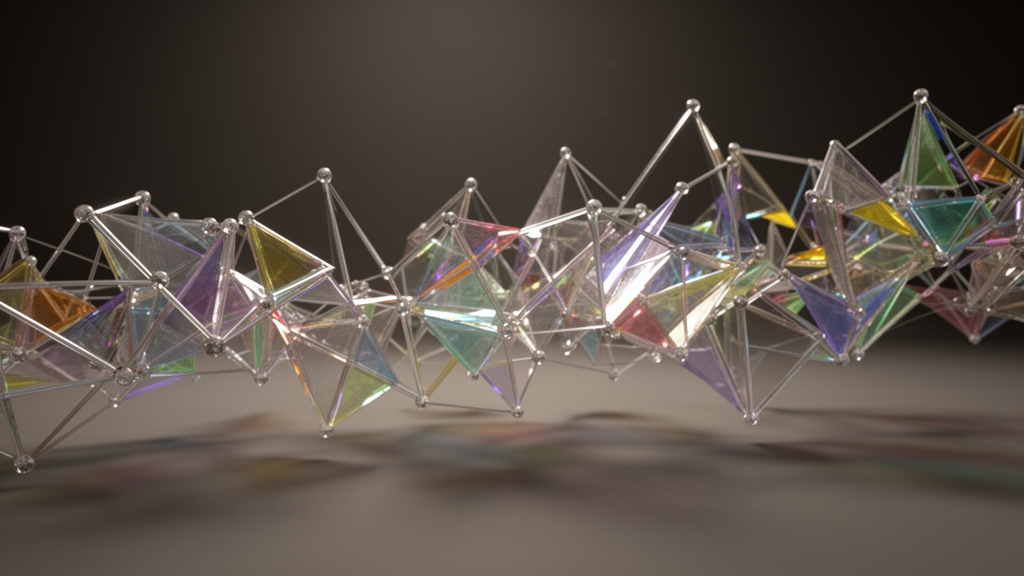
Researchers Archana Babu, Sunil Jacob John, and Baiju Thankachan have formulated an algebraic framework extending topological data analysis by introducing weighted product point clouds and weighted product simplicial complexes over commutative rings with unity and integral domains. In modern data science, topological data analysis has emerged as a mathematical methodology capable of identifying the underlying geometry, shapes, and structural organizations within complex datasets. While classical topological approaches based on homeomorphism require more discriminating tools to classify geometric objects, algebraic homology provides an effective classification technique using algebraic structures like groups and rings. Homology characterizes spaces by identifying higher-dimensional holes and connected components: zero-dimensional holes correspond to connected components, one-dimensional holes represent tunnels, and two-dimensional holes characterize internal cavities. Furthermore, homology bridges geometry and topology by examining continuous transformations while preserving essential structural invariants. Beyond theoretical comparisons, homology serves diverse applied domains, including digital image analysis, component detection in circuit diagrams, tumor identification in X-ray images, geoscience modeling, and fluid dynamics analysis.
Within topological data analysis, simplicial complexes serve as the primary mathematical data structure for representing topological spaces by decomposing them into basic geometric components. Detecting topological holes through simplicial homology is characterized by computational simplicity, operational efficiency, and effective data storage management. Betti numbers provide numerical invariants that summarize connectivity, voids, and higher-dimensional features across these spaces. However, unweighted simplicial complexes face inherent limitations when modeling higher-order interactions. Weighted simplicial complexes resolve this issue by illustrating higher-order networks without information loss, simultaneously capturing weighted data topology and relational interactions. Robert J. Dawson initiated the theoretical exploration of weighted homology in simplicial complexes, restricting weights to nonnegative integers and analyzing their categorical properties to uncover how weights govern complex topology. Building on this foundation, Ren and colleagues generalized weighted simplicial complexes by drawing weights from an arbitrary integral domain. Because integral domains encompass familiar algebraic structures including integers and polynomial rings, this generalization created a versatile framework for analyzing weighted topological spaces.
To ground their developments, the authors formalize foundational definitions from algebraic topology and abstract algebra. An s-simplex is defined as an s-dimensional polytope formed by the convex hull of s plus one affinely independent points. A simplicial complex is a collection of simplices containing every face of its constituent simplices, where any intersecting simplices share a common face. An n-chain represents a formal sum of n-simplices over integer coefficients, forming an additive chain group. The standard boundary map sends an n-simplex to the alternating sum of its n minus one dimensional faces by successively omitting individual vertices. Cycles are chains whose boundary vanishes, while boundaries are chains that form the boundary of higher-dimensional chains. The nth homology group is the quotient of the cycle subgroup by the boundary subgroup. In abstract algebra, an integral domain is a commutative ring with non-zero multiplicative identity containing no zero divisors, which embeds monomorphically into its quotient field. Additionally, category theory formalizes collections of objects and sets of morphisms governed by associative composition and identity mappings.
The investigation establishes Cartesian product operations on point clouds and simplicial complexes, distinguishing the product construction from the simplicial join. While a simplicial join combines vertex sets via disjoint union and connects every simplex in the first complex to every simplex in the second, the Cartesian product constructs vertices and simplices through direct Cartesian products of constituent elements. The authors define weighted point cloud data as a finite subset of Euclidean space paired with a weight function mapping into a commutative ring with unity. For two weighted point clouds in Euclidean spaces of dimensions m1 and m2, their weighted product point cloud is defined in Euclidean space of dimension m1 plus m2, where the composite weight of any paired vertex is the product of its individual vertex weights. The authors extend this definition to m distinct weighted point clouds in Euclidean space of dimension equal to the sum of their individual dimensions, defining the composite weight as the product of all m component vertex weights.
Building upon point clouds, the researchers formulate weighted product simplicial complexes over commutative rings with unity. A weighted simplicial complex requires that whenever a simplex is contained within another, its weight must divide the weight of the larger simplex. In a weighted product simplicial complex, the product weight function similarly ensures that if one product simplex is a face of another, its weight divides that of the larger simplex. To assign weights to higher-dimensional product simplices, the authors define the product weighting on an l-simplex as the product of all coordinate vertex weights across the constituent vertices. Generalizing this concept, the weighted m-product simplicial complex extends product weighting across m complexes. Result 1 and Corollary 1 demonstrate that for any l-simplex in a product complex, there exist constituent subsimplices of dimension at most l whose individual weights divide the composite product simplex weight, guaranteeing that the algebraic product construction remains compatible with the underlying simplicial structure.
The authors further analyze the multiplicative behavior of product weightings under geometric operations. Result 2 proves that if an l-simplex in a product complex decomposes into component l-simplices spanning distinct vertices across both constituent complexes, then the product weight assigned to the product simplex factors exactly into the product of the individual simplex weights. Furthermore, Proposition 2 establishes that restricting the product weighting to the vertices of the product complex precisely recovers the weighted product point cloud weight function. Proposition 2 also confirms the divisibility requirement for subsimplices: if one product simplex is a face of another, the weight of the smaller simplex divides the weight of the larger simplex within the ring. Corollary 2 extends both findings to m-fold product complexes, confirming that the vertex restriction equals the m-fold point cloud weight function and that simplex containment guarantees divisibility across arbitrary finite Cartesian products.
The mathematical study investigates the interaction between product weight functions and ring ideals. Lemma 1 establishes that for any ideal within a commutative ring, the preimage of the ideal under the product weight function forms an upper set: if a product simplex has its weight in an ideal, every larger product simplex containing it also belongs to that preimage. Corollary 3 generalizes this property to m-fold complexes. When considering prime ideals, Theorem 3 proves that if a product simplex belongs to the preimage of a prime ideal, there must be at least one constituent vertex whose individual weight belongs to that prime ideal in its respective complex. Corollary 4 broadens this result to m-fold Cartesian products. Consequently, Result 4 and Corollary 5 establish that if a product simplex has its weight in a prime ideal, then the largest subsimplex spanned by its vertices in at least one constituent complex must also reside in the preimage of that prime ideal.
Examining the geometry of complexes formed by removing ideal preimages reveals further topological structure. Theorem 5 and Corollary 6 prove that removing the preimage of an ideal from a weighted product complex yields a valid simplicial subcomplex. Result 6 and Corollary 7 show that taking the Cartesian product of constituent complexes with their respective ideal preimages removed produces a subcomplex of the full product complex. Theorem 7 and Corollary 8 demonstrate that the complement of the product ideal preimage is contained within the product of the individual complement subcomplexes. However, Example 8 demonstrates that the converse containment does not generally hold. Over the integers with the ideal generated by 4, the authors define weighted point clouds whose component complement complexes contain non-trivial vertices, yielding a non-empty product of complement subcomplexes. Yet, the product weight assigned to the composite simplex evaluates to 4, causing the complement of the product ideal preimage to be entirely empty.
To establish algebraic relationships across complexes, the researchers formalize induced simplicial maps. Definition 20 and Definition 21 define induced product simplicial maps acting on vertices of product complexes. In Example 10, the authors illustrate that not all simplicial maps between product complexes arise from component maps, proving that induced maps constitute a distinct class. Result 11 and Corollary 11 establish that when component maps are categorical morphisms satisfying weight divisibility, the induced product map is also a valid morphism of weighted simplicial complexes. Restricting the ground ring to an integral domain, Definition 22 and Definition 23 define weighted product chain groups as free modules whose bases consist of product simplices possessing nonzero weights. Definition 24 and Definition 25 introduce induced weighted homomorphisms between chain groups, which scale image simplices by the quotient of the source simplex weight over the target simplex weight when vertices remain distinct, and evaluate to zero otherwise.
Finally, the authors construct weighted product homology. Definition 26 and Definition 27 formulate the weighted product boundary operator, incorporating alternating face deletions weighted by the ratio of the simplex weight to the face weight. Result 12 and Corollary 12 show that this quotient simplifies directly to the product of the omitted vertex weights. Proposition 4 and Corollary 13 prove that the composition of consecutive boundary maps vanishes identically, confirming the boundary of a boundary is zero. Proposition 5 proves that induced chain homomorphisms commute with boundary maps. Consequently, Definition 28 and Definition 29 define weighted product homology groups as cycle modules modulo boundary modules. In Example 14, computing homology over the integers with a positive integer weight n yields a zero-dimensional homology group isomorphic to the direct sum of the integers and the cyclic group of order n. In conclusion, the authors propose extending this framework to weighted product persistent homology to differentiate topological filtrations across product spaces.
Subject of Research: Weighted product point clouds, simplicial complexes, and weighted homology in topological data analysis
Article Title: Weighted product of point clouds and simplicial complexes
Article References: Babu, A., John, S. J., & Thankachan, B. (2025). Weighted product of point clouds and simplicial complexes. Applicable Algebra in Engineering, Communication and Computing, 36(5), 897-923. https://doi.org/10.1007/s00200-024-00644-8
Image Credits: AI Generated
DOI: 10.1007/s00200-024-00644-8
Keywords: topological data analysis, simplicial complexes, weighted point clouds, Cartesian product, weighted homology, integral domains, boundary operators, chain complexes, Betti numbers, product simplicial complexes, simplicial maps, prime ideals, quotient fields, commutative rings, algebraic topology, discrete Morse theory, product weighting
News Source: Denise Maddox. (November 26, 2026). Mathematicians Formulate Weighted Product Homology for Simplicial Complexes and Point Clouds. Scienmag.