• HOME
  • NEWS
  • EXPLORE
    • CAREER
      • Companies
      • Jobs
    • EVENTS
    • iGEM
      • News
      • Team
    • PHOTOS
    • VIDEO
    • WIKI
  • BLOG
  • COMMUNITY
    • FACEBOOK
    • INSTAGRAM
    • TWITTER
Monday, May 11, 2026
BIOENGINEER.ORG
No Result
View All Result
  • Login
  • HOME
  • NEWS
  • EXPLORE
    • CAREER
      • Companies
      • Jobs
        • Lecturer
        • PhD Studentship
        • Postdoc
        • Research Assistant
    • EVENTS
    • iGEM
      • News
      • Team
    • PHOTOS
    • VIDEO
    • WIKI
  • BLOG
  • COMMUNITY
    • FACEBOOK
    • INSTAGRAM
    • TWITTER
  • HOME
  • NEWS
  • EXPLORE
    • CAREER
      • Companies
      • Jobs
        • Lecturer
        • PhD Studentship
        • Postdoc
        • Research Assistant
    • EVENTS
    • iGEM
      • News
      • Team
    • PHOTOS
    • VIDEO
    • WIKI
  • BLOG
  • COMMUNITY
    • FACEBOOK
    • INSTAGRAM
    • TWITTER
No Result
View All Result
Bioengineer.org
No Result
View All Result
Home NEWS Science News Chemistry

Largest study of Asia’s rivers unearths 800 years of paleoclimate patterns

Bioengineer by Bioengineer
December 30, 2020
in Chemistry
Reading Time: 3 mins read
0
IMAGE
Share on FacebookShare on TwitterShare on LinkedinShare on RedditShare on Telegram

The SUTD study will be crucial for assessing future climatic changes and making more informed water management decisions.
IMAGE

Credit: SUTD

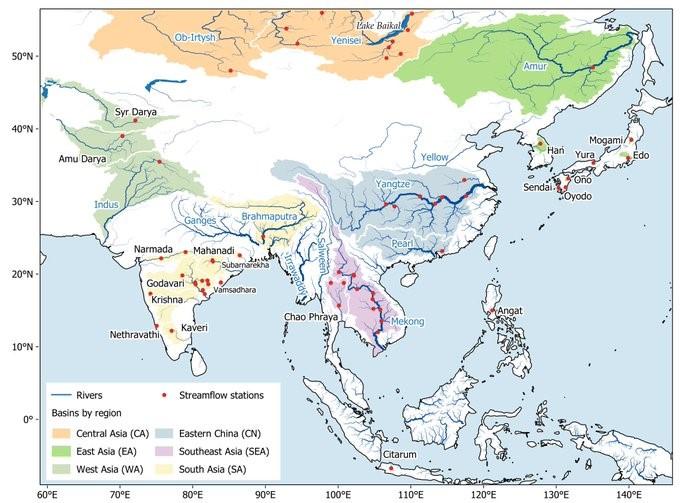
813 years of annual river discharge at 62 stations, 41 rivers in 16 countries, from 1200 to 2012. That is what researchers at the Singapore University of Technology and Design (SUTD) produced after two years of research in order to better understand past climate patterns of the Asian Monsoon region.

Home to many populous river basins, including ten of the world’s biggest rivers (Figure 1), the Asian Monsoon region provides water, energy, and food for more than three billion people. This makes it crucial for us to understand past climate patterns so that we can better predict long term changes in the water cycle and the impact they will have on the water supply.

To reconstruct histories of river discharge, the researchers relied on tree rings. An earlier study by Cook et al. (2010) developed an extensive network of tree ring data sites in Asia and created a paleodrought record called the Monsoon Asia Drought Atlas (MADA). SUTD researchers used the MADA as an input for their river discharge model.

They developed an innovative procedure to select the most relevant subset of the MADA for each river based on hydroclimatic similarity. This procedure allowed the model to extract the most important climate signals that influence river discharge from the underlying tree ring data.

“Our results reveal that rivers in Asia behave in a coherent pattern. Large droughts and major pluvial periods have often occurred simultaneously in adjacent or nearby basins. Sometimes, droughts stretched as far as from the Godavari in India to the Mekong in Southeast Asia (Figure 2). This has important implications for water management, especially when a country’s economy depends on multiple river basins, like in the case of Thailand,” explained first author Nguyen Tan Thai Hung, a PhD student from SUTD.

Using modern measurements, it has been known that the behaviour of Asian rivers is influenced by the oceans. For instance, if the Pacific Ocean becomes warmer in its tropical region in an El Nino event, this will alter atmospheric circulations and likely cause droughts in South and Southeast Asian rivers. However, the SUTD study revealed that this ocean-river connection is not constant over time. The researchers found that rivers in Asia were much less influenced by the oceans in the first half of the 20th century compared to the 50 years before and 50 years after that period.

“This research is of great importance to policy makers; we need to know where and why river discharge changed during the past millennium to make big decisions on water-dependent infrastructure. One such example is the development of the ASEAN Power Grid, conceived to interconnect a system of hydropower, thermoelectric, and renewable energy plants across all ASEAN countries. Our records show that ‘mega-droughts’ have hit multiple power production sites simultaneously, so we can now use this information to design a grid that is less vulnerable during extreme events,” said principal investigator Associate Professor Stefano Galelli from SUTD.

###

Media Contact
Jessica Sasayiah
[email protected]

Original Source

https://agupubs.onlinelibrary.wiley.com/doi/abs/10.1029/2020WR027883

Related Journal Article

http://dx.doi.org/10.1029/2020WR027883

Tags: Climate ChangeClimate ScienceEarth ScienceEcology/EnvironmentEnergy SourcesHydrology/Water ResourcesTechnology/Engineering/Computer Science
Share12Tweet8Share2ShareShareShare2

Related Posts

Miniature Sensor Uses Light to Detect Touch — Chemistry

Miniature Sensor Uses Light to Detect Touch

May 8, 2026
Iron Minerals Determine Whether Dissolved Organic Matter Fuels Microbes or Becomes Long-Term Carbon Storage — Chemistry

Iron Minerals Determine Whether Dissolved Organic Matter Fuels Microbes or Becomes Long-Term Carbon Storage

May 8, 2026

Kate Evans Appointed Associate Lab Director for Biological and Environmental Systems Science at ORNL

May 8, 2026

Advancing Multiscale Modeling and Overcoming Operational Challenges in Autothermal COâ‚‚-to-Methanol Reactors

May 8, 2026
Please login to join discussion

POPULAR NEWS

  • Research Indicates Potential Connection Between Prenatal Medication Exposure and Elevated Autism Risk

    840 shares
    Share 336 Tweet 210
  • New Study Reveals Plants Can Detect the Sound of Rain

    727 shares
    Share 290 Tweet 181
  • Salmonella Haem Blocks Macrophages, Boosts Infection

    61 shares
    Share 24 Tweet 15
  • Breastmilk Balances E. coli and Beneficial Bacteria in Infant Gut Microbiomes

    57 shares
    Share 23 Tweet 14

About

We bring you the latest biotechnology news from best research centers and universities around the world. Check our website.

Follow us

Recent News

New Post-Hoc Analysis Explores Daily Oral Orforglipron Use in Adults Over 65 with Obesity, Regardless of Diabetes Status

Evaluating Digoxin Use in Patients with Symptomatic Rheumatic Heart Disease

Evaluating the Effectiveness and Safety of Digitalis Glycosides in Treating Heart Failure

Subscribe to Blog via Email

Enter your email address to subscribe to this blog and receive notifications of new posts by email.

Join 82 other subscribers
  • Contact Us

Bioengineer.org © Copyright 2023 All Rights Reserved.

Welcome Back!

Login to your account below

Forgotten Password?

Retrieve your password

Please enter your username or email address to reset your password.

Log In
No Result
View All Result
  • Homepages
    • Home Page 1
    • Home Page 2
  • News
  • National
  • Business
  • Health
  • Lifestyle
  • Science

Bioengineer.org © Copyright 2023 All Rights Reserved.