Astronomers have charted the largest-ever volume of the universe with a new map of active supermassive black holes living at the centers of galaxies. Called quasars, the gas-gobbling black holes are, ironically, some of the universe’s brightest objects.
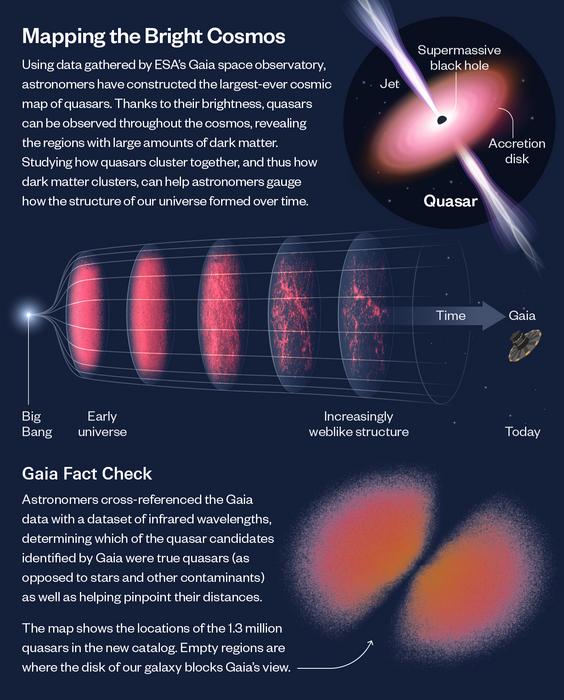
Credit: ESA/Gaia/DPAC; Lucy Reading-Ikkanda/Simons Foundation; K. Storey-Fisher et al. 2024
Astronomers have charted the largest-ever volume of the universe with a new map of active supermassive black holes living at the centers of galaxies. Called quasars, the gas-gobbling black holes are, ironically, some of the universe’s brightest objects.
The new map logs the location of about 1.3 million quasars in space and time, the furthest of which shone bright when the universe was only 1.5 billion years old. (For comparison, the universe is now 13.7 billion years old.)
“This quasar catalog is different from all previous catalogs in that it gives us a three-dimensional map of the largest-ever volume of the universe,” says map co-creator David Hogg, a senior research scientist at the Flatiron Institute’s Center for Computational Astrophysics in New York City and a professor of physics and data science at New York University. “It isn’t the catalog with the most quasars, and it isn’t the catalog with the best-quality measurements of quasars, but it is the catalog with the largest total volume of the universe mapped.”
Hogg and his colleagues present the map in a paper published March 18 in The Astrophysical Journal. The paper’s lead author, Kate Storey-Fisher, is a postdoctoral researcher at the Donostia International Physics Center in Spain.
The scientists built the new map using data from the European Space Agency’s Gaia space telescope. While Gaia’s main objective is to map the stars in our galaxy, it also inadvertently spots objects outside the Milky Way, such as quasars and other galaxies, as it scans the sky.
“We were able to make measurements of how matter clusters together in the early universe that are as precise as some of those from major international survey projects — which is quite remarkable given that we got our data as a ‘bonus’ from the Milky Way–focused Gaia project,” Storey-Fisher says.
Quasars are powered by supermassive black holes at the centers of galaxies and can be hundreds of times as bright as an entire galaxy. As the black hole’s gravitational pull spins up nearby gas, the process generates an extremely bright disk and sometimes jets of light that telescopes can observe.
The galaxies that quasars inhabit are surrounded by massive halos of invisible material called dark matter. By studying quasars, astronomers can learn more about dark matter, such as how much it clumps together.
Astronomers can also use the locations of distant quasars and their host galaxies to better understand how the cosmos expanded over time. For example, scientists have already compared the new quasar map with the oldest light in our cosmos, the cosmic microwave background. As this light travels to us, it is bent by the intervening web of dark matter — the same web mapped out by the quasars. By comparing the two, scientists can measure how strongly matter clumps together.
“It has been very exciting to see this catalog spurring so much new science,” Storey-Fisher says. “Researchers around the world are using the quasar map to measure everything from the initial density fluctuations that seeded the cosmic web to the distribution of cosmic voids to the motion of our solar system through the universe.”
The team used data from Gaia’s third data release, which contained 6.6 million quasar candidates, and data from NASA’s Wide-Field Infrared Survey Explorer and the Sloan Digital Sky Survey. By combining the datasets, the team removed contaminants such as stars and galaxies from Gaia’s original dataset and more precisely pinpointed the distances to the quasars. The team also created a map showing where dust, stars and other nuisances are expected to block our view of certain quasars, which is critical for interpreting the quasar map.
“This quasar catalog is a great example of how productive astronomical projects are,” says Hogg. “Gaia was designed to measure stars in our own galaxy, but it also found millions of quasars at the same time, which give us a map of the entire universe.”
ABOUT THE FLATIRON INSTITUTE
The Flatiron Institute is the research division of the Simons Foundation. The institute’s mission is to advance scientific research through computational methods, including data analysis, theory, modeling and simulation. The institute’s Center for Computational Astrophysics creates new computational frameworks that allow scientists to analyze big astronomical datasets and to understand complex, multi-scale physics in a cosmological context.
Journal
The Astrophysical Journal
DOI
10.3847/1538-4357/ad1328
Method of Research
Observational study
Subject of Research
Not applicable
Article Publication Date
18-Mar-2024