Ultra-high energy gamma rays from the far reaches of the galaxy provide powerful proof that the predictions of relativity, including the constant speed of light, hold to the highest energy extremes yet probed
Credit: Courtesy of Jordan Goodman
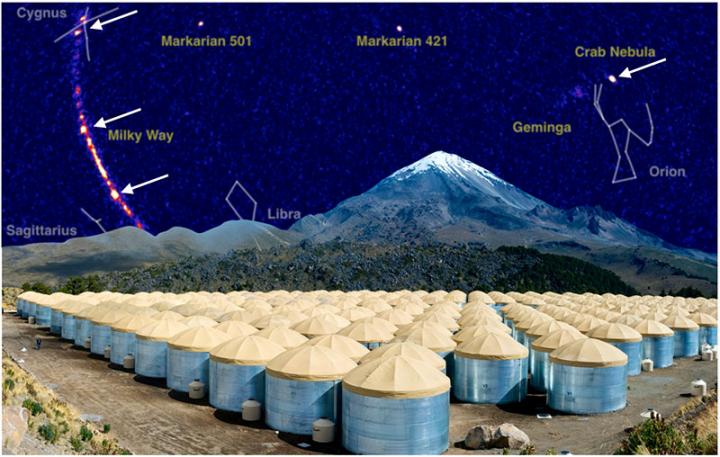
LOS ALAMOS, N.M., March 30, 2020 — New measurements confirm, to the highest energies yet explored, that the laws of physics hold no matter where you are or how fast you’re moving. Observations of record-breaking gamma rays prove the robustness of Lorentz Invariance – a piece of Einstein’s theory of relativity that predicts the speed of light is constant everywhere in the universe. The High Altitude Water Cherenkov observatory in Puebla, Mexico detected the gamma rays coming from distant galactic sources.
“How relativity behaves at very high energies has real consequences for the world around us,” said Pat Harding, an astrophysicist in the Neutron Science and Technology group at Los Alamos National Laboratory and a member of the HAWC scientific collaboration. “Most quantum gravity models say the behavior of relativity will break down at very high energies. Our observation of such high-energy photons at all raises the energy scale where relativity holds by more than a factor of a hundred.”
Lorentz Invariance is a key part of the Standard Model of physics. However, a number of theories about physics beyond the Standard Model suggest that Lorentz Invariance may not hold at the highest energies. If Lorentz Invariance is violated, a number of exotic phenomena become possibilities. For example, gamma rays might travel faster or slower than the conventional speed of light. If faster, those high-energy photons would decay into lower-energy particles and thus never reach Earth.
The HAWC Gamma Ray Observatory has recently detected a number of astrophysical sources which produce photons above 100 TeV (a trillion times the energy of visible light), much higher energy than is available from any earthly accelerator. Because HAWC sees these gamma rays, it extends the range that Lorentz Invariance holds by a factor of 100 times.
“Detections of even higher-energy gamma rays from astronomical distances will allow more stringent the checks on relativity. As HAWC continues to take more data in the coming years and incorporate Los Alamos-led improvements to the detector and analysis techniques at the highest energies, we will be able to study this physics even further,” said Harding.
###
Publication: Constraints on Lorentz invariance violation from HAWC observations of gamma rays above 100 TeV, Physical Review Letters, DOI: 10.1103/PhysRevLett.124.131101
Funding: LDRD, DOE HEP, NSF
About Los Alamos National Laboratory
Los Alamos National Laboratory, a multidisciplinary research institution engaged in strategic science on behalf of national security, is managed by Triad, a public service oriented, national security science organization equally owned by its three founding members: Battelle Memorial Institute (Battelle), the Texas A&M University System (TAMUS), and the Regents of the University of California (UC) for the Department of Energy’s National Nuclear Security Administration.
Los Alamos enhances national security by ensuring the safety and reliability of the U.S. nuclear stockpile, developing technologies to reduce threats from weapons of mass destruction, and solving problems related to energy, environment, infrastructure, health, and global security concerns.
Media Contact
James Riordon
[email protected]
Related Journal Article
http://dx.