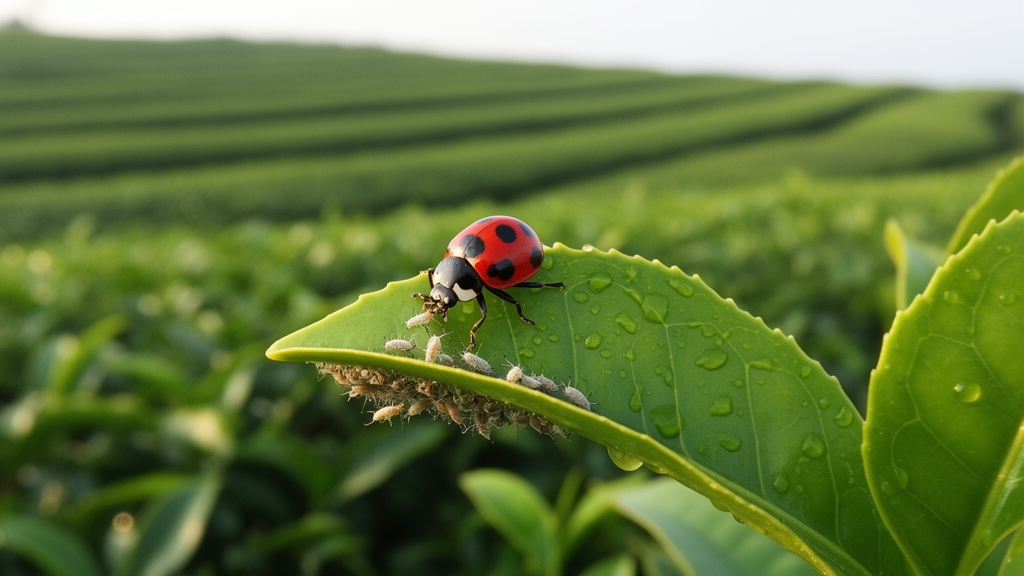
A lady beetle long studied only in laboratory dishes has now been caught, quite literally, with its prey. A year-long field study in a Chinese tea plantation, combined with DNA sequencing of beetle gut contents, has produced direct molecular evidence that the predatory lady beetle Chilocorus kuwanae feeds on the tea green leafhopper Empoasca onukii, one of the most damaging pests in Chinese tea agroecosystems.
The research team, led by Jiayi Chen and Tingbang Yang with colleagues including Charles C. Y. Xu, set out to answer a question that laboratory functional response experiments cannot resolve: what does C. kuwanae actually eat when it is free to forage in a complex field environment? Previous work on the species had concentrated almost entirely on its predation of scale insects under controlled conditions, quantifying how consumption rates change across prey densities. Such assays are informative but deliberately simplified, stripping away multispecies prey communities, environmental fluctuations, and habitat structure. Whether the beetle suppresses the major pests that plague tea growers in the field remained unevaluated.
The study site was an approximately ten-hectare section of a tea plantation in Chengjia Town, Chengdu City, in Sichuan Province, where tea is the dominant cash crop and where four pests are recognized as predominant: the tea green leafhopper E. onukii, the camellia spiny whitefly Aleurocanthus camelliae, the tea geometrid Ectropis grisescens, and the tea silvery geometrid Scopula subpunctaria. All four are still heavily controlled with chemical insecticides. Sampling ran monthly from May 2020 to April 2021, with three sessions per month separated by at least seven days, and exclusively on rain-free days; no insecticides were applied in the study area throughout the period. Five 20-by-20-metre quadrats arranged in an X-shaped configuration were sampled by beating the tea canopy over an insect net, after which beetles and potential prey were collected with a suction device. Each beetle was stored individually in a microcentrifuge tube to prevent cross-contamination.
The population data revealed a striking temporal pattern. C. kuwanae abundance peaked in late May and mid-June, and the leafhopper E. onukii showed a closely matching first peak in late May. The other three pests peaked at different times: A. camelliae in late April and again in early July, E. grisescens in four distinct waves across the year, and S. subpunctaria in mid-May and early December. Of the four pest species, E. onukii tracked the beetle most closely, a synchrony the authors interpret as a potential numerical response in which predator populations rise as prey become abundant.
To move beyond correlation, the team applied Convergent Cross Mapping, a time-series method designed to detect causal coupling in ecological data. The analysis identified the interaction between C. kuwanae and E. onukii as the strongest of all pairwise predator-pest combinations examined, with high predictive skill in both directions: a cross-map skill of 0.90 when mapping from the beetle to the leafhopper and 0.76 in the reverse direction. The interaction also showed the smallest absolute time lag, roughly one to two sampling intervals of about ten days, indicating rapid ecological response between the two species. No significant causal linkage was detected between the beetle and any of the other three pests.
Synchrony and causal coupling alone, however, do not prove predation. For direct evidence, the researchers turned to DNA metabarcoding of gut contents. Thirty adult beetles were collected during the population peak, and genomic DNA was extracted from whole specimens after careful decontamination. Using the degenerate primer pair mlCOIintF and Fol-degen-rev, which targets a 365-base-pair region of the cytochrome c oxidase subunit I barcode gene, the team amplified prey DNA and sequenced the products on an Illumina NovaSeq 6000 platform. An in silico PCR check confirmed that the primers could amplify all 22 common invertebrate tea pest species in Sichuan Province, and extraction blanks served as negative controls throughout.
The sequencing results were unambiguous. Each sample yielded on average more than 84,000 raw reads, of which about 97.4 percent belonged to the beetle itself, leaving a rich residue of prey DNA. After filtering, the team identified 28 arthropod prey taxa spanning the classes Insecta, Collembola, and Arachnida, with most taxa resolved to genus level and 42.9 percent to species level. Among the detected prey were three of the four major tea pests: E. onukii, A. camelliae, and E. grisescens. Most notably, E. onukii showed the highest relative read abundance of any prey taxon at 25.2 percent and the highest occurrence frequency at 36.7 percent, meaning it appeared in more than a third of the beetles analyzed and dominated the prey sequences overall.
The metabarcoding also revealed a broader diet than laboratory studies had suggested. Where earlier functional response work documented predation on scale insects and thrips, the field beetles had consumed springtails, spiders, crickets, flies, and other small arthropods. Thrips were detected in the gut contents, but no scale insect sequences appeared, a discrepancy the authors attribute to the extremely low abundance of scale insects at the study site and to gaps in public COI reference databases for tea-associated scale species. A comparison with morphological identification of field-collected arthropods showed strong complementarity: metabarcoding detected 15 prey families, morphology revealed 98, and 14 families overlapped between the two methods. Both approaches independently ranked the leafhopper family Cicadellidae and the springtail family Entomobryidae as the two most abundant, while the eriophyid mite family Eriophyidae was found only by metabarcoding, likely because these mites average roughly 200 micrometres in length and escape conventional sampling.
The authors are careful about the limits of the technique. DNA metabarcoding cannot determine the developmental stage of consumed prey, so whether the beetle ate leafhopper eggs, nymphs, or adults remains unknown, though coccinellids typically target immobile or slow-moving prey such as eggs and early instars. The method also cannot distinguish direct predation from secondary predation, in which a beetle eats another predator that had previously consumed pest DNA; in this study, however, no predatory arthropods appeared among the prey, making secondary detection unlikely. Quantification is similarly constrained, since differential DNA degradation and PCR bias mean sequence reads cannot be converted directly into numbers of prey consumed. And because dietary analysis was performed only on beetles collected during the population peak, seasonal shifts in diet, particularly during winter scarcity, remain unexplored.
Even with those caveats, the convergence of evidence is notable. Independent lines of data, temporal synchrony, bidirectional causal coupling in the time-series analysis, and the dominant presence of leafhopper DNA in beetle guts, all point to the same conclusion: C. kuwanae is a key predator of E. onukii in Chinese tea plantations. The authors argue that this supports developing cost-effective mass-rearing protocols for the beetle and its periodic release in augmentative biological control programs, alongside management practices that favor its persistence, including reduced broad-spectrum insecticide use, greater landscape heterogeneity, and flowering strips that supply pollen, nectar, and overwintering refuges. The beetle’s ability to feed on non-pest prey such as springtails may even aid mass rearing, since easily cultured alternative food can sustain predators when target pests are scarce. The study also offers a replicable framework, pairing ecological monitoring with molecular dietary analysis, for identifying which resident predators actually matter in complex agroecosystems, and the authors suggest future work should test how C. kuwanae might combine with spiders and parasitoid wasps in a multi-trophic control system. Raw sequencing data have been deposited in the NCBI database under BioProject accession PRJNA1402043.
Subject of Research: Field surveys and DNA metabarcoding of gut contents identify the lady beetle Chilocorus kuwanae as a key predator of the tea green leafhopper in Chinese tea plantations.
Article Title: Biocontrol potential of Chilocorus kuwanae (Silvestri) (Coleoptera: Coccinellidae) against tea pests in China
Article References: Chen, J., Wang, L., Zhu, R., Xu, C. C. Y., Song, X., Zhang, F., & Yang, T. (2026). Biocontrol potential of Chilocorus kuwanae (Silvestri) (Coleoptera: Coccinellidae) against tea pests in China. Egyptian Journal of Biological Pest Control, 36(1), Article 31. https://doi.org/10.1186/s41938-026-00910-6
Image Credits: AI Generated
DOI: 10.1186/s41938-026-00910-6
Keywords: biological control, Chilocorus kuwanae, Empoasca onukii, tea plantations, DNA metabarcoding, lady beetle, integrated pest management, Convergent Cross Mapping, predator-prey interactions, China, gut content analysis, sustainable agriculture
News Source: Alan Morgan. (October 28, 2026). Lady beetle shown to be key field predator of major tea pest in China. Scienmag.