


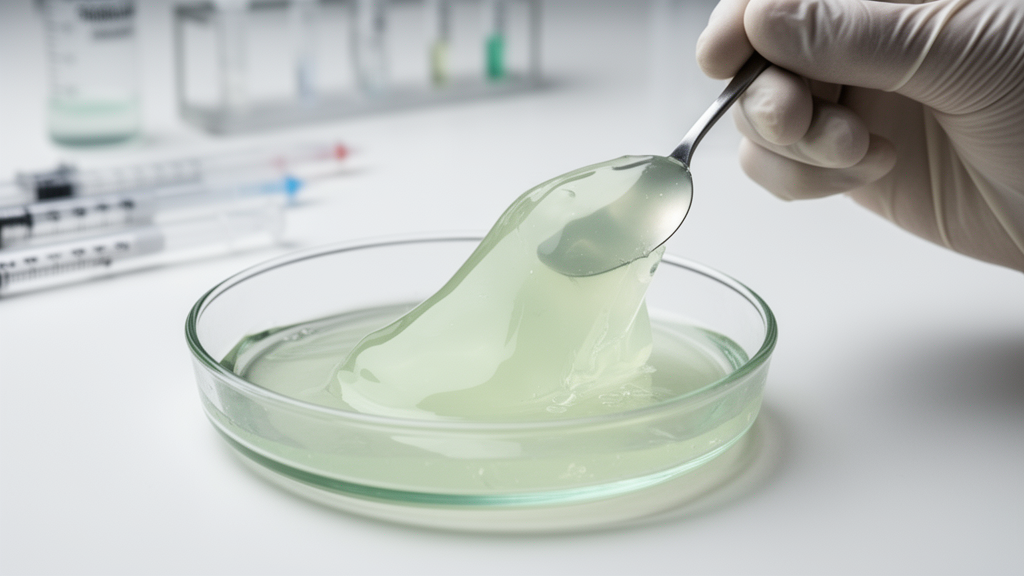
Researchers at Vellore Institute of Technology in India have built a composite hydrogel that can hold L-theanine, the amino acid that gives tea its umami taste, and let it seep out slowly over two days. Writing in Frontiers in Nanotechnology, the team compared three versions of the material: an unloaded control hydrogel, one loaded directly with free L-theanine, and one carrying the amino acid inside PLGA nanoparticles embedded in the gel. Over a 48-hour test in phosphate-buffered saline, the directly loaded hydrogel released 69.48 percent of its payload, while the nanoparticle-loaded version released only 42.23 percent. That slower pace, the authors stress, reflects more tightly regulated release kinetics rather than a greater total amount delivered, and it is the central finding of the study.
The hydrogel matrix itself is a blend of polyvinylpyrrolidone (PVP), polyethylene glycol (PEG), and gelatin, mixed in a 10:5:2 ratio. The team set the gel using a hybrid crosslinking strategy: glutaraldehyde chemically reacts with the epsilon-amino groups of gelatin lysine residues to form Schiff bases, while repeated freeze-thaw cycles at around minus 35 degrees Celsius physically texture the network by driving phase separation between ice crystals and the polymer-rich phase. Scanning electron microscopy, Fourier-transform infrared spectroscopy, and powder X-ray diffraction confirmed that the gels formed successfully and that the drug was incorporated. The unloaded hydrogel showed a gel fraction, a measure of insoluble crosslinked network, of 74.576 percent plus or minus 1.03 percent.
Free and nanoparticle-bound L-theanine affected the network in opposite ways. Adding free L-theanine modestly lowered the gel fraction to 69.452 percent, possibly because the dissolved drug interfered with glutaraldehyde-mediated crosslinking or with the packing of gelatin chains. The nanoparticles, by contrast, pushed the gel fraction up to 79.326 percent, consistent with the particles acting as extra physical crosslinking points or filler within the polymer mesh. Swelling behaviour told a similar story of competing effects. In deionized water, the directly loaded hydrogel absorbed the most water, swelling by 1033.53 percent plus or minus 9.25 percent, significantly more than the other two formulations, which the authors attribute to L-theanine’s hydrophilic interactions widening the polymer mesh. The nanoparticle-loaded gel swelled less, particularly in the ionic environment of phosphate-buffered saline, where it reached only 463.3 percent, apparently because the particles fill gaps in the matrix and restrict expansion.
Degradation over seven days in phosphate-buffered saline followed the same ordering. The unloaded hydrogel proved the most stable, losing 34.32 percent plus or minus 0.58 percent of its mass by day seven, while the directly loaded and nanoparticle-loaded versions lost 40.71 percent plus or minus 0.76 percent and 45.32 percent plus or minus 0.71 percent, respectively. None of the formulations reached 50 percent degradation within the observation window. Statistical analysis showed that time dominated the degradation pattern, accounting for 91.4 percent of the variance, with formulation contributing a smaller but significant 6.8 percent. The authors suggest the faster erosion of the loaded gels stems from localized disruption of the polymer network at nanoparticle-matrix interfaces and hydrolysis of the entrapped PLGA particles, rather than from bulk porosity differences.
The nanoparticles themselves were characterized before embedding. Dynamic light scattering gave a hydrodynamic diameter of 254 plus or minus 19.23 nanometers with a polydispersity index of 0.12 plus or minus 0.05, indicating a narrow, near-monodisperse distribution, and a zeta potential of minus 22.5 plus or minus 3.2 millivolts, consistent with a negatively charged, colloidally stable surface. Electron microscopy confirmed predominantly spherical particles. Encapsulation efficiency was high in both routes: 95.46 percent plus or minus 0.932 percent for the nanoparticle formulation, and 99.76 percent plus or minus 1.32 percent for the directly loaded gel, calculated by mass balance from the drug recovered in the freeze-thaw exudate and rinse water.
The release profiles diverged in instructive ways. The directly loaded hydrogel showed a lag of roughly six hours, releasing under 4 percent in that period, consistent with matrix swelling and hydration preceding the formation of diffusion channels. Release then accelerated between 6 and 12 hours, climbed to nearly 45 percent by 24 hours, and reached 69.48 percent by 48 hours. The nanoparticle-loaded gel behaved differently: it began with a burst of 11.33 percent in the first half hour, attributed to surface-associated L-theanine escaping before the intact PLGA shell became rate-limiting, then settled into a slow, steady climb to 42.23 percent by 48 hours. Two-way analysis of variance found the overall formulation effect on mean cumulative release was not statistically significant, with comparable averages of 24.08 percent and 23.29 percent, while time and the time-by-formulation interaction were highly significant.
Kinetic modelling sharpened the mechanistic picture. Because correlation values fitted on differently transformed axes are not directly comparable, the team also computed adjusted R-squared, root-mean-square error, and Akaike information criterion values on the original cumulative-release scale. The directly loaded hydrogel was best described by the Higuchi model, with an adjusted R-squared of 0.996 and the lowest AIC of all five models tested, pointing to Fickian diffusion through the porous matrix. The nanoparticle-loaded gel instead fit the Korsmeyer-Peppas model best, with an adjusted R-squared of 0.958, and a release exponent of 0.286, below the threshold normally associated with anomalous transport. The authors interpret this low exponent as quasi-Fickian, diffusion-dominated release, with the PLGA shell adding a diffusional barrier that explains the deviation from a simple Higuchi profile.
Antioxidant activity, measured with the DPPH radical scavenging assay, tracked the release behaviour. Free L-theanine scavenged fastest, starting at 54.20 percent within five minutes and reaching near-complete scavenging of 99.56 percent by 60 minutes, reflecting the unhindered availability of the free molecule. Ascorbic acid, the positive control, rose more slowly to 96.98 percent at 450 minutes. The directly loaded hydrogel reached 80.71 percent plus or minus 0.92 percent scavenging at 450 minutes, plateauing in its later stages, while the nanoparticle-loaded gel reached 75.83 percent plus or minus 1.23 percent. The hybrid nanoparticle-hydrogel matrix, the authors suggest, promotes a more localized, sustained antioxidant response rather than an immediate one, mirroring its moderated release kinetics.
The structural evidence rounds out the picture. Infrared spectroscopy showed a broad hydrogen-bonding band across 3250 to 3450 reciprocal centimeters in all gels, along with shifts in the carbon-nitrogen stretching region and an intensified band near 1080 reciprocal centimeters that the authors describe as consistent with, but not independently confirming, glutaraldehyde-mediated chemical crosslinking. X-ray diffraction showed that the crystalline peaks of pure L-theanine vanished in the loaded gels, indicating the drug became amorphously dispersed in the polymer matrix, though the authors caution that dilution below the detection threshold cannot be excluded as an alternative explanation.
Important limitations temper any talk of medical use. Residual unreacted glutaraldehyde, a known cytotoxin, was not quantified after the five-minute water rinse; no cytocompatibility, hemocompatibility, or in vivo safety data exist for any formulation; all measurements came from technical triplicates of a single batch per condition, so batch-to-batch reproducibility is untested; and the DPPH assay lacked hydrogel and solvent blanks, meaning some of the reported scavenging may reflect matrix interference rather than L-theanine alone. The authors frame the work strictly as an in vitro demonstration that combining hydrogel encapsulation with nanoparticle carriers can modulate the rate, not the extent, of L-theanine release, and they state that cytocompatibility, biological efficacy, pharmacokinetics, and in vivo safety must be evaluated before any therapeutic potential can be established.
Subject of Research: Composite hydrogels encapsulating L-theanine for sustained in vitro drug release and antioxidant activity
Article Title: Formulation of hydrogel and nanoparticle hydrogel encapsulated with L-theanine: comparative release analysis and antioxidant activity
Article References: Chandran, P. A., Dharshini, L. C. P., Shraddha, S., Selvakumar, A., & Mandal, A. K. A. (2026). Formulation of hydrogel and nanoparticle hydrogel encapsulated with L-theanine: comparative release analysis and antioxidant activity. Frontiers in Nanotechnology, 8, 1945439. https://doi.org/10.3389/fnano.2026.1945439
Image Credits: AI Generated
DOI: 10.3389/fnano.2026.1945439
Keywords: L-theanine, hydrogels, nanoparticles, drug delivery, PLGA, controlled release, antioxidant activity, DPPH assay, gelatin, PVP, release kinetics, in vitro
News Source: Denise Maddox. (October 29, 2026). L-Theanine Hydrogels Show Sustained Release and Antioxidant Activity in Lab Tests. Scienmag.



