


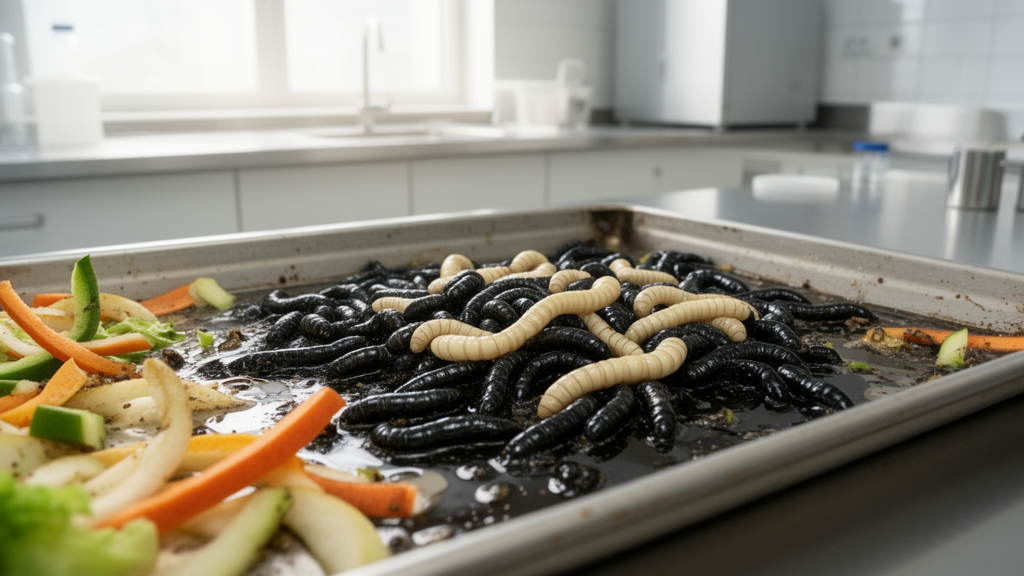
Black soldier fly larvae can convert kitchen wastewater into nutrient-rich larval biomass while keeping ammonia emissions low, according to a study published in the journal Animal Microbiome on 24 September 2026.
The team compared four substrates: kitchen waste (KW), fresh chicken manure (FM), dry chicken manure rehydrated with plain water (DW), and dry chicken manure amended with kitchen wastewater (DK). By running these treatments side by side, the researchers could separate the effect of kitchen wastewater as a moisture and nutrient source from the effect of the solid feed itself. Bioconversion efficiency was assessed through larval nutritional composition, growth performance, ammonia (NH3) emissions and intestinal flora composition, the latter analysed with 16S rRNA-based high-throughput sequencing.
Larvae raised on kitchen waste showed the highest nutritional quality of all groups. They contained elevated levels of essential amino acids, including threonine at 1.69 percent and valine at 2.52 percent, a total amino acid content of 36.89 percent, and medium-chain saturated fatty acids dominated by lauric acid (C12:0) at 26.35 percent. These larvae also achieved significantly higher biomass and converted fresh weight more efficiently than larvae in the other groups, and they produced the lowest ammonia emissions measured in the experiment.
The DK group, in which kitchen wastewater served as the moisture source for dry chicken manure, produced a distinctly different larval profile. Larvae in this group were significantly enriched in glutamic acid at 5.18 percent, cysteine at 0.32 percent and total unsaturated fatty acids at 60.52 percent. Despite a total amino acid content of 35.44 percent that was comparable to the kitchen waste group, the DK larvae grew better and emitted less ammonia than larvae reared on dry chicken manure rehydrated with plain water.
These results suggest that kitchen wastewater is not merely a neutral source of hydration but an active amendment that reshapes both larval biochemistry and rearing conditions.
Microbial sequencing of the larval gut revealed a consistent core community across all treatments. Firmicutes and Bacteroidota dominated the intestinal flora regardless of substrate, indicating that the black soldier fly gut maintains a characteristic bacterial backbone even when the diet varies widely.
Diversity, however, shifted markedly between groups. The fresh chicken manure group showed the highest microbial diversity, while the kitchen waste group had the lowest. The authors do not report functional consequences of this difference in the available findings, but the contrast illustrates how substrate choice shapes not only larval nutrition and emissions but also the ecological structure of the insects’ gut communities.
The finding that kitchen waste and kitchen-wastewater-amended substrates produced lower ammonia emissions than the water-rehydrated manure treatment suggests that wastewater amendment could help reduce the environmental footprint of larval rearing facilities that use dry manure as a base substrate.
The study’s conclusions position kitchen wastewater as a supplement that can enhance resource recovery and reduce environmental impacts in black soldier fly bioconversion. Because the work is presented as a controlled comparison of four substrates rather than a full-scale industrial trial, the reported percentages describe the experimental groups tested, and translating the results to commercial operations would require validation under production conditions. The article is open access and was shared early as a peer-reviewed, accepted manuscript carrying a permanent DOI, with a final version of record to follow.
For waste managers and insect-protein producers, the practical takeaway is that a single waste stream, kitchen wastewater, can serve two roles at once: supplying moisture to dry substrates and enriching the resulting larvae with specific amino acids and unsaturated fatty acids. Combined with the strong performance of kitchen waste itself, which produced the fastest-growing, most protein-dense larvae with the lowest ammonia emissions, the findings add to a growing body of work on using black soldier flies to close nutrient loops between food waste and animal feed.
Subject of Research: Bioconversion of kitchen waste and kitchen wastewater into black soldier fly larval biomass
Article Title: Bioconversion of kitchen wastewater into high-value larval biomass using black soldier fly larvae
Article References: Liu, K., Wang, J., Li, Y., Jiao, M., Guo, J., Li, J., Shi, H., Wang, X., Zhang, W., Quan, K., & Xia, W. (2026). Bioconversion of kitchen wastewater into high-value larval biomass using black soldier fly larvae. Animal Microbiome. https://doi.org/10.1186/s42523-026-00635-9
Image Credits: AI Generated
DOI: 10.1186/s42523-026-00635-9
Keywords: black soldier fly, kitchen wastewater, larval biomass, bioconversion, ammonia emissions, amino acids, fatty acids, gut microbiome, waste valorization, Hermetia illucens, chicken manure, 16S rRNA sequencing
News Source: Morgan Morrow. (October 29, 2026). Kitchen wastewater boosts black soldier fly larvae as high-value biomass. Scienmag.



