

• HOME
  • NEWS
  • EXPLORE
    • CAREER
      • Companies
      • Jobs
    • EVENTS
    • iGEM
      • News
      • Team
    • PHOTOS
    • VIDEO
    • WIKI
  • BLOG
  • COMMUNITY
    • FACEBOOK
    • INSTAGRAM
    • TWITTER
Saturday, October 31, 2026
BIOENGINEER.ORG
No Result
View All Result
  • Login
  • HOME
  • NEWS
  • EXPLORE
    • CAREER
      • Companies
      • Jobs
        • Lecturer
        • PhD Studentship
        • Postdoc
        • Research Assistant
    • EVENTS
    • iGEM
      • News
      • Team
    • PHOTOS
    • VIDEO
    • WIKI
  • BLOG
  • COMMUNITY
    • FACEBOOK
    • INSTAGRAM
    • TWITTER
No Result
View All Result
Bioengineer.org
No Result
View All Result
Home NEWS Science News Biology

Killer Whale Parasite Redescribed from Stranded Orca in Indonesia with First DNA Sequences

by
October 29, 2026
in Biology
Reading Time: 2 mins read
0
Killer Whale Parasite Redescribed from Stranded Orca in Indonesia with First DNA Sequences

Killer Whale Parasite Redescribed from Stranded Orca in Indonesia with First DNA Sequences

Share on FacebookShare on TwitterShare on LinkedinShare on RedditShare on Telegram

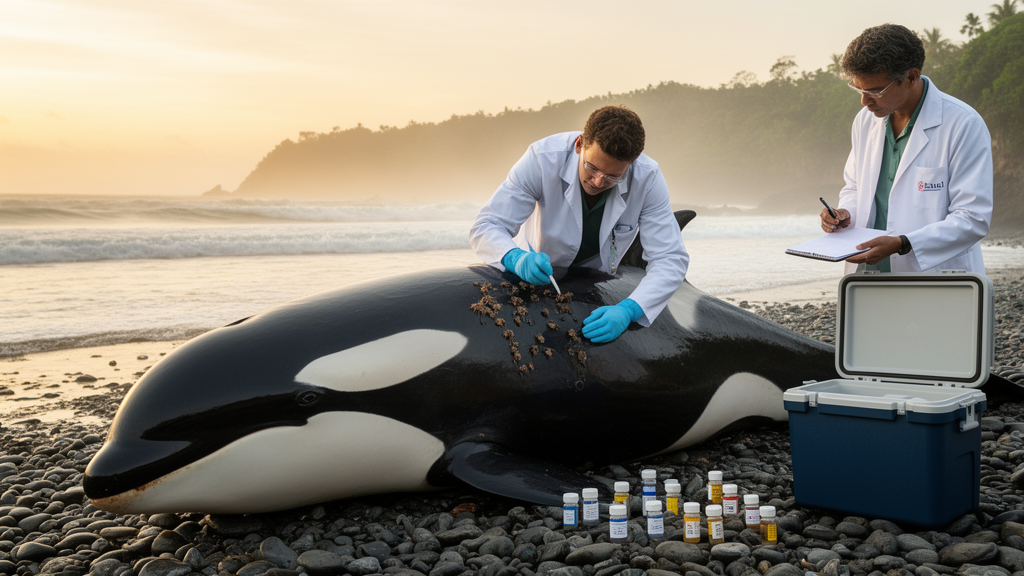
Scientists have redescribed Orcinocyamus orcini, a tiny whale-louse amphipod found only on killer whales, using specimens collected from the skin lesions of an Orcinus orca stranded in East Java, Indonesia. The study, published in Acta Parasitologica, combines detailed microscopy with genetic analysis and delivers the first DNA sequences ever recorded for the species.

Whale lice are not true lice but cyamid amphipods, crustaceans that live on the skin of certain whales and dolphins, often within lesions. O. orcini was originally described in 1970, and its association with killer whales makes it a host-specific parasite. The Indonesian specimens were examined under both light and scanning electron microscopy, confirming their identity and revealing diagnostic features including anterodorsal epaulette-like processes, ventral abdominal spines, and paired double, sausage-shaped, non-fasciculate gills on segments 3 and 4.

The researchers obtained two COI sequences for O. orcini, deposited in GenBank under accession numbers PX513872 and PX513873. When compared with sequences from ten other cyamid species, these differed by 17.8 to 21.3 percent, and phylogenetic analysis placed O. orcini on a distinct lineage of its own. This genetic separation supports the morphological evidence that the species is distinct from its relatives.

Beyond the taxonomic detail, the findings carry a geographic significance. The study expands the documented distribution of O. orcini to the tropical Indo-Pacific, adding Indonesia to the record of where this killer whale-associated amphipod has been found. The authors note that the updated morphological characterization and the first molecular reference data will facilitate future identification of the species. Because the specimens came from a single stranded animal, the report reflects one documented occurrence rather than a survey of parasite prevalence in the region, and the description rests on material from that individual host.

Subject of Research: Redescription and first molecular characterization of the killer whale cyamid amphipod Orcinocyamus orcini from Indonesia

Article Title: Redescription of Orcinocyamus orcini (Amphipoda: Cyamidae) from Orcinus orca Stranded at East Java Island, Indonesia

Article References: Hassan, M., Yudhana, A., Ulkhaq, M. F., Mazelan, S., Ishak, A. N., Yusoff, N. A. H., Abdullah, F., Shukor, N. A., Zalati, C. W. S. C. W., & Peng, T. L. (2026). Redescription of Orcinocyamus orcini (Amphipoda: Cyamidae) from Orcinus orca Stranded at East Java Island, Indonesia. Acta Parasitologica, 71(6), Article 253. https://doi.org/10.1007/s11686-026-01436-5

Image Credits: AI Generated

DOI: 10.1007/s11686-026-01436-5

Keywords: Orcinocyamus orcini, whale lice, cyamid amphipods, killer whale, Orcinus orca, COI barcode, taxonomy, Indonesia, parasitology, Acta Parasitologica, Redescription, Orcinocyamus

News Source: Juliet Wilcox. (October 29, 2026). Killer Whale Parasite Redescribed from Stranded Orca in Indonesia with First DNA Sequences. Scienmag.


Tags: Acta ParasitologicaCOI barcodecyamid amphipodsIndonesiakiller whaleOrcinocyamusOrcinocyamus orciniOrcinus orcaParasitologyredescriptiontaxonomywhale lice
Share12Tweet7Share2ShareShareShare1

Related Posts

Microbial Sources and Stress Shape the Hidden Endophytes of an Invasive Plant

Microbial Sources and Stress Shape the Hidden Endophytes of an Invasive Plant

October 30, 2026
Firebreaks Leave Lasting Scars in Grasslands While Wildfire Heals Fast

Firebreaks Leave Lasting Scars in Grasslands While Wildfire Heals Fast

October 30, 2026

Hidden Peptides in Non-Coding RNAs Reshape Cardiovascular Biology

October 30, 2026

Phage K Holin’s C-Terminal Region Shapes Antibacterial Activity, Study Finds

October 30, 2026

POPULAR NEWS

  • Microbial Sources and Stress Shape the Hidden Endophytes of an Invasive Plant

    Microbial Sources and Stress Shape the Hidden Endophytes of an Invasive Plant

    29 shares
    Share 12 Tweet 7
  • Firebreaks Leave Lasting Scars in Grasslands While Wildfire Heals Fast

    29 shares
    Share 12 Tweet 7
  • ZNF207 shields glutamine transporter ASCT2 from degradation to fuel liver cancer growth

    29 shares
    Share 12 Tweet 7
  • Systematic review maps sustainability tensions in offshore wind development

    29 shares
    Share 12 Tweet 7

About

We bring you the latest biotechnology news from best research centers and universities around the world. Check our website.

Follow us

Recent News

Microbial Sources and Stress Shape the Hidden Endophytes of an Invasive Plant

Firebreaks Leave Lasting Scars in Grasslands While Wildfire Heals Fast

ZNF207 shields glutamine transporter ASCT2 from degradation to fuel liver cancer growth

Subscribe to Blog via Email

Enter your email address to subscribe to this blog and receive notifications of new posts by email.

Join 86 other subscribers
  • Contact Us

Bioengineer.org © Copyright 2023 All Rights Reserved.

Welcome Back!

Login to your account below

Forgotten Password?

Retrieve your password

Please enter your username or email address to reset your password.

Log In
No Result
View All Result
  • Homepages
    • Home Page 1
    • Home Page 2
  • News
  • National
  • Business
  • Health
  • Lifestyle
  • Science

Bioengineer.org © Copyright 2023 All Rights Reserved.
