The next time you crack your backdoor to let your cat outside for its daily adventure, you may want to think again. For a cat, the outdoors is filled with undesirable potential. Like the risks of catching and transmitting diseases, and the uncontrollable drive to hunt and kill wildlife, which has been shown to reduce native animal populations and degrade biodiversity.
Credit: Daniel Herrera
The next time you crack your backdoor to let your cat outside for its daily adventure, you may want to think again. For a cat, the outdoors is filled with undesirable potential. Like the risks of catching and transmitting diseases, and the uncontrollable drive to hunt and kill wildlife, which has been shown to reduce native animal populations and degrade biodiversity.
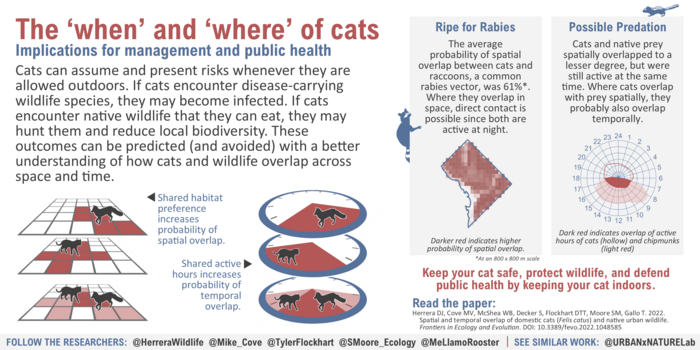
A new study by University of Maryland researchers has concluded that humans bear the primary responsibility, and that these risks can be significantly reduced by keeping cats indoors. The study’s analysis used data from the D.C. Cat Count, a Washington, D.C.–wide survey that deployed 60 motion-activated wildlife cameras spread across 1,500 sampling locations. The cameras recorded what cats preyed on and demonstrated how they overlapped with native wildlife, which helped researchers understand why cats and other wildlife are present in some areas, but absent from others. The paper was published on November 21, in the journal Frontiers in Ecology and Evolution.
“We discovered that the average domestic cat in D.C. has a 61% probability of being found in the same space as racoons — America’s most prolific rabies vector — 61% spatial overlap with red foxes, and 56% overlap with Virginia opossums, both of which can also spread rabies,” said Daniel Herrera, lead author of the study and Ph.D. student in UMD’s Department of Environmental Science and Technology (ENST). “By letting our cats outside we are significantly jeopardizing their health.”
In addition to the risk of being exposed to diseases that they can then bring indoors to the humans in their families (like rabies and toxoplasmosis), outdoor cats threaten native wildlife. The D.C. Cat Count survey demonstrated that cats that are allowed to roam outside also share the same spaces with and hunt small native wildlife, including grey squirrels, chipmunks, cottontail rabbits, groundhogs, and white footed mice. By hunting these animals, cats can reduce biodiversity and degrade ecosystem health.
“Many people falsely think that cats are hunting non-native populations like rats, when in fact they prefer hunting small native species,” explained Herrera. “Cats are keeping rats out of sight due to fear, but there really isn’t any evidence that they are controlling the non-native rodent population. The real concern is that they are decimating native populations that provide benefits to the D.C. ecosystem.”
In general, Herrera found that the presence of wildlife is associated with tree cover and access to open water. On the other hand, the presence of cats decreased with those natural features but increased with human population density. He says that these associations run counter to arguments that free-roaming cats are simply stepping into a natural role in the ecosystem by hunting wildlife.
“These habitat relationships suggest that the distribution of cats is largely driven by humans, rather than natural factors,” explained Travis Gallo, assistant professor in ENST and advisor to Herrera. “Since humans largely influence where cats are on the landscape, humans also dictate the degree of risk these cats encounter and the amount of harm they cause to local wildlife.”
Herrera encourages pet owners to keep their cats indoors to avoid potential encounters between their pets and native wildlife. His research notes that feral cats are equally at risk of contracting diseases and causing native wildlife declines, and they should not be allowed to roam freely where the risk of overlap with wildlife is high – echoing previous calls for geographic restrictions on where sanctioned cat colonies can be established or cared for.
Journal
Frontiers in Ecology and Evolution
DOI
10.3389/fevo.2022.1048585
Method of Research
Observational study
Subject of Research
Animals
Article Title
Spatial and temporal overlap of domestic cats (Felis catus) and native urban wildlife
Article Publication Date
21-Nov-2022