Credit: University of SA
A new microchip that enables continuous monitoring of pH and chlorine levels in swimming pools will vastly improve water safety and hygiene for more than 2.7 million Australians as new research shows it can deliver consistent and accurate pool chemistry for reliable pool management.
Developed by the University of South Australia using world-class fabrication capabilities, in partnership with electronics research and manufacturing company Tekelek Australia, the new ‘lab-on-a-chip’ technology, makes monitoring swimming pools more affordable, more reliable, and easy to install – even on existing pools.
UniSA researcher and micro/nanofabrication expert, Associate Professor Craig Priest, says the microfluidic chip could be a vital addition to Australian swimming pools, particularly as COVID-19 makes people more aware of the importance of pool hygiene.
“Pool chemistry keeps swimmers safe from viruses and bacteria, yet getting it right takes a lot of effort,” Assoc Prof Priest says.
“Backyard swimming pool management would be a lot easier with a continuous and automated water quality sensor that can reliably measure accurate chlorine and pH levels all summer.
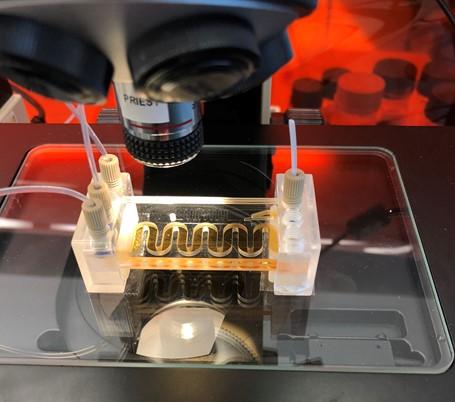
“The sensor that we’ve developed is essentially a ‘lab-on-a-chip’ – a network of microscopic pipes running through a credit card-sized chip.
“The chip quickly and continuously does all the work of a chemistry laboratory using tiny amounts of chemical, without leaving the poolside.
“For pool owners, this removes the arduous task of manually testing swimming pools and avoids overuse of pool chemicals, which saves time, money and, most importantly, the risk of infection from incorrect pool chemistry.”
In Australia, 2.7 million people (13 per cent of the population) live in a house with a swimming pool. Currently, existing pool monitoring systems – either wireless swimming pool sensors with expensive hardware or labour-intensive manual testing kits such as those purchased at hardware stores – are used to monitor the safety of chemicals in pools.
But, as Assoc Prof Priest says, asking pool owners to be backyard chemists could turn summer fun into a health hazard.
“Many of the domestic pools samples showed flaws in manual pool testing,” Assoc Prof Priest says.
“One family’s swimming pool was seriously overdosed with chlorine, yet they had no idea.
“Having just bought their home, they did a quick water check at the local pool shop and were told that there was ‘enough’ chlorine in the water but didn’t show that there was actually too much.
“A few weeks later, the chlorine levels dropped to zero, which not only highlighted a problem with the chlorinator, but also showed how quickly pool chemistry can become unsafe.”
The research tested samples from 12 swimming pools (nine domestic, two public and one outdoor public) with measures taken on multiple occasions. Every sample had its own ambient situation – frequent public use, high leaf matter, different chlorination methods – ensuring realistic sensor challenges.
An over-dosage of chlorine can cause adverse health effects to the skin, eyes, and immune system, while under-dosage creates risks of infection for swimmers.
Research partner, Stephen Thornton, Tekelek Australia says the new microchip has mass potential for both private and public swimming pools.
“Right now, the need to stay healthy is paramount for us all, and while we generally feel safe in our own backyard, we must remember that all swimming pools need to be accurately and efficiently monitored to ensure water safety,” Thornton says.
“Partnering with UniSA has meant that we’ve been able to develop a product that truly meets the needs of the market, while also ensuring public health and safety.”
The research team is currently in the final stages of developing the microchip with industry and hopes to have it on the market soon.
###
Media contact: Annabel Mansfield
Office +61 88302 0351 Mobile: 0417 717 504 Email: [email protected]
Jenny Qian Email: [email protected]
Researcher: Associate Professor Craig Priest, Foundation Fellow at UniSA’s Future Industries Institute and SA Node Director of the Australian National Fabrication Facility.
Office: +61 8 8302 5146 Email: Craig.Priest @unisa.edu.au
Media Contact
Annabel Mansfield
[email protected]
Original Source
https:/
Related Journal Article
http://dx.