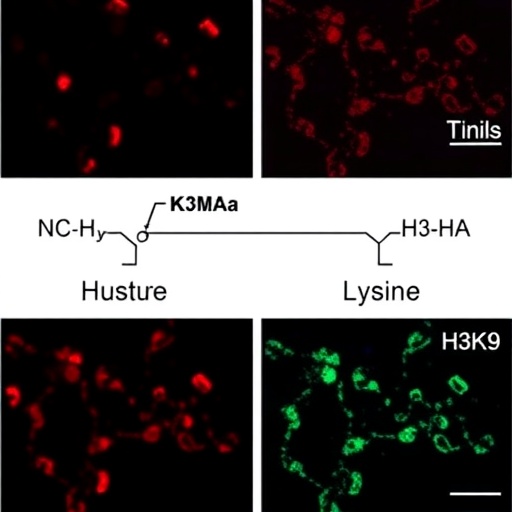
In a groundbreaking study published in Nature Chemistry, researchers have unveiled a novel enzymatic activity of KDM3A that extends beyond its known histone demethylase function. This work elucidates how KDM3A catalyzes the oxidation of acetyl-lysine to hydroxyacetyl-lysine specifically at histone H3 lysine 9 (H3K9), revealing a previously unrecognized layer of epigenetic regulation. The findings not only deepen our understanding of histone modifications but also open new avenues for exploring chromatin dynamics and gene expression regulation at the molecular level.
Histone modifications have long been recognized as essential determinants of chromatin structure and function, influencing transcriptional outcomes and cellular identity. Lysine acetylation, in particular, is associated with transcriptional activation by loosening chromatin and facilitating access for transcriptional machinery. KDM3A, widely studied as a lysine demethylase targeting histone H3K9 methylation marks, is now shown to have a dual enzymatic role that adds complexity to the epigenetic landscape. This novel oxidative activity converts acetylated lysine residues to hydroxyacetyl-lysine, a modification whose functional implications are just beginning to be unraveled.
The study employed a comprehensive suite of biochemical assays, mass spectrometry analyses, and chromatin immunoprecipitation sequencing (ChIP-seq) to characterize the catalytic activity of KDM3A on acetylated histones. These experiments demonstrated that KDM3A directly mediates an oxidation reaction on the acetyl group attached to H3K9, generating hydroxyacetyl-lysine. This oxidation is a subtle but potentially powerful modification, altering the chemical nature of the histone tail and possibly its interaction with chromatin-associated proteins and transcription factors.
Delving deeper into the mechanistic aspects, the authors revealed that the catalytic domain of KDM3A responsible for demethylation also facilitates this oxidation process. This suggests that the enzyme harnesses a similar iron-dependent dioxygenase mechanism to mediate different histone post-translational modifications. The dual functionality of KDM3A challenges the classical view of ‘single-function’ histone-modifying enzymes and implies a broader spectrum of biochemical activities embedded within epigenetic regulators.
Functional assays performed on cellular models revealed that the hydroxyacetylation mark generated by KDM3A oxidation influences chromatin accessibility and transcriptional activation at specific genomic loci involved in cellular stress responses and differentiation pathways. This highlights the biological relevance of this novel histone modification and suggests that hydroxyacetyl-lysine could serve as an epigenetic signal integrating metabolic and environmental cues into chromatin-dependent gene regulation.
Notably, the discovery of KDM3A’s ability to oxidize acetyl-lysine expands the repertoire of histone modifications, adding hydroxyacetylation as a stable or transient mark that could cross-talk with other epigenetic modifications. This adds a new dimension to the so-called “histone code,” where combinations of chemical tags dictate the epigenetic states of chromatin, influencing genome stability, replication timing, and repair processes.
The implications of these findings extend beyond basic biology, promising translational potential in disease contexts, particularly cancer and metabolic disorders where epigenetic dysregulation is prominent. Aberrant function or expression of KDM3A has been implicated in several cancers, and the identification of this new enzymatic activity might aid in developing selective inhibitors or modulators that target both demethylation and oxidation functions, offering refined therapeutic strategies.
From a technical perspective, the authors employed state-of-the-art mass spectrometry capable of discriminating between acetyl and hydroxyacetyl modifications with high sensitivity, overcoming previous limitations in detecting subtle oxidative histone marks. Structural studies using cryo-electron microscopy and molecular dynamics simulations provided further insight into how the enzyme accommodates acetylated substrates and catalyzes their oxidation, revealing key active site residues involved.
This discovery propels the field of chromatin biology into a new era, underscoring the complexity and adaptability of epigenetic enzymes. It questions the binary classification of histone modifiers and suggests that multifunctionality may be a more widespread feature among chromatin regulators than previously recognized. Such versatility allows cells to finely tune gene expression programs in response to intricate signaling networks and metabolic states.
Moreover, the identification of hydroxyacetyl-lysine on histones opens questions about the presence and roles of other oxidative modifications on chromatin proteins. Are there distinct reader proteins that recognize hydroxyacetylation? How is this modification reversed or maintained throughout the cell cycle and under physiological or pathological conditions? These remain exciting avenues for future research inspired by the pioneering work on KDM3A.
The study also sparks interest in how metabolic intermediates and cellular redox states influence epigenetic landscapes. Since oxidation reactions depend on cofactors such as molecular oxygen and iron, KDM3A’s activity might be tightly linked to cellular metabolism, linking environmental oxygen levels or metabolic fluxes directly to chromatin modifications. Understanding this interplay may uncover novel regulatory pathways that govern cell fate decisions and responses to stress.
This work exemplifies the power of interdisciplinary approaches that combine enzymology, structural biology, epigenetics, and cellular biology to unravel complex biochemical phenomena. The authors’ integrated methodology establishes a new paradigm for studying histone-modifying enzymes beyond their classical functions, emphasizing the dynamic and multifaceted nature of chromatin regulation.
Ultimately, these findings herald a significant shift in the epigenetics field, inviting a re-evaluation of histone modification networks and their enzymatic motors. Future research will undoubtedly expand this concept, identifying additional multifunctional enzymes and revealing new chemical marks that mediate gene expression modulation with high precision.
As the scientific community embraces these insights, potential applications may also emerge in biotechnology, synthetic biology, and personalized medicine. The ability to engineer or manipulate such oxidative histone modifications could pave the way for novel gene expression control systems or epigenetic therapies tailored to individual patient needs.
In summary, the work by Belle, Bukowski, Schiller, and colleagues marks a milestone in chromatin biology, establishing KDM3A as a bifunctional enzyme capable of both demethylation and oxidation of histone residues. This discovery highlights the intricate regulation embedded in chromatin modifications and propels new questions about the biochemical and biological consequences of oxidative histone marks. The implications of hydroxyacetyl-lysine as a regulatory epigenetic modification promise to transform our understanding of gene regulation from molecular mechanisms to organismal outcomes.
Subject of Research: Epigenetic regulation via histone modifications, focusing on the enzymatic oxidation of acetyl-lysine by KDM3A on histone H3K9.
Article Title: KDM3A catalyses the oxidation of acetyl-lysine to hydroxyacetyl-lysine on histone H3K9.
Article References:
Belle, R., Bukowski, JP., Schiller, R. et al. KDM3A catalyses the oxidation of acetyl-lysine to hydroxyacetyl-lysine on histone H3K9. Nat. Chem. (2026). https://doi.org/10.1038/s41557-026-02112-x
Image Credits: AI Generated
DOI: https://doi.org/10.1038/s41557-026-02112-x
Tags: acetyl-lysine oxidationbiochemical assays for histone enzymesChIP-seq analysis of histone modificationschromatin dynamics and gene expressionepigenetic regulation mechanismshistone demethylase dual functionhistone H3K9 modificationhydroxyacetyl-lysine formationKDM3A enzymatic activitylysine acetylation in transcriptionmass spectrometry in epigeneticsnovel histone post-translational modifications