• HOME
  • NEWS
  • EXPLORE
    • CAREER
      • Companies
      • Jobs
    • EVENTS
    • iGEM
      • News
      • Team
    • PHOTOS
    • VIDEO
    • WIKI
  • BLOG
  • COMMUNITY
    • FACEBOOK
    • INSTAGRAM
    • TWITTER
Sunday, August 23, 2026
BIOENGINEER.ORG
No Result
View All Result
  • Login
  • HOME
  • NEWS
  • EXPLORE
    • CAREER
      • Companies
      • Jobs
        • Lecturer
        • PhD Studentship
        • Postdoc
        • Research Assistant
    • EVENTS
    • iGEM
      • News
      • Team
    • PHOTOS
    • VIDEO
    • WIKI
  • BLOG
  • COMMUNITY
    • FACEBOOK
    • INSTAGRAM
    • TWITTER
  • HOME
  • NEWS
  • EXPLORE
    • CAREER
      • Companies
      • Jobs
        • Lecturer
        • PhD Studentship
        • Postdoc
        • Research Assistant
    • EVENTS
    • iGEM
      • News
      • Team
    • PHOTOS
    • VIDEO
    • WIKI
  • BLOG
  • COMMUNITY
    • FACEBOOK
    • INSTAGRAM
    • TWITTER
No Result
View All Result
Bioengineer.org
No Result
View All Result
Home NEWS Science News Biology

KBRI team reduces neurodegeneration associated with dementia in animal models

Bioengineer by Bioengineer
November 26, 2019
in Biology
Reading Time: 2 mins read
0
IMAGE
Share on FacebookShare on TwitterShare on LinkedinShare on RedditShare on Telegram

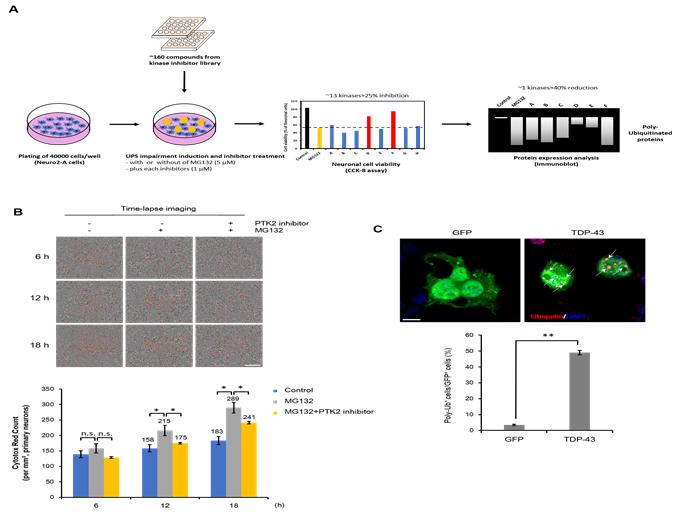
PTK2/FAK regulates UPS impairment via SQSTM1/p62 phosphorylation in TARDBP/TDP-43 proteinopathies
IMAGE

Credit: @ Korea Brain Research Institute


The Korea Brain Research Institute (KBRI, President Pann Ghill Suh) announced on November 12 that korean research team made up of Dr. Hyung-Jun Kim and Shinrye Lee of KBRI, and professor Kiyoung Kim of Soonchunhyang University, found a new molecular mechanism of suppressing neuronal toxicity associateded dementia and Lou Gehrig’s disease.

These findings were published in the November issue of Autophagy (IF=11.059). The authors’ names and the title of the paper are as follows.

  • Paper: PTK2/FAK regulates UPS impairment via SQSTM1/p62 phosphorylation in TARDBP/TDP-43 proteinopathies
  • Authors: Shinrye Lee (first author), Yu-Mi Jeon, Sun Joo Cha, Seyeon Kim, Younghwi Kwon, Myungjin Jo, You-Na Jang, Seongsoo Lee, Jaekwang Kim, Sang Ryong Kim, Kea Joo Lee, Sung Bae Lee, Kiyoung Kim*, Hyung-Jun Kim*(corresponding author*)

    Neurons in patients with dementia or Lou Gehrig’s disease often have abnormal aggregates that contain TDP-43* protein, and these accumulated aggregates can cause neurodegeneration by interupting ubiquitin proteasome system (UPS) that removes damaged or unnecessary proteins.

  • UPS(Ubiquitin proteasome system): It is a part of protein quality control system (mechanism that removes or restores abnormal proteins to ensure a certain protein performs its intended function). It is known that UPS prevents cell death by degrading abnormal proteins in damaged neurons.
  • TDP-43 : Protein that contributes toward maintaining the function and safety of RNA. It is known as a major disease-related protein in amyotrophic lateral sclerosis (ALS), frontotemporal lobar degeneration dementia (FTD) and Alzheimer’s disease (AD).

The research team found a new role of three proteins (PTK2, TBK1, SQSTM1) which can inhibit neuronal degeneration by TDP-43 and demonstrated for the first time that their interaction can alleviate neurodegeneration by strengthening “autophagy lysosome pathway (ALP),*” which consists of another protein quality control system in case of damage to the UPS.

This research is regarded as one that presents new therapeutic strategies that can remove abnormal protein accumulation in the neurons of patients with dementia in the future by revealing a new molecular mechanism that restores neurodegeneration by TDP-43 protein, which has been the major cause of dementia and Lou Gehrig diseases.

Hyung-Jun Kim, the principal researcher at KBRI and senior author of the study, said, “this research reveals the pathogenesis of TDP-43 associated neurodegeneration at the basic level, so further clinical verification process is necessary to develop a therapy for dementia.” He added, “we will proceed follow-up research to verify the mechanism in actual patient tissues in cooperation with brain banks and hospitals at home and abroad.”

The Korea Brain Research Institute signed an MOU with the Dementia Research Institute of King’s College at London (UK DRI) in August to analyze the etiology using the blood and brain tissues of patients. Research for verification based on human-originated resources will start next year.

###

Media Contact
Hyung-Jun Kim
[email protected]
82-539-803-380

Related Journal Article

http://dx.doi.org/10.1080/15548627.2019.1686729

Tags: BiologyCell BiologyMolecular Biology
Share12Tweet8Share2ShareShareShare2

Related Posts

Delayed antiviral response in alveolar type 2 cells heightens influenza susceptibility

Delayed antiviral response in alveolar type 2 cells heightens influenza susceptibility

August 22, 2026
Genetic evidence links sleep disruption to hemorrhoidal disease, revealing a hidden connection

Genetic evidence links sleep disruption to hemorrhoidal disease, revealing a hidden connection

August 22, 2026

LASIK Versus Contact Lenses for Correcting Myopia

August 22, 2026

New Advances in Minimally Invasive Laryngeal Surgery

August 22, 2026
Please login to join discussion

POPULAR NEWS

  • Blocking glucosylceramide production kills cancer cells via lysosomal dysfunction, not ceramide buildup

    29 shares
    Share 12 Tweet 7
  • ZCCHC4 boosts replication-dependent histone mRNA translation by interacting with eIF3

    29 shares
    Share 12 Tweet 7
  • KAIST Surface Defects Boost Droplet Formation, Removal, and Heat Transfer by 5.5-Fold

    29 shares
    Share 12 Tweet 7
  • Dual-oxygen pancreatic cancer organoids mirror basal-classical diversity, spatial transcriptomics confirms

    29 shares
    Share 12 Tweet 7

About

We bring you the latest biotechnology news from best research centers and universities around the world. Check our website.

Follow us

Recent News

Blocking glucosylceramide production kills cancer cells via lysosomal dysfunction, not ceramide buildup

ZCCHC4 boosts replication-dependent histone mRNA translation by interacting with eIF3

KAIST Surface Defects Boost Droplet Formation, Removal, and Heat Transfer by 5.5-Fold

Subscribe to Blog via Email

Success! An email was just sent to confirm your subscription. Please find the email now and click 'Confirm' to start subscribing.

Join 85 other subscribers
  • Contact Us

Bioengineer.org © Copyright 2023 All Rights Reserved.

Welcome Back!

Login to your account below

Forgotten Password?

Retrieve your password

Please enter your username or email address to reset your password.

Log In
No Result
View All Result
  • Homepages
    • Home Page 1
    • Home Page 2
  • News
  • National
  • Business
  • Health
  • Lifestyle
  • Science

Bioengineer.org © Copyright 2023 All Rights Reserved.