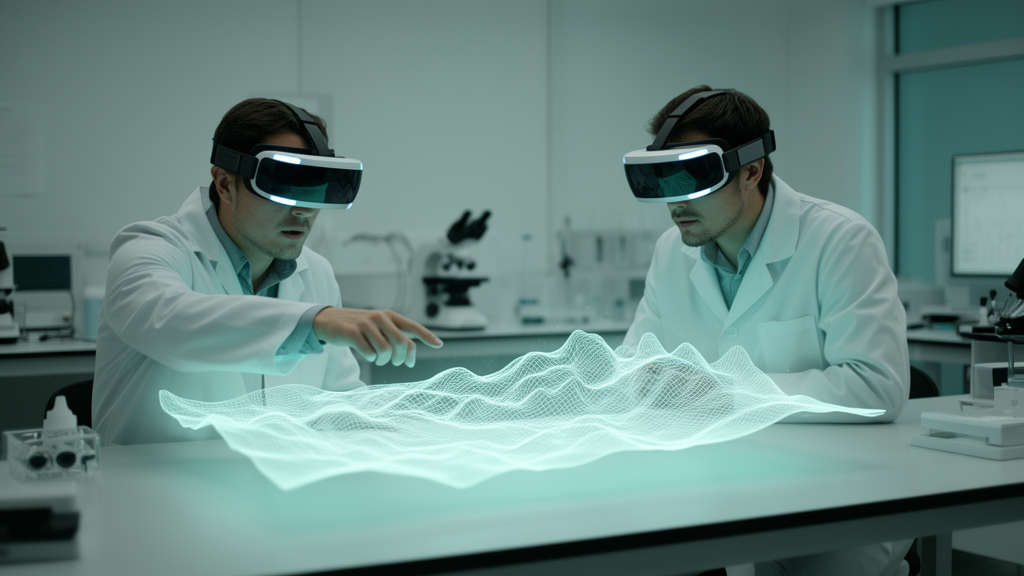
A research team from the Korea Advanced Institute of Science and Technology (KAIST) has developed a visual technique that allows users in virtual reality (VR) to perceive the roughness of objects without haptic devices. The method, led by Professor Woontack Woo of the Graduate School of Metaverse, encodes tactile information into the changing shape and movement of a virtual hand’s outline. By making roughness visible, the system bridges the sensory gap between collaborators who have different types of equipment, enabling more effective joint decision-making in shared virtual environments.
The research addresses a common challenge in collaborative VR: sensory asymmetry. In many setups, one user may possess a haptic device that delivers vibrations to the fingertips, allowing them to feel an object’s texture, while a partner without such hardware must rely solely on visual cues. This imbalance can hinder tasks that require comparing, selecting, or sorting virtual objects based on their physical properties.
The core of the technique involves modifying the outline of a virtual hand to represent three distinct levels of roughness: low, medium, and high. Rather than attempting to reproduce the actual tactile sensation on the skin, the system uses the outline’s shape and movement as visual cues. This approach allows users without haptic devices to distinguish between different levels of roughness by observing the virtual hand’s behavior.
To validate the effectiveness of this visual encoding, the team first conducted two preliminary experiments. These initial studies confirmed that users could successfully distinguish between the different visual cues and that these cues were consistent with the roughness perceived through haptic feedback.
The main study involved a collaborative VR experiment with 48 participants organized into 24 pairs. In each pair, one participant used a haptic device while the other worked without one, simulating the equipment disparity common in real-world applications. The pairs were tasked with sorting virtual objects according to their roughness levels. The experiment compared performance when visual roughness cues were displayed on both participants’ virtual hands versus when no such cues were provided.
The results demonstrated a significant improvement in task performance when the visual cues were present. Pairs completed the sorting task approximately 23% faster when roughness cues were displayed on both participants’ virtual hands compared to the condition without visual cues. Importantly, this speed increase was achieved while maintaining high sorting accuracy, indicating that the visual information did not compromise the quality of the decisions made. The findings suggest that visualizing tactile information can help users make shared decisions even when only one partner has access to haptic feedback, effectively leveling the playing field in collaborative tasks.
Beyond speed and accuracy, the study also explored the psychological impact of the visual cues on the participants. Users without haptic devices reported greater confidence in their judgments and a stronger sense of contribution when the cues appeared on their own virtual hands. The team also found that collaboration was influenced not only by how roughness was represented, but also by whose virtual hand displayed the information.
The research team, led by Professor Woo, has a strong track record in this field, having received the Best Paper Award at the IEEE International Symposium on Mixed and Augmented Reality (ISMAR) for three consecutive years. The 2026 award follows wins in 2024 and 2025, with previous research focusing on mixed reality remote collaboration, spatial sharing, and visual and tactile experiences. This consistent recognition underscores the lab’s commitment to advancing extended reality (XR) research. The findings could inform the design of VR education and training programs, as well as remote collaboration environments involving users with different equipment, potentially expanding the accessibility and utility of VR technologies.
Professor Woo noted that the achievement is made possible by government support for talent development and research in virtual convergence, KAIST’s research infrastructure, and the interdisciplinary efforts of the lab’s young researchers. The team plans to continue advancing virtual convergence research that integrates XR and AI to enable people to share knowledge and experiences beyond time and space. The study, supported by the Virtual Convergence Graduate School Support Program funded by the Ministry of Science and ICT, represents a step toward more inclusive and effective virtual collaboration tools that can address real-world challenges and expand human capabilities in digital environments.
Subject of Research: Visual encoding of tactile roughness in collaborative virtual reality environments
Article Title: KAIST makes virtual roughness visible to improve VR collaboration
Article References: KAIST makes virtual roughness visible to improve VR collaboration. Original publication (Bibliographic details unavailable.)
Image Credits: AI Generated
DOI: Not provided
Keywords: virtual reality, haptic feedback, collaborative VR, visual cues, tactile perception, KAIST research, extended reality, sensory asymmetry, virtual hand outline, task completion time, XR research, remote collaboration, virtual convergence, ISMAR award, spatial computing, user interface design, perceptual encoding, equipment disparity, shared decision-making, VR education
News Source: Denise Maddox. (November 14, 2026). KAIST Visualizes Virtual Roughness to Boost VR Collaboration. Scienmag.