• HOME
  • NEWS
  • EXPLORE
    • CAREER
      • Companies
      • Jobs
    • EVENTS
    • iGEM
      • News
      • Team
    • PHOTOS
    • VIDEO
    • WIKI
  • BLOG
  • COMMUNITY
    • FACEBOOK
    • INSTAGRAM
    • TWITTER
Thursday, November 19, 2026
BIOENGINEER.ORG
No Result
View All Result
  • Login
  • HOME
  • NEWS
  • EXPLORE
    • CAREER
      • Companies
      • Jobs
        • Lecturer
        • PhD Studentship
        • Postdoc
        • Research Assistant
    • EVENTS
    • iGEM
      • News
      • Team
    • PHOTOS
    • VIDEO
    • WIKI
  • BLOG
  • COMMUNITY
    • FACEBOOK
    • INSTAGRAM
    • TWITTER
No Result
View All Result
Bioengineer.org
No Result
View All Result
Home NEWS Science News Technology

Tuned Catalyst and Adsorbent Proximity Enhances Ethylene Production From Ethane

by
November 14, 2026
in Technology
Reading Time: 2 mins read
0
Tuned Catalyst and Adsorbent Proximity Enhances Ethylene Production From Ethane

Tuned Catalyst and Adsorbent Proximity Enhances Ethylene Production From Ethane

Share on FacebookShare on TwitterShare on LinkedinShare on RedditShare on Telegram

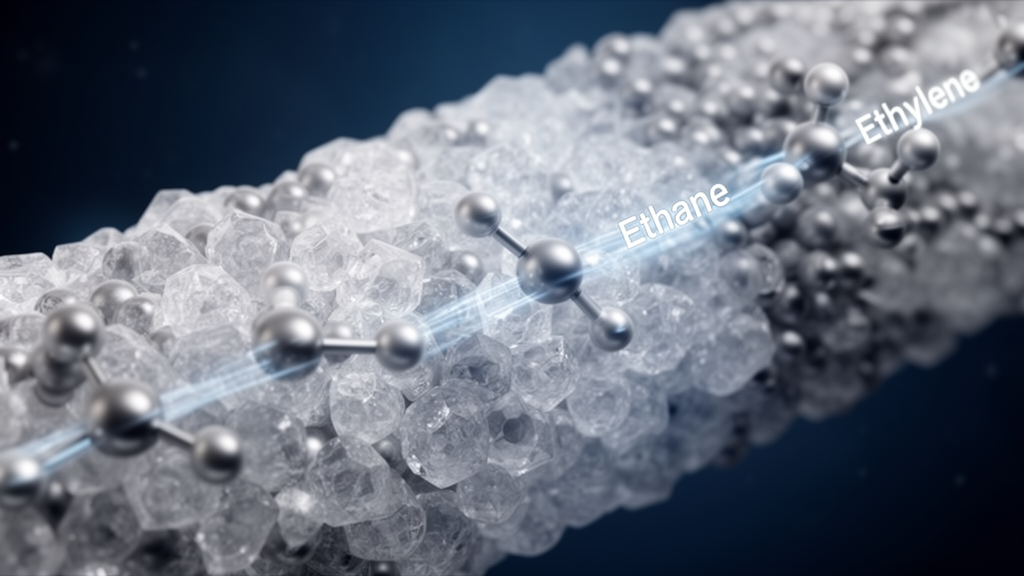
An integrated carbon dioxide capture and conversion system coupling Co-ZSM-5 catalysts with Ca4MgO5 adsorbents achieved efficient oxidative dehydrogenation of ethane, producing a 45.4 percent ethylene yield with 54.3 percent ethane conversion and a carbon dioxide capture capacity of 10.8 millimoles per gram at 650 degrees Celsius.

The research, led by Professor Jun Hu from East China University of Science and Technology in China and published in the Chinese Journal of Catalysis, evaluated how local catalytic microenvironments and proximity-governed effects influence integrated reaction performance.

Integrated carbon dioxide capture and conversion technology combines sorption and catalytic transformation within a single reactor vessel. This dual functionality avoids the energy-intensive sorbent regeneration steps and gas transportation infrastructure required by conventional stepwise capture and conversion operations.

By pairing the capture process with ethane oxidative dehydrogenation, the system uses captured carbon dioxide as a mild oxidant. This reaction scheme overcomes the thermodynamic equilibrium limitations inherent in traditional dehydrogenation pathways to enhance ethylene generation while converting captured carbon dioxide into chemical resources.

The reaction sequence faces direct competition from the dry reforming of ethane side reaction, an unselective pathway driven by competing cleavage between carbon-hydrogen and carbon-carbon bonds in ethane molecules. Developing dual-functional materials and managing site interactions are essential to suppress reforming and preserve dehydrogenation selectivity.

To optimize catalytic activity, the researchers tailored the catalyst structure in Co-ZSM-5-1.5 to maximize the relative concentration of divalent cobalt cations. The resulting highly dispersed cobalt sites situated within confined zeolite channels significantly promoted ethylene formation.

Spatial arrangements inside the fixed-bed reactor proved decisive in controlling local reaction conditions through a granule-stacking configuration. Tuning the physical proximity between the adsorbent and the catalyst established a critical local microenvironment, as excessive proximity concentrated carbon dioxide too heavily around catalytic sites and favored the competing dry reforming pathway.

In-situ diffuse reflectance infrared Fourier transform spectroscopy and density functional theory calculations showed that maintaining a relatively lower local carbon dioxide concentration provides steric and electronic benefits. These conditions lower the activation energy required to cleave the first carbon-hydrogen bond in ethane and facilitate ethylene synthesis as released carbon dioxide sequentially consumes hydrogen intermediates.

Subject of Research: Integrated carbon dioxide capture and oxidative dehydrogenation of ethane

Article Title: Engineering catalytic microenvironments for integrated CO2 capture and oxidative dehydrogenation

Article References: Engineering catalytic microenvironments for integrated CO2 capture and oxidative dehydrogenation. Original publication (Bibliographic details unavailable.)

Image Credits: AI Generated

DOI: Not provided

Keywords: integrated CO2 capture and conversion, oxidative dehydrogenation of ethane, ethylene production, Co-ZSM-5 catalysts, Ca4MgO5 adsorbents, catalytic microenvironments, adsorbent-catalyst proximity, dry reforming of ethane, granule-stacking configuration, fixed bed reactor, in-situ DRIFTS, density functional theory, C-H bond cleavage, carbon neutrality, East China University of Science and Technology, Chinese Journal of Catalysis, mild oxidant

News Source: Bethany Barker. (November 14, 2026). Tuned Catalyst and Adsorbent Proximity Enhances Ethylene Production From Ethane. Scienmag.

Tags: adsorbent-catalyst proximityC-H bond cleavageCa4MgO5 adsorbentscarbon neutralitycatalytic microenvironmentsChinese Journal of CatalysisCo-ZSM-5 catalystsdensity functional theorydry reforming of ethaneEast China University of Science and Technologyethylene productionfixed-bed reactorgranule-stacking configurationin situ DRIFTSintegrated CO2 capture and conversionmild oxidantoxidative dehydrogenation of ethane
Share12Tweet7Share2ShareShareShare1

Related Posts

Swarm Optimization Framework Improves Flying Ad Hoc Network Energy and Routing Lifetime

Swarm Optimization Framework Improves Flying Ad Hoc Network Energy and Routing Lifetime

November 19, 2026
German Radiology Corpus Advances Automated Information Extraction for Urinary Stone Diagnostics

German Radiology Corpus Advances Automated Information Extraction for Urinary Stone Diagnostics

November 19, 2026

Adaptive Adversarial Network Boosts Seismic Fault Identification Accuracy Across Surveys

November 19, 2026

Combined Carbonation and Water Curing Densifies CO2-Injected Model Concrete Matrices

November 19, 2026

POPULAR NEWS

  • Tryptophan Can Contribute to Seawater Iron Reduction at Lower pH

    Tryptophan Can Contribute to Seawater Iron Reduction at Lower pH

    29 shares
    Share 12 Tweet 7
  • Preserving Cervical Carotid Segments During Autopsy May Facilitate Subsequent Facial Embalming

    29 shares
    Share 12 Tweet 7
  • Adaptive Adversarial Network Boosts Seismic Fault Identification Accuracy Across Surveys

    29 shares
    Share 12 Tweet 7
  • Prenatal Testing Identifies Rare Mosaic Trisomy 14 in Early Severe Fetal Malformations

    29 shares
    Share 12 Tweet 7

About

We bring you the latest biotechnology news from best research centers and universities around the world. Check our website.

Follow us

Recent News

Uropathogens Colonize 27.6 Percent of Diabetic Patients in Ghanaian Hospital Study

Machine Learning Reveals Discordance Between Infective Endocarditis Mortality Risk and Surgical Use

Early DIP Payment in Inner Mongolia Linked to Suggestive Procedure-Intensity Changes

Subscribe to Blog via Email

Enter your email address to subscribe to this blog and receive notifications of new posts by email.

Join 88 other subscribers
  • Contact Us

Bioengineer.org © Copyright 2023 All Rights Reserved.

Welcome Back!

Login to your account below

Forgotten Password?

Retrieve your password

Please enter your username or email address to reset your password.

Log In
No Result
View All Result
  • Homepages
    • Home Page 1
    • Home Page 2
  • News
  • National
  • Business
  • Health
  • Lifestyle
  • Science

Bioengineer.org © Copyright 2023 All Rights Reserved.