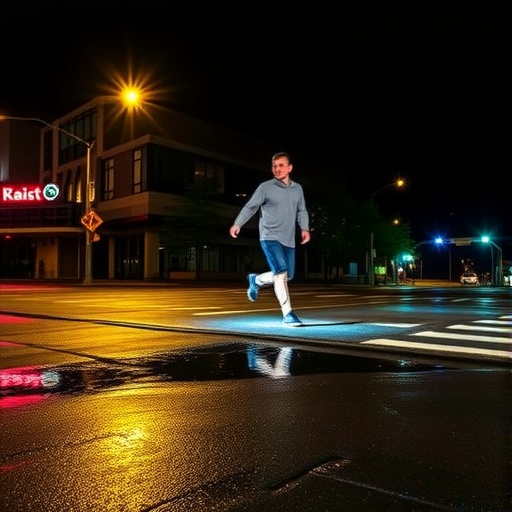
In a significant stride towards revolutionizing autonomous driving and medical diagnostics, researchers at the Korea Advanced Institute of Science and Technology (KAIST) have unveiled a groundbreaking polarization sensor technology that transcends the limitations of conventional imaging systems. Traditional sensors have struggled to differentiate between water puddles and asphalt on dimly lit roads, often leading to inaccuracies that hinder autonomous vehicle safety and reliability. The newly developed sensor array by the KAIST team captures not just the intensity of light but, crucially, its polarization—the direction in which light waves vibrate—enabling an unprecedented depth of environmental perception.
At the heart of this innovation lies a “self-reconfigurable” polarization sensor array, engineered to dynamically modulate its detection parameters by leveraging polarization information. Led by Professor Joonki Suh of the Department of Chemical and Biomolecular Engineering, the research group introduced a sensor capable of autonomously adjusting its operational state in real-time by exploiting the vibrational directionality of light. This capability marks a dramatic departure from conventional image sensors, which are limited to sensing light intensity alone, thereby constraining their ability to discern object orientation or surface textures critical for precise scene interpretation.
The breakthrough was achieved through the fabrication of a heterostructure combining two anisotropic materials—tellurium (Te) and rhenium disulfide (ReS₂). Each material exhibits distinct crystalline anisotropy, meaning their electronic and optical responses vary depending on the direction relative to their crystal lattice. By precisely stacking these materials to intersect at defined crystalline orientations, the sensor gains sensitivity to multiple polarization states, effectively decoding complex light vibration patterns with remarkable fidelity.
This meticulous stacking was accomplished using epitaxial atomic layer deposition (E-ALD), a technique that enables atomic-scale precision in material layering while preserving the crystal integrity across interfaces. Unlike conventional fabrication methods, E-ALD facilitates the creation of an interlocked crystal structure, which enhances reproducibility and operational stability—a crucial factor for sensor reliability in real-world applications. The resultant heterointerface acts as a site for interfacial carrier dynamics, including charge transfer and trapping phenomena, profoundly influencing the photoresponse characteristics of the sensor.
One of the most striking features observed in this heterostructure sensor is its bipolar photoresponse. Depending on variables such as light intensity, wavelength, and polarization direction, the photocurrent can flip direction—a functionality that can be harnessed for versatile sensor reconfiguration without the need for external electrical inputs. This intrinsic optical controllability lays the groundwork for sensors that autonomously adapt to changing environmental conditions, significantly reducing energy consumption and computation load.
Crucially, the technology transcends mere detection, aligning with the emerging paradigm of “in-sensor computing.” Unlike traditional systems where sensors simply capture data and transmit it to external processors, this approach integrates computational capabilities directly within the sensor hardware. Such integration enables real-time, low-latency processing of multi-dimensional optical information, including temporal changes, without reliance on complex post-processing algorithms. In dynamic scenarios, such as autonomous navigation, this could translate into faster decision-making with markedly improved energy efficiency.
Experimental validation of the sensor’s capabilities demonstrated an impressive accuracy rate exceeding 95% in recognizing moving objects, attesting to its potential for deployment in safety-critical applications ranging from self-driving vehicles to advanced medical imaging. The sensor’s ability to discern nuanced surface properties and object orientations under challenging lighting conditions heralds a new era for machine vision technologies, directly addressing long-standing challenges that have impeded progress in AI-powered perception systems.
Professor Joonki Suh emphasized the broader implications of their research, stating that harnessing polarization information enriches the visual data landscape far beyond conventional brightness metrics. The research paves the way for smarter AI vision technologies characterized by low power consumption and elevated performance, essential for the next generation of intelligent autonomous systems.
The research team, including postdoctoral researcher Wenxuan Zhu and integrated MS-PhD student Changhwan Kim as first authors, alongside a multidisciplinary group of experts, culminated their findings in a paper published in the prestigious journal Nature Sensors. Their work embodies a fusion of advanced materials science, optoelectronics, and AI-driven computational paradigms, setting a benchmark for future investigations into polarization-based sensing.
This innovation also signifies a transformative step in bridging the gap between physical sensor design and intelligent data processing, highlighting the potential of tailored heterostructures to decode complex optical signals in situ. Looking ahead, such technologies could catalyze breakthroughs across a spectrum of sectors, including augmented reality, environmental sensing, and biomedical diagnostics, where extracting rich optical information with minimal energy footprint is paramount.
Moreover, the interdisciplinary nature of this work underscores the growing convergence between materials engineering and artificial intelligence, reflecting a shift toward holistic system architectures that integrate sensing, computation, and adaptive feedback within single devices. Through this approach, the KAIST team exemplifies how foundational scientific advancements can yield practical solutions addressing contemporary technological challenges.
As sensor arrays evolve to incorporate polarization sensitivity and self-reconfiguration capabilities, the implications for autonomous machine perception are profound. Heretofore unresolved issues such as discerning subtle surface differences and dynamic environmental changes under low-light conditions are now within reach of reliable resolution, promising safer autonomous navigation and more accurate diagnostic imaging.
In sum, the KAIST-developed self-reconfigurable polarization sensor array not only redefines the capabilities of next-generation imaging technologies but also catalyzes a shift toward intelligent, energy-efficient sensory computation. This fusion of physical sensor innovation and computational intelligence marks a foundational leap toward realizing fully autonomous, perceptually sophisticated systems capable of thriving in complex real-world environments.
Subject of Research: Not applicable
Article Title: Self-reconfigurable polarization perception in dual-anisotropy heterostructures for high-dimensional in-sensor computing
News Publication Date: 14-Apr-2026
Web References: 10.1038/s44460-026-00057-9
Image Credits: KAIST
Keywords
Polarization sensor, heterostructure, tellurium, rhenium disulfide, epitaxial atomic layer deposition, in-sensor computing, autonomous driving, AI vision technology, bipolar photoresponse, anisotropy, optical sensing, light polarization
Tags: advanced environmental perception in autonomous carsanisotropic material sensors in imagingautonomous driving nighttime puddle detectiondynamic sensor parameter modulationimproving autonomous vehicle reliability at nightKAIST sensor innovation for road safetyovercoming low-light imaging challengespolarization sensor technology for vehiclespolarization-based water and asphalt differentiationreal-time sensor adaptation in drivingself-reconfigurable polarization sensor arraytellurium-based polarization sensors