Study reveals DNA secrets of 100 tomato types
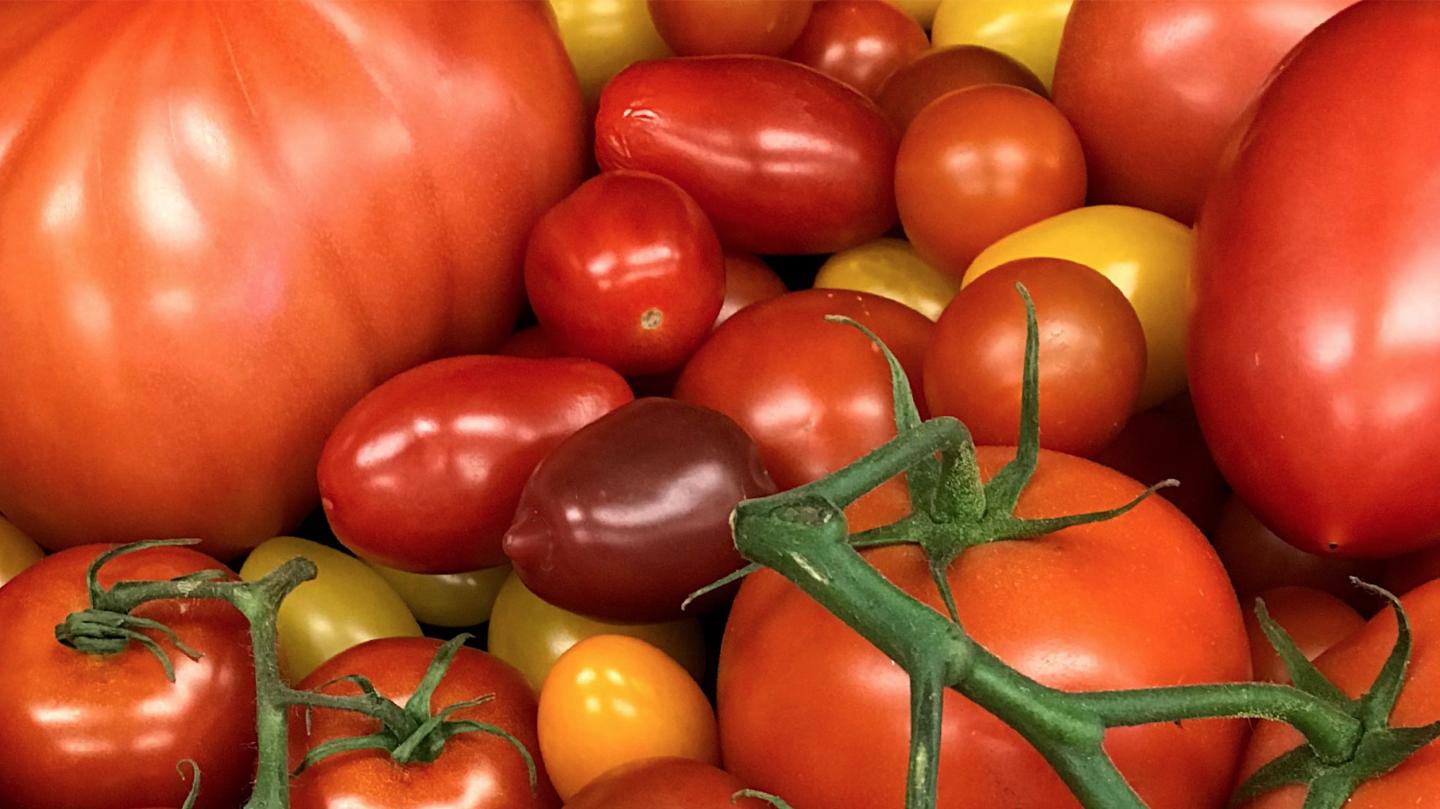
Credit: Zachary Lippman
When Pulitzer Prize and Grammy award winner Kendrick Lamar rapped “I got millions, I got riches buildin’ in my DNA,” he almost certainly wasn’t talking about the humble tomato. But a new study unveiling more than 230,000 DNA differences across 100 tomato varieties which will allow breeders and scientists to engineer larger, juicier, more profitable plants, proves that tomatoes indeed have riches buildin’ in their DNA, too.
The study will be published June 17 in Cell.
“The vast majority of the DNA differences we discovered are completely new,” says Michael Schatz, Bloomberg Distinguished Associate Professor of Computer Science and Biology at Johns Hopkins University and the study’s co-corresponding author.
As one of the largest fruit crops in the world, the commercially growing tomatoes is an $190 billion global industry that relies pinpointing which large-scale difference between genomes, or structural variants, are responsible for the variety of tomato shapes, colors and tastes we see at the store.
Previous technologies, however, didn’t allowed scientists to read large portions of a genome, only allowing for small bits to be read at a time in a piecemeal fashion.
“Like a big jigsaw puzzle with hundreds of millions of small pieces, maybe you manage to put together the corners, but not the big blue sky. The new technology used in this study allowed us to zoom in and get larger, clearer puzzle pieces,” says Schatz.
Using new DNA sequencing technology and software to ‘sharpen’ their view, Schatz and more than 30 collaborators around the world in a self-proclaimed “tomato consortium” were able to sequence and compare the genomes of 100 different tomato types. In doing so, they found more than 230,000 structural variants.
From there, the team dove deeper with detailed genetic experiments to understand how some of those variants affect tomato traits. In one experiment, they found that duplication of a particular gene causes a plant’s tomatoes to be about 20% larger. Next, they discovered a gene that contributes to a smoky flavor in some tomatoes. And in a third set of experiments, the researchers uncovered a complex interaction involving four structural variants that can mitigate a potential trade-off between a feature that simplifies tomato harvesting and another that reduces productivity.
The scale of their investigation has never been accomplished for any other crop, says Cold Spring Harbor Laboratory professor and Howard Hughes Medical Institute investigator Zachary Lippman, who co-led the project.
“I think it sets the foundation for what other crops and people in those working on those crops should be thinking about,” says Lippman.
“All crops are based on mutations. Everything that we eat is based on mutations and up until now it’s pretty been pretty slow process to identify and evaluate the importance of those mutations.”
Adds Schatz: “We’ve taken processes that used to take hundreds, or in some cases, even thousands of years, and performed them very rapidly. From here, we can apply our understanding of genetics to very rapidly domesticate some of the species related to tomatoes and create new crops to feed the world with.”
###
Media Contact
Chanapa Tantibanchachai
[email protected]