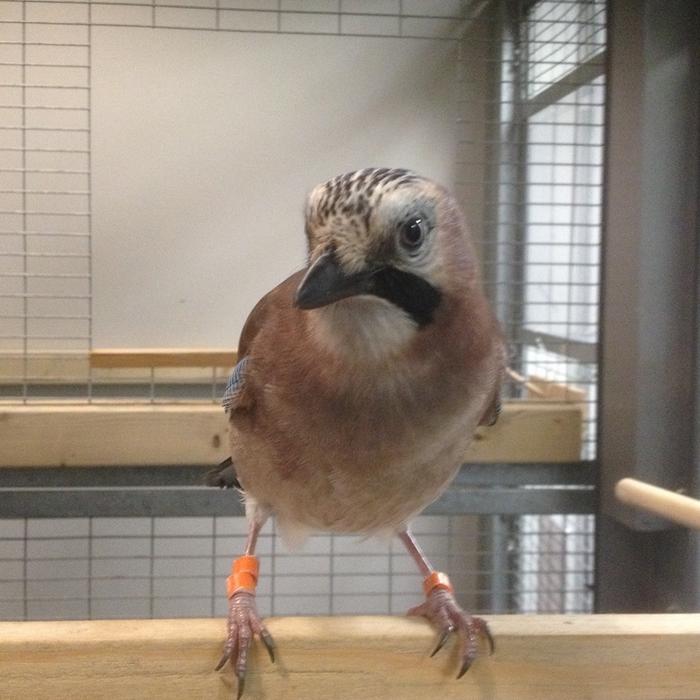
New research has found that two similar species of birds – both capable of displaying self-control through delayed gratification – behave very differently around their favourite food when they have company.
Credit: Please credit Rachael Miller
New research has found that two similar species of birds – both capable of displaying self-control through delayed gratification – behave very differently around their favourite food when they have company.
Published in the journal PLOS ONE, the study was led by researchers from Anglia Ruskin University (ARU) in Cambridge, UK, and the University of Cambridge, who compared the behaviour of two species of corvids: Eurasian jays (Garrulus glandarius) and New Caledonian crows (Corvus moneduloides).
Although both are highly intelligent birds from the same family, the researchers found that jays will settle for an immediate, less preferred food option when another bird is present, while crows will always hold out for their favourite food, regardless of the social context.
The study involved a rotating tray task, with the birds presented with two food choices, a high-quality and low-quality option, which they had to remove from under clear plastic cups. For jays, the high-quality food was mealworm and the low-quality food was bread, while crows’ preferred food was meat and the less preferred option was apple.
Each bird was tested separately, and they watched as both food types were added to the rotating tray. At the same time, a second bird – either a direct competitor or a non-competitor bird – remained in an adjacent compartment.
Just before the less preferred food option became available on the rotating tray, the door between the compartments was opened, allowing the second bird access. The bird being tested could then choose either the immediate option or wait 15 seconds for the delayed, preferred option to become available.
The study found that each jay selected the high-quality, delayed reward (mealworm) while alone, but typically chose the immediate food choice (bread) when either a competitor or non-competitor bird was present.
In contrast, each crow stood its ground and waited for the high-quality, delayed reward (meat) over the immediate, less preferred option (apple) in all three test conditions.
Co-lead author Dr Rachael Miller, Senior Lecturer in Biology at Anglia Ruskin University, said: “Delayed gratification, in this case declining an immediate, small food reward and waiting for something better, demonstrates the ability for self-control. We have also used this rotating tray task to comparably measure self-control in young children.
“Both the Eurasian jay and the New Caledonian crow are capable of delaying gratification for a better reward, and we expected both species would wait for the higher-quality, preferred reward when alone and potentially with a non-competitor bird present, but would choose the lower-quality, immediate reward when a competitor was present, as waiting could risk them losing out.
“Interestingly, we found that jays were highly flexible in their use of delayed gratification, and this was entirely influenced by the presence of other birds, but the crows consistently chose the better, delayed reward, regardless of rival birds being present.
“These findings add to our understanding of self-control and the factors influencing delayed gratification in animals, which may relate to a particular species’ social tolerance and levels of competition.
“New Caledonian crows tend to be more sociable and tolerant of others than Eurasian jays, and while both hide food for later use, jays rely more on this tactic for their survival. This might explain why the more territorial jays altered their choosing strategy when competitors were present and selected the immediate, less preferred food to avoid missing out entirely.”
The full open access article, published in the journal PLOS ONE, can be read here: https://journals.plos.org/plosone/article?id=10.1371/journal.pone.0289197
Journal
PLoS ONE
DOI
10.1371/journal.pone.0289197
Article Title
Social influences on delayed gratification in New Caledonian crows and Eurasian jays
Article Publication Date
6-Dec-2023