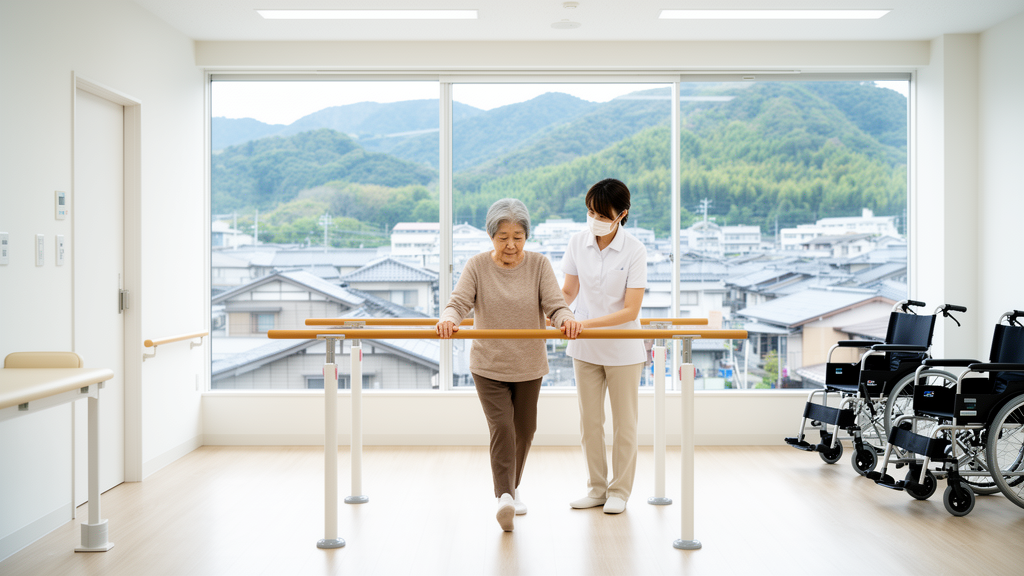
Inpatient rehabilitation provision varied across Japan in fiscal year 2019, with relatively high values in several western areas and relatively low values more frequently found in parts of eastern and northern Japan. A nationwide ecological study covering all 335 secondary medical service areas found that the median standard rehabilitation provision ratio for total rehabilitation units was 0.762, with an interquartile range of 0.466 to 1.035. The analysis also detected weak positive spatial autocorrelation, with Moran’s I of 0.207 ( p < 0.001).
Researchers used national open data to compare rehabilitation provision across Japan while adjusting for differences in population age and sex. The standard rehabilitation provision ratio, or SRPR, was calculated through indirect age- and sex-standardization based on national rehabilitation provision rates. This approach allowed the investigators to compare areas with different population structures using a common reference.
To account for spatial dependence and the number of rehabilitation units expected in each area, the team also calculated smoothed SRPRs with a Bayesian Poisson Leroux conditional autoregressive model. The model incorporated expected rehabilitation-unit counts, while Bayesian posterior inference was performed using integrated nested Laplace approximation. The smoothed estimates showed a similar broad geographic pattern: comparatively high provision in several western areas and comparatively low provision in parts of the east and north.
In the adjusted spatial model, the number of therapists per 100,000 residents was associated with greater rehabilitation provision. The estimated rate ratio was 2.40, with a 95% credible interval of 1.97 to 2.93. The presence of at least one physiatrist was associated with an even larger rate ratio of 5.80, with a 95% credible interval of 3.50 to 9.66.
These estimates describe associations between regional characteristics and provision in the study data; they do not establish that changes in staffing would directly produce the reported differences. Population aging was associated with lower provision in the same model. Areas with higher aging rates had a rate ratio of 0.53, with a 95% credible interval of 0.41 to 0.68.
The finding means that the higher aging rate was associated with a lower modeled rehabilitation-provision ratio after the other variables included in the analysis were taken into account. The results are based on an ecological analysis of data from a single fiscal year, so they describe variation between areas rather than changes over time. The authors said that patient-level data, regional need indicators and cross-area utilization require further assessment before the findings can support specific policy decisions.
Taken together, the analysis identifies geographic variation in inpatient rehabilitation provision under Japan’s public health insurance system and links that variation with the availability of rehabilitation personnel, the presence of physiatrists and population aging. Instead, it supplies a national descriptive view of where provision was relatively high or low in fiscal year 2019 and identifies regional patterns that merit additional investigation. For science and health-services researchers, the study shows how national open data and spatial statistics can be used to examine the distribution of rehabilitation resources.
The observed rate ratios indicate that local workforce and demographic characteristics were associated with provision, while the weak positive Moran’s I value provides a descriptive measure of geographic clustering. Further work would need to assess local need and utilization across areas and evaluate the findings with patient-level information before drawing conclusions about individual care.
Subject of Research: Geographic variation in inpatient rehabilitation provision across Japan
Article Title: Spatial analysis of geographic variation in inpatient rehabilitation provision under Japan’s public health insurance system: a nationwide ecological study using national open data
Article References: Wada, Y., Otaka, Y., & Kawaguchi, H. (2026). Spatial analysis of geographic variation in inpatient rehabilitation provision under Japan’s public health insurance system: a nationwide ecological study using national open data. BMC Health Services Research. https://doi.org/10.1186/s12913-026-15857-5
Image Credits: AI Generated
DOI: 10.1186/s12913-026-15857-5
Keywords: inpatient rehabilitation, Japan, health services research, geographic variation, rehabilitation workforce, physiatrists, population aging, spatial analysis, national open data, Spatial, analysis, geographic
News Source: Ophelia Keating. (October 20, 2026). Japan’s inpatient rehabilitation provision varies geographically, nationwide study finds. Scienmag.