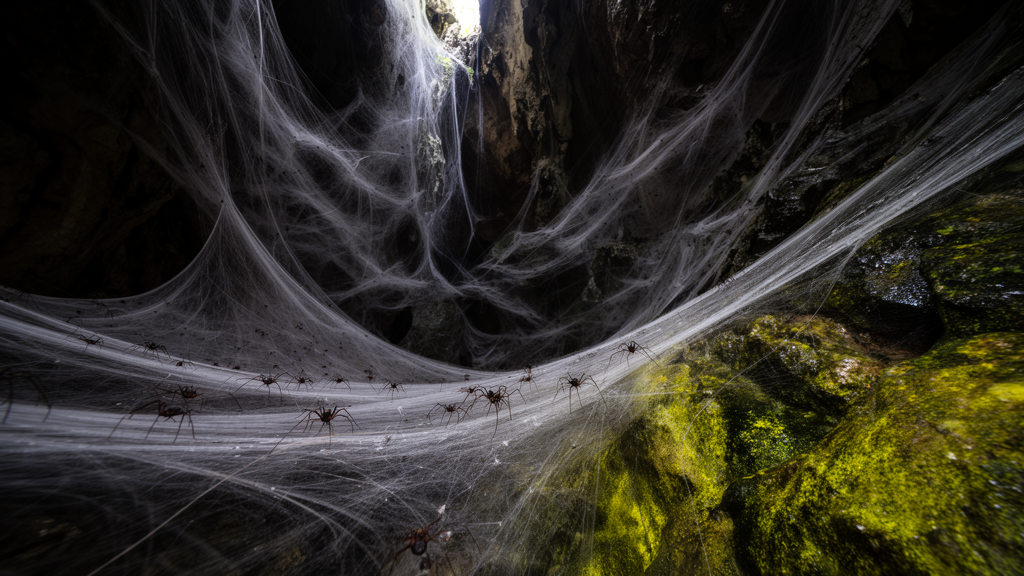
A field study of Sulfur Cave, a hypogenic limestone system crossing the Albania–Greece border, documented a colonial web covering an estimated 106 square metres of cave wall. Quadrat sampling and visual counts estimated 69,113 Tegenaria domestica and 42,400 Prinerigone vagans, making the assemblage the first documented colonial web formation reported for these two species.
The colony occupies the left side of the cave’s sulfidic stream in a permanently dark passage beginning about 50 metres from the entrance. The entrance is in Greece and the deeper sections extend into Albania. The stream maintains a year-round temperature of 26 °C and carries hydrogen sulfide concentrations as high as 65 mg l⁻¹, while the cave atmosphere can reach 14 ppm H₂S. White biofilms containing filamentous sulfur-oxidizing bacteria, including Beggiatoa and Thiothrix, cover the stream sediments.
Researchers combined field surveys, microscopy, DNA barcoding, stable-isotope analysis and preliminary 16S metabarcoding. For population estimates, they placed 15-by-15-centimetre quadrants at 30 randomly selected wall locations and counted funnel-shaped T. domestica webs in photographs. T. domestica had a mean estimated density of 652 ± 149 individuals per square metre, with local values ranging from 178 to 2,756. P. vagans averaged 823 ± 556 individuals per square metre, with a range of 133 to 2,200. The counting method may overestimate abundance because abandoned or unoccupied funnel webs are difficult to distinguish from occupied webs.
The web coincided with a dense swarm of the non-biting midge Tanytarsus albisutus above the stream. Resting midges were estimated at 45,500 per square metre, and their observed distribution across roughly half the colony’s area produced an extrapolation of 2,414,440 flies. The authors considered abundant chironomid prey to be the most likely driver of T. domestica colonization, although that explanation was presented as a hypothesis rather than directly tested experimentally.
Carbon and nitrogen stable-isotope measurements indicated a food web associated with material produced inside the cave. Adult T. albisutus and the agelenid and linyphiid spiders inhabiting the colony had δ¹⁵N and δ¹³C values ranging from −2‰ to −10‰, compared with values of 1‰ to 4‰ in conspecific or ecologically similar surface-dwelling taxa. Together with observations of microbial biofilms and abundant terrestrial invertebrates, these measurements support the interpretation that sulfur-oxidizing chemoautotrophs form an important basal resource in the cave food web. The study did not directly trace the transfer of carbon from microbes to midges and spiders, however, and the proposed pathway through chironomids to the colony predators remains inferential.
Morphological examination of genital structures and analysis of mitochondrial cytochrome c oxidase sequences identified T. domestica as the web-forming species and P. vagans as its colony associate. Three additional species—Metellina merianae, Lepthyphantes magnesiae and Kryptonesticus eremita—occurred elsewhere in the cave, while a small, blind and depigmented Cataleptoneta species was reported from deeper sections. All 32 sequenced T. domestica individuals shared a haplotype one mutation from a common haplotype represented across North America, Europe, Turkey, Pakistan and New Zealand. The three sequenced P. vagans individuals shared a haplotype three mutations from a widespread haplotype, while the two K. eremita individuals had a distinct haplotype. The study interpreted these patterns as evidence consistent with limited exchange between some cave and surface populations, but it did not directly measure gene flow.
Reproduction also varied among sampling periods. The researchers opened 86 T. domestica egg sacs collected in June 2024, October 2024 and March 2025. Clutches averaged 16.15 ± 0.62 eggs, with a range of 6–33, and egg size averaged 0.53 ± 0.05 mm, ranging from 0.4 to 0.6 mm. An analysis of variance detected differences among months. June clutches averaged 26 eggs, significantly more than October clutches at 14.5 and March clutches at 13, while October and March did not differ significantly. The authors did not determine why cave clutches may contain fewer eggs than the first cocoons reported for surface-dwelling females.
Preliminary microbiome comparisons found lower bacterial diversity in T. domestica from the cave than in one surface individual collected near Pixaria Cave. The cave spiders had a mean Shannon diversity index of 0.82 ± 0.25, compared with 2.99 for the surface specimen, and many reads came from intracellular symbionts including Mycoplasmopsis, Mycoplasma and Wolbachia. This comparison involved one surface individual and 29 analyzable cave individuals, and whole opisthosomas were used, so the results could not separate microbial contributions from different abdominal organs.
The study provides a detailed field characterization of a mixed T. domestica–P. vagans colony in a chemoautotrophic cave ecosystem, while also documenting reproduction, genetic variation and microbiome differences. Its principal limitations are the extrapolated population estimates, small microbiome comparison and inferential linkage between sulfur-oxidizing biofilms, chironomid prey and the spiders. The authors hypothesized that darkness may reduce the larger T. domestica’s visual detection of the smaller P. vagans, allowing the two species to coexist within the shared web, but no dedicated experiment tested that explanation.
Subject of Research: Field documentation and trophic characterization of a mixed-species spider colony in a sulfidic cave on the Albania–Greece border
Article Title: An extraordinary colonial spider community in Sulfur Cave (Albania/Greece) sustained by chemoautotrophy
Article References: Urák, I., Vrenozi, B., Głąbiak, Z., Lecoquierre, N., Eiberger, C., Maraun, M., Ştefan, A., Flot, J.-F., Brad, T., Dainelli, L., Sarbu, S. M., & Băncilă, R. I. (2025). An extraordinary colonial spider community in Sulfur Cave (Albania/Greece) sustained by chemoautotrophy. Subterranean Biology, 53, 155-177. https://doi.org/10.3897/subtbiol.53.162344
Image Credits: AI Generated
DOI: 10.3897/subtbiol.53.162344
Keywords: Sulfur Cave, spider colony, Tegenaria domestica, Prinerigone vagans, chemoautotrophy, sulfur-oxidizing bacteria, stable isotopes, Albania, Greece, subterranean ecology, extraordinary, colonial
News Source: Gavin Prescott. (October 20, 2026). Field study finds a vast mixed-species spider colony sustained by a sulfidic cave food web. Scienmag.