NICT’s optical ground station successfully received downlink light from DLR’s small satellite-mounted optical terminal (OSIRISv1)
Credit: NICT
[Points]
- -Successful experiment to receive downlink light at NICT optical ground station from DLR optical terminal mounted on Univ. of Stuttgart’s Flying Laptop satellite
-Succeeded in the initial experiment of the newly developed atmospheric turbulence measuring device and simple optical ground station for future optical ground station technology enhancement
-Acquired valuable data to contribute to the research and development of future space optical communication technology
[Abstract]
The National Institute of Information and Communications Technology (NICT, President: TOKUDA Hideyuki, Ph.D.) has conducted an international joint experiment with the German Aerospace Center (DLR) between the optical terminal (OSIRISv1) onboard the University of Stuttgart’s Flying Laptop satellite and NICT’s optical ground station equipped with newly developed optical bench with fine-pointing system. In February 2021, success in receiving the downlink light from OSIRISv1 at NICT’s optical ground station was achieved.
At the same time, an initial experiment of the newly developed atmospheric turbulence measuring device was performed successfully. Furthermore, a successful demonstration experiment using a simple optical ground station composed of low-cost commercial parts was conducted by receiving laser light from the satellite.
The OSIRISv1 optical terminal, mounted on the University of Stuttgart’s Flying Laptop satellite uses body pointing for tracking and this is the first time a successful experiment with such implementation is performed in Japan. As a result, valuable experimental data that will contribute to the research and development of future space optical communication technology has been acquired.
[Background]
NICT is conducting research and development of space optical communications for the advancement of future satellite communication. Between 2014 and 2016 multiple experiments were performed between the small optical communication transponder (SOTA) and not only optical ground stations in Japan, but also in Europe (German Space Agency (DLR), French National Centre for Space Studies (CNES), and European Space Agency (ESA)) and Canada (Canadian Space Agency (CSA)), and valuable space optical communication experiment data was acquired. NICT has signed a joint research agreement with DLR, that has been developing several optical-communication payloads (OSIRIS). As a result, NICT has carried out an international joint experiment using the onboard optical terminal (OSIRISv1).
[Results of this experiment campaign]
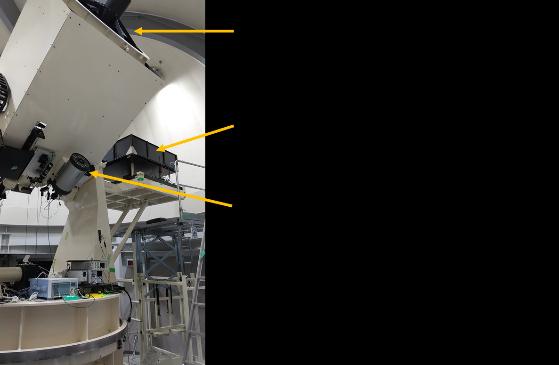
During this experimental phase that took place between the end of January and the beginning of February 2021, NICT planned experiments to receive the laser light from OSIRISv1 at the optical ground station in Tokyo, which is equipped with a 1-m telescope (Fig. 1). In this experiment, NICT used the newly developed optical bench with fine-pointing system that has been developed for the future High Speed Communication with Advanced Laser Instrument (HICALI) experiments (Fig. 2), which performance was confirmed in advance. It is the first time an experiment with body-pointing implementation was conducted successfully in Japan.
In addition, in this experiment, NICT succeeded in the initial test of the newly-developed atmospheric-turbulence measuring device, which contribute for the estimation and mitigation of the atmospheric-turbulence effects on the space optical-communication links.
Furthermore, aiming for global spread of space optical communications, it is necessary to develop a small low-cost ground station. A small 20-cm-order off-the-shelf telescope was installed in parallel of the 1-meter optical ground station and successful experiments in receiving the downlink light (first light) were performed.
The collected valuable data during these successful experiments is important for the modelling of the atmospheric turbulence and tracking errors, and is expected to contribute to the further development of the space optical communication technology.
[Future prospects]
By proceeding with the analysis of the gathered experimental data, research and development of a complete easy-to-use receiving system with single-mode fiber coupling technology, low-noise optical amplification technology, and high-sensitivity receiving technology on the receiving side is planned. This is expected to contribute to the development and popularization of space optical communication systems in future. Furthermore, this successful demonstration of international system interoperability with OSIRISv1/Flying Laptop is an important contribution for The Consultative Committee for Space Data Systems (CCSDS), where standardization of space optical-communication technology is currently taking place.
###
[Role sharing of each institution]
NICT: Development of measuring instruments for optical ground stations and optical reception experiments, and preparation for the experiments in Japan
DLR: Development and operation of OSIRISv1
University of Stuttgart: Development, integration and operation of the Flying Laptop satellite
Media Contact
HIROTA Sachiko
[email protected]
Original Source
https:/