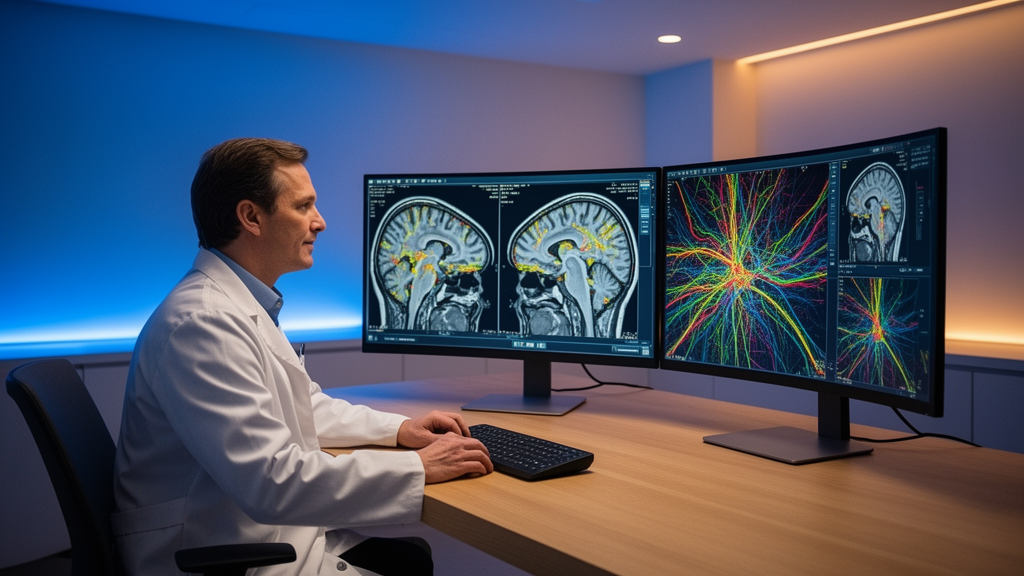
Microstructure-informed diffusion magnetic resonance imaging indices incorporating an intra-neurite volume fraction weighting factor showed stronger correlations with Mini-Mental State Examination scores than conventional diffusion metrics in an evaluation of patients across the Alzheimer’s disease continuum. According to findings published in the Journal of Medical and Biological Engineering by Oh-In Kwon, Geon-Ho Jahng, and Munbae Lee, these associations were particularly pronounced within the brain’s left hemisphere, where a specific intra-neurite-weighted index achieved the strongest correlation with cognitive performance alongside favorable relative model support based on the Akaike Information Criterion.
The research addressed key limitations in conventional diffusion tensor imaging analysis along the perivascular space, known as the DTI-ALPS index. While the conventional DTI-ALPS index has served as an established diffusion imaging metric reflecting directional water diffusivity along the axis oriented with the perivascular space, cognitive decline across the continuum of Alzheimer’s disease is accompanied by multifaceted tissue microstructural changes that standard directional diffusivity metrics alone cannot capture.
To capture these complex biological alterations, the investigators formulated microstructure-informed ALPS-derived indices designed to separate intra-neurite and extra-neurite components within brain tissue. The team incorporated the intra-neurite volume fraction as a specific neurite-density weighting factor, mathematically combining perivascular-space-oriented directional diffusivity with tissue volume fractions to generate unified compartment-specific metrics.
The study evaluated magnetic resonance imaging data collected from a cohort of 120 human participants. This participant group encompassed individuals classified across three clinical categories: cognitively normal individuals, patients diagnosed with mild cognitive impairment, and individuals diagnosed with Alzheimer’s disease.
During data analysis, the researchers evaluated statistical associations connecting the compartment-specific, weighted indices to participant age, Mini-Mental State Examination scores, and established clinical diagnostic groups. In addition to demonstrating stronger linear correlations with cognitive scores than the conventional unweighted ALPS index, the intra-neurite-weighted indices revealed more evident statistical separation between diagnostic groups across the Alzheimer’s disease spectrum.
The authors concluded that compartment-specific and intra-neurite-volume-fraction-weighted ALPS indices may serve as microstructure-informed composite imaging markers associated with dementia-related tissue alterations and progressive cognitive decline. Critically, the researchers emphasized that the proposed metrics should be interpreted strictly as composite measures integrating directional diffusivity with neurite-density information, rather than as process-specific biological indicators.
Subject of Research: Microstructure-informed ALPS-derived diffusion MRI indices in cognitive impairment
Article Title: Microstructure-Informed ALPS-Derived Indices in Patients with Cognitive Impairment
Article References: Kwon, O.-I., Jahng, G.-H., & Lee, M. (2026). Microstructure-Informed ALPS-Derived Indices in Patients with Cognitive Impairment. Journal of Medical and Biological Engineering. https://doi.org/10.1007/s40846-026-01063-5
Image Credits: AI Generated
DOI: 10.1007/s40846-026-01063-5
Keywords: diffusion MRI, DTI-ALPS, perivascular space, directional water diffusivity, intra-neurite volume fraction, extra-neurite diffusion, neurite density, Alzheimer's disease continuum, mild cognitive impairment, cognitive decline, Mini-Mental State Examination, Akaike information criterion, left hemisphere diffusivity, compartment-specific indices, composite imaging markers, microstructural alterations
News Source: Ophelia Keating. (November 12, 2026). IVF-Weighted ALPS Diffusion Indices Show Stronger Correlations with Cognitive Test Scores. Scienmag.