

• HOME
  • NEWS
  • EXPLORE
    • CAREER
      • Companies
      • Jobs
    • EVENTS
    • iGEM
      • News
      • Team
    • PHOTOS
    • VIDEO
    • WIKI
  • BLOG
  • COMMUNITY
    • FACEBOOK
    • INSTAGRAM
    • TWITTER
Monday, July 13, 2026
BIOENGINEER.ORG
No Result
View All Result
  • Login
  • HOME
  • NEWS
  • EXPLORE
    • CAREER
      • Companies
      • Jobs
        • Lecturer
        • PhD Studentship
        • Postdoc
        • Research Assistant
    • EVENTS
    • iGEM
      • News
      • Team
    • PHOTOS
    • VIDEO
    • WIKI
  • BLOG
  • COMMUNITY
    • FACEBOOK
    • INSTAGRAM
    • TWITTER
  • HOME
  • NEWS
  • EXPLORE
    • CAREER
      • Companies
      • Jobs
        • Lecturer
        • PhD Studentship
        • Postdoc
        • Research Assistant
    • EVENTS
    • iGEM
      • News
      • Team
    • PHOTOS
    • VIDEO
    • WIKI
  • BLOG
  • COMMUNITY
    • FACEBOOK
    • INSTAGRAM
    • TWITTER
No Result
View All Result
Bioengineer.org
No Result
View All Result
Home NEWS Science News Biology

IUPUI cell biologist tackles age-related hearing loss

Bioengineer by Bioengineer
September 14, 2017
in Biology
Reading Time: 2 mins read
0
Share on FacebookShare on TwitterShare on LinkedinShare on RedditShare on Telegram
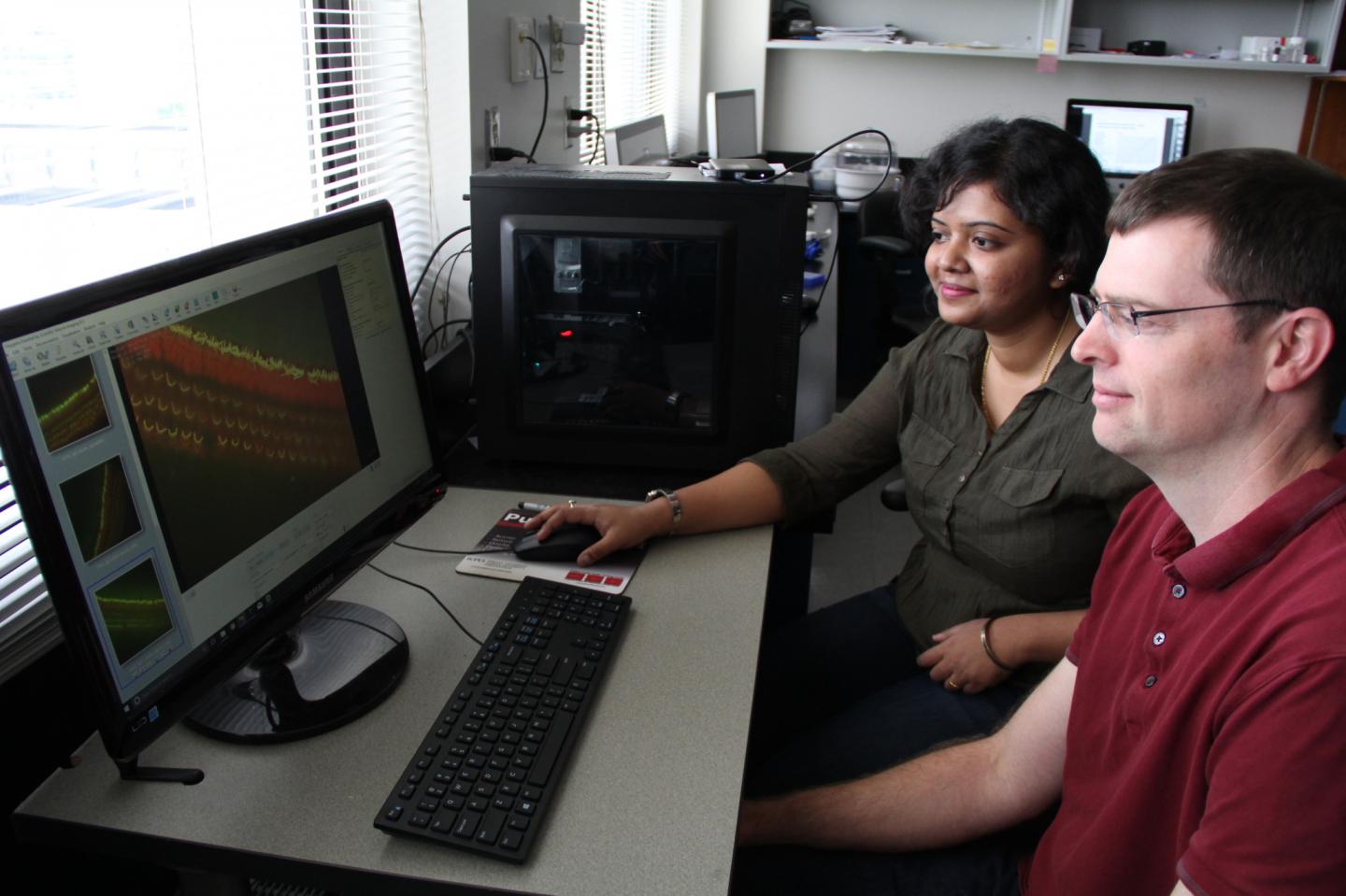
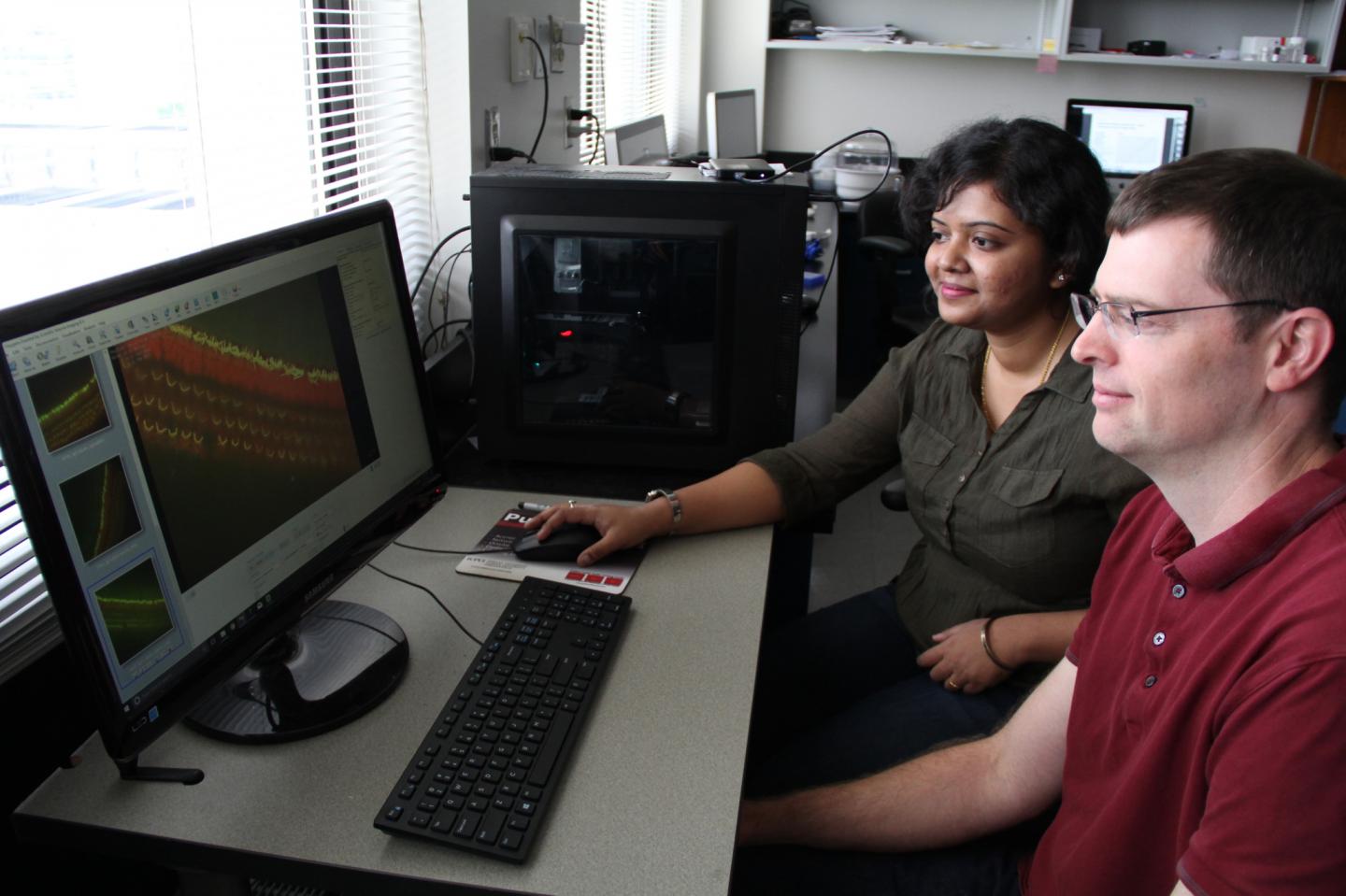
IMAGE

Credit: School of Science at IUPUI

INDIANAPOLIS — Cell biologist Benjamin J. Perrin of the School of Science at Indiana University-Purdue University Indianapolis is advancing knowledge of age-related hearing loss with the goal of informing possible therapeutic cell-regeneration approaches to the often-debilitating problem. Perrin's work is supported by a new $1.9 million five-year grant from the National Institute on Deafness and Other Communication Disorders.

Approximately 15 to 20 percent of American adults have trouble hearing. Almost everyone experiences at least some degree of hearing loss as they age, with the greatest loss typically occurring between ages 60 and 69.

Perrin is tackling the problem at the cellular level by exploring the function of the portion of the sensory cells in the inner ear that are responsible for detecting sound waves. These bundles of rod-like protrusions, called stereocilia, bend as sound hits them, opening ion channels. When stereocilia work properly, they convert sound waves into electric signals that are transmitted to the body's neurons, thus enabling one to hear speech, music and other sound.

Stereocilia may be abnormal at birth; they deteriorate as we age; and they can be damaged or destroyed by disease, toxins or loud noises. They do not grow back; hearing loss occurs if stereocilia malfunction or degenerate.

"To successfully convert sound waves into electric signals that can be understood by neurons, the stereocilia have to be exactly the right shape, size and conformation," Perrin said. "We are studying the dynamics and stability of how proteins move in and out of stereocilia to gain a better understanding of how these micromachines maintain themselves over long periods of time.

"If you want to try to regenerate stereocilia, you have to know how these living machines work in the first place. With this knowledge, it may be possible in the future to regenerate them to prevent or restore hearing loss. We are hoping to solve a biological puzzle with implications for millions of people."

Perrin envisions the development of a maintenance-of-living-cells approach — remodeling or regrowing a tiny piece of the cell before the whole cell is dead — rather than totally replacing them.

Each semester, three IUPUI graduate students and two to five undergraduates will work on the projec

###

t under Perrin's tutelage, conducting sophisticated experiments on mouse sensory cells, which are very similar to human sensory cells, and analyzing the data obtained from those experiments.

Cytoskeletal Stability in Stereocilia Maintenance is supported by NIDCD grant R01DC015495-01A1.

Media Contact

Cindy Fox Aisen
[email protected]
317-843-2275

http://science.iupui.edu/

Original Source

http://science.iupui.edu/news/iupui-cell-biologist-tackles-age-related-hearing-loss-19-million-nidcd-grant
Share13Tweet8Share2ShareShareShare2

Related Posts

Han directs new $15M NIH center for organ-on-chip technology

Han directs new $15M NIH center for organ-on-chip technology

July 11, 2026
Bacteriophages Enable Next-Gen Smart Pathogen Detection Sensors

Bacteriophages Enable Next-Gen Smart Pathogen Detection Sensors

July 10, 2026

Temperature Fluctuations Have Greater Impact Than Previously Believed

July 10, 2026

New Study Uncovers Biology Behind Glioma Cancer Progression

July 10, 2026
Please login to join discussion

POPULAR NEWS

  • Detection of EDCs in Breast Milk and Infant Urine Up to Six Months Highlights Early Exposure Risks

    77 shares
    Share 31 Tweet 19
  • New Drug Candidate Developed at McMaster Shows Potential for Treating Brain Cancer

    58 shares
    Share 23 Tweet 15
  • KTU Researchers Explore Ultrasound’s Role in Enhancing Blood Flow Beyond Diagnostics

    53 shares
    Share 21 Tweet 13
  • 高齢者の骨粗鬆症治療の持続性比較

    51 shares
    Share 20 Tweet 13

About

We bring you the latest biotechnology news from best research centers and universities around the world. Check our website.

Follow us

Recent News

Nationwide Study Reveals Multimorbidity Factors in Older Chinese Adults

Clinicopathologic Study Reveals Amyloid Clearance in Alzheimer’s Disease

Long-Term Kidney Outcomes After Living Donation in Older Adults Explored

Subscribe to Blog via Email

Enter your email address to subscribe to this blog and receive notifications of new posts by email.

Join 85 other subscribers
  • Contact Us

Bioengineer.org © Copyright 2023 All Rights Reserved.

Welcome Back!

Login to your account below

Forgotten Password?

Retrieve your password

Please enter your username or email address to reset your password.

Log In
No Result
View All Result
  • Homepages
    • Home Page 1
    • Home Page 2
  • News
  • National
  • Business
  • Health
  • Lifestyle
  • Science

Bioengineer.org © Copyright 2023 All Rights Reserved.