In the wild, it might seem like male animals run the show. But in a review publishing in Trends in Ecology & Evolution on May 18, researchers lay a new framework to assess power distribution between the sexes, and its application shows that in some animal species, females rule the roost and that their paths to power look very different than their male counterparts’.
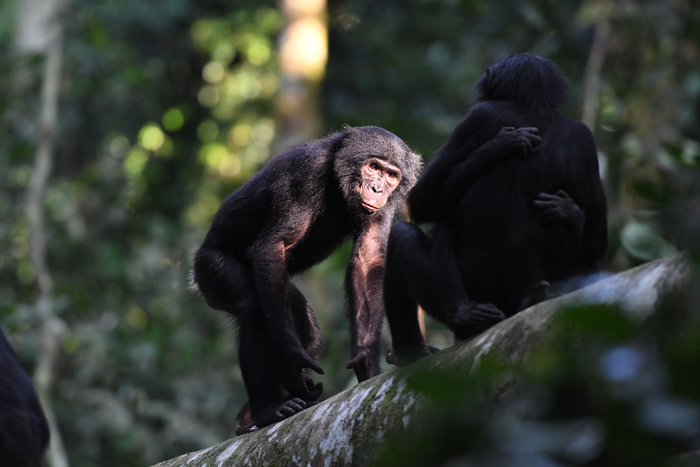
Credit: Martin Surbeck
In the wild, it might seem like male animals run the show. But in a review publishing in Trends in Ecology & Evolution on May 18, researchers lay a new framework to assess power distribution between the sexes, and its application shows that in some animal species, females rule the roost and that their paths to power look very different than their male counterparts’.
Social power among animal species has typically been categorized as being either male dominated or female dominated. “Progress in this area has long been hampered by a binary vision of power asymmetries between the sexes, where most species were dominated by males and female dominance was anecdotal,” says co-author Elise Huchard, a behavioral ecologist at the Institute of Evolutionary Science in Montpellier, France. “This simplistic view has been reinforced by stereotypes that researchers carry because of the society in which they live and then unconsciously project onto the animals they’re studying.”
Huchard has spent part of her career studying power dynamics in mammals and noticed that the distribution of power between the sexes was rarely quantified. After she and her colleagues carefully defined what power means and how it can be measured in animals, they developed a system by which to measure it. “Any species can be positioned on a continuum from strict male dominance to strict female dominance so that we can actually test hypotheses regarding how females or males can empower themselves,” she says.
For males, the path to power seems simple: coercion and physical dominance. For females, however, the routes to establishing social power can be physiological, morphological, behavioral, and socio-ecological. The common thread for species in which females hold power, such as hyenas, lemurs, and bonobos, is reproductive control, control over when and with which partner to mate. This comes in the form of resistance to mating, promiscuity, and even, in the case of hyenas, genitals designed specifically to allow the females to control fertilization.
“We hope that this framework will be used to quantify intersexual power in reproductive and social contexts and to facilitate the study and comparison of intersexual power relationships across mammalian societies, perhaps even including humans,” the authors write.
###
This work received support from the Sopa Society.
Trends in Ecology & Evolution, Davidian et al. “The eco-evolutionary landscape of power relationships between males and females” https://www.cell.com/trends/ecology-evolution/fulltext/S0169-5347(22)00087-8
Trends in Ecology & Evolution (@Trends_Ecol_Evo), published by Cell Press, is a monthly review journal that contains polished, concise, and readable reviews and opinions in all areas of ecology and evolutionary science. It aims to keep scientists informed of new developments and ideas across the full range of ecology and evolutionary biology—from the pure to the applied and from molecular to global. Visit: http://www.cell.com/trends/ecology-evolution. To receive Cell Press media alerts, please contact [email protected].
Journal
Trends in Ecology & Evolution
DOI
10.1016/j.tree.2022.04.004
Method of Research
Literature review
Subject of Research
Animals
Article Title
The eco-evolutionary landscape of power relationships between males and females
Article Publication Date
18-May-2022