A new study published in the journal Geothermal Energy presents the first systematic evaluation of geothermal systems across the entire Italian territory using the modern geothermal play concept, offering a standardized framework that researchers say could guide future exploration and energy planning.
The research, led by M. R. Galione and colleagues including A. Manzella and E. Trumpy, combines geological, tectonic, geothermal and utilization data within a geographic information system to map geothermal play types across the country.
In total, the team identified twenty-seven geothermal plays, which they grouped into six main types. Volcanic, plutonic and extensional domains make up the convection-dominated categories, while foreland basins, orogenic belts and basement rock provinces form the conduction-dominated ones. Together these constitute the first geothermal play type map ever produced for Italy.
From this national map, the researchers selected seventeen key play reservoirs for detailed analysis. Drawing on borehole temperature measurements, lithostratigraphy, reservoir geometries and petrophysical parameters taken from published literature, they estimated the geothermal potential of each reservoir using volumetric methods. These calculations addressed Heat in Place, and where the data allowed, Heat Storage Potential for medium- and high-temperature aquifer thermal energy storage.
Because subsurface properties are inherently uncertain, the team relied on probabilistic Monte Carlo simulations to quantify the range of possible outcomes.
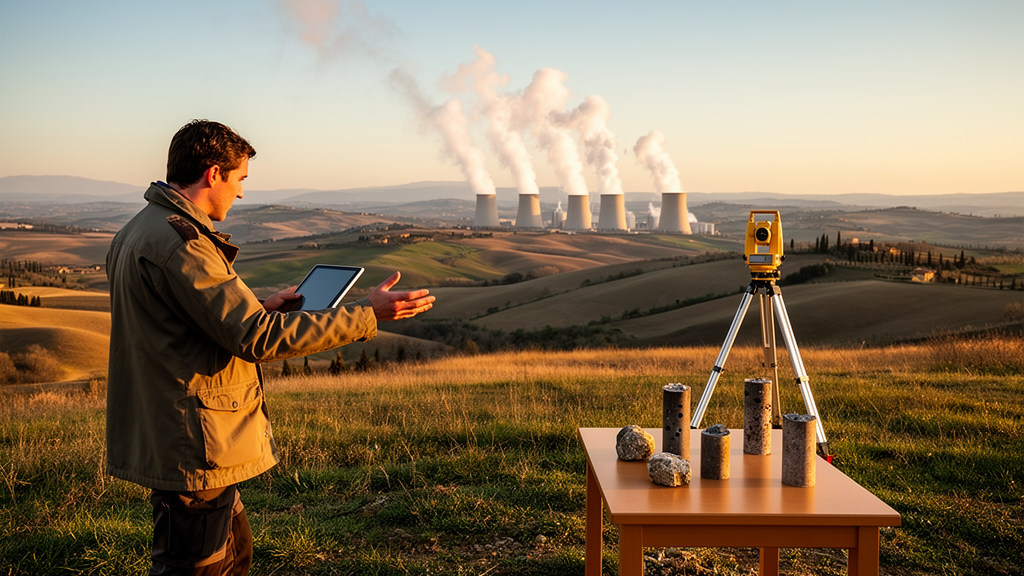
The results underscore the exceptional geothermal potential of Tuscany’s traditional convection-dominated plutonic systems, the same type of system where all of Italy’s geothermal power plants currently operate. These magmatic-related systems remain the country’s proven backbone for electricity generation from subsurface heat.
However, the study’s broader message concerns a different part of the country. Conduction-dominated sedimentary basins, particularly within the Po Plain in northern Italy, show significant potential for direct heat use and thermal energy storage. This potential is supported by large reservoir volumes and favorable petrophysical properties, according to the assessment. Because this play type is distributed broadly across Italy, the researchers conclude that the country’s geothermal potential extends well beyond its traditional magmatic areas.
The implications reach beyond national borders. The authors describe the framework as a robust basis for geothermal energy planning, a tool for cross-border comparison within Europe, and a means of identifying priority targets for future exploration, direct heat utilization and large-scale subsurface thermal energy storage. A standardized play-typing approach allows Italian systems to be compared directly with geological settings elsewhere on the continent.
Subject of Research: A national geothermal play-type assessment and resource potential mapping of Italy
Article Title: The Italian geothermal play-typing, a blueprint for unlocking national geothermal development
Article References: Galione, M. R., Manzella, A., Botteghi, S., Ferrigno, F., Yang, L., & Trumpy, E. (2026). The Italian geothermal play-typing, a blueprint for unlocking national geothermal development. Geothermal Energy. https://doi.org/10.1186/s40517-026-00400-w
Image Credits: AI Generated
DOI: 10.1186/s40517-026-00400-w
Keywords: geothermal energy, Italy, play typing, Po Plain, Tuscany, heat in place, aquifer thermal energy storage, Monte Carlo simulation, conduction-dominated systems, convection-dominated systems, GIS mapping, energy planning
News Source: Violet Maxwell. (October 28, 2026). Italy Maps Its Geothermal Potential Beyond the Volcanic Heartland. Scienmag.