


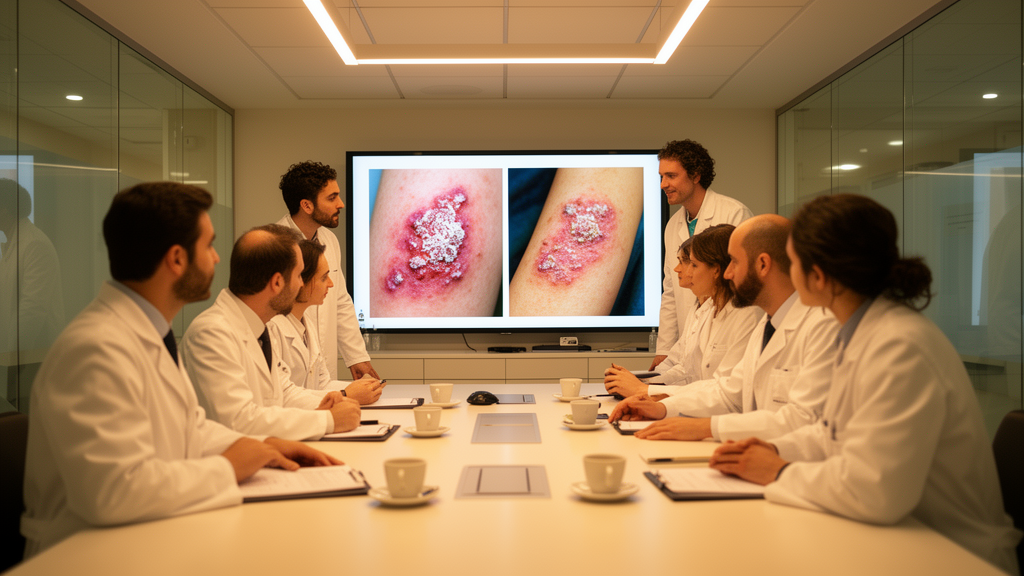
Eczema and psoriasis, long taught as two separate diseases of the skin, may in fact sit at opposite ends of a single continuum of immune dysregulation, according to a new consensus study conducted among Italian dermatologists. In an electronic Delphi process published in Dermatology and Therapy, a steering committee of eight experts drafted 43 statements on the definition, clinical presentation and treatment of eczema–psoriasis overlap, and a national panel of dermatologists voted on each one.
The study was motivated by a growing body of evidence that atopic dermatitis and psoriasis, traditionally distinguished by their dominant immune pathways, can share mechanisms and even coexist in the same patient. Atopic dermatitis has classically been described as a T helper 2-driven disease, while psoriasis is associated with Th1 and Th17 activation. Yet certain subtypes of atopic dermatitis, including Asian and paediatric forms, show substantial immunologic and histopathologic overlap with psoriasis. Elevated levels of the interleukin-17 and interleukin-22 proteins have been reported in both conditions, pointing to a role for Th17 and Th22 cells in each, and molecular research has confirmed overlapping genetic and transcriptomic features between the two diseases.
The clinical reality behind these findings is varied. Some patients experience the two conditions at different stages of life, most often developing atopic dermatitis in childhood and psoriasis in adulthood. Others show sudden phenotypic switches between eczematous and psoriatic patterns during the course of disease, a phenomenon the authors refer to as flip-flop, reflecting the dynamic plasticity between Th2-dominant and Th17-dominant inflammation. In some patients the two diseases coexist simultaneously, either as distinct lesions at separate body sites or as hybrid lesions displaying the hallmarks of both, including psoriatic features such as acanthosis and parakeratosis alongside eczematous findings such as spongiosis and eosinophilic infiltration.
Epidemiological data, though limited, support the existence of this overlap. Meta-analyses estimate a prevalence of approximately 2 percent of psoriasis among patients with atopic dermatitis, and 2 percent of atopic dermatitis among those with psoriasis, with higher rates of up to 4 to 9 percent when lifetime occurrence or paediatric populations are considered. Terminology has long been inconsistent, with labels such as psema, psorema, eczematous psoriasis and psoriasis dermatitis applied interchangeably, a confusion the authors say has contributed to underestimation of the overlap and to the lack of robust epidemiological data.
To build the consensus, a steering committee of eight Italian dermatologists, each with more than five years of clinical experience managing both diseases and each having treated more than 200 patients with psoriasis and more than 200 with atopic dermatitis, conducted a literature search and identified three key areas: problem definition, clinical presentation and therapeutic management. They drafted 43 statements, 13 on problem definition, 5 on clinical presentation and 25 on therapeutic management, the last subdivided into spontaneous forms, patients at risk of drug-induced forms, and patients with established drug-induced forms. These were distributed to 131 board-certified dermatologists across Northern, Central and Southern Italy, who rated each statement on a numeric scale from 1, strongly disagree, to 9, strongly agree.
Of the 131 invited panellists, 104 responded, a response rate of 79.4 percent. During the first voting round, held online in October 2025, consensus was reached for 42 of the 43 statements. The single failure concerned whether a personal history of respiratory atopic comorbidities influences the choice of biologic agents in patients with psoriasis. Because the statement was dichotomous, it was not revised or re-voted. Notably, comments from panellists who disagreed consistently indicated that such a history is considered clinically relevant: many respondents reported preferring to avoid interleukin-17 inhibitors in these patients, favouring broader immunomodulatory approaches or interleukin-23 inhibitors instead. The authors describe this lack of consensus as an informative finding in itself, reflecting genuine heterogeneity in clinical practice.
A major focus of the consensus is drug-induced overlap, which biologic therapies have brought into sharp relief. Eczematous eruptions have been reported in 1 to 12 percent of patients treated with biologics for psoriasis, most frequently with anti-interleukin-17 agents, followed by anti-TNF and, less commonly, anti-interleukin-23 therapies; among interleukin-17 inhibitors, brodalumab, which targets the interleukin-17 receptor, appears to carry the lowest risk. Conversely, psoriasiform eruptions can occur in patients receiving biologics for atopic dermatitis, most frequently with the dual anti-interleukin-4/interleukin-13 agent dupilumab, with an estimated prevalence of around 3 percent, higher than the rate observed with selective anti-interleukin-13 agents, although data remain limited. These reactions are thought to result from selective cytokine blockade causing immune axis imbalance or unmasking of latent disease predispositions.
On treatment, the panel agreed that mild overlap cases can often be managed with topical therapies such as corticosteroids or calcineurin inhibitors, while moderate-to-severe forms may benefit from broader T cell suppression strategies, including conventional systemic agents such as methotrexate, cyclosporine and phototherapy, which act across both Th1- and Th2-driven inflammation. From a pathophysiological standpoint, Janus kinase, TYK2 and phosphodiesterase 4 inhibitors represent a rational option for overlap phenotypes, since JAK inhibitors target both Th1- and Th2-related pathways and interfere with interleukin-23/interleukin-17 and interleukin-4/interleukin-13 signalling. Early case series and real-world observations suggest potential efficacy in overlap cases, but formal evidence from controlled clinical studies is still lacking. Combination therapy with two biologics may be considered in selected refractory cases, though safety concerns and economic considerations limit routine use.
The consensus also offers practical guidance on avoiding drug-induced switching. Most experts agreed that a personal history of atopic dermatitis should guide avoidance of the biologic classes most often associated with drug-induced eczema, and that patients with psoriasis showing minor atopic features, such as keratosis pilaris, palmar hyperlinearity, xerosis, Dennie–Morgan lines, white dermographism, orbital darkening, dirty neck or angular cheilitis, should preferably avoid these agents in favour of small molecules or broader immunomodulatory therapies. Conversely, in patients with atopic dermatitis, personal or subclinical psoriatic features, including inflammatory joint pain, scalp scaling, psoriatic nail changes or hyperkeratosis of the elbows and knees, should influence treatment selection, with JAK inhibitors a preferred option and selective interleukin-13 inhibitors possibly favoured over dual interleukin-4/interleukin-13 blockade. When drug-induced forms do occur, mild cases can typically be managed with topical therapy without stopping the culprit drug, while moderate-to-severe cases may require discontinuation and a switch to broader-spectrum therapies such as JAK inhibitors or interleukin-23 blockers.
The authors caution that the recommendations rest on limited evidence and expert clinical experience and should not be considered formal guidelines, which would require stronger scientific support. The panel was not a statistically representative sample of Italian dermatologists, demographic and professional characteristics of participants were not collected, the study was limited to a single country, and only one Delphi round was conducted. Epidemiological data on the incidence and prevalence of the overlap remain scarce. Even so, the authors argue that recognizing the potential overlap, identifying risk factors for drug-induced reactions and defining practical therapeutic strategies are key steps toward more individualized management, and that the consensus lays the groundwork for future studies to elucidate the underlying pathogenic mechanisms and refine evidence-based recommendations.
Subject of Research: A national eDelphi consensus among Italian dermatologists on the clinical definition and therapeutic management of eczema–psoriasis overlap.
Article Title: Eczema–Psoriasis Overlap: An eDelphi Consensus on Clinical Presentation and Therapeutic Management Among Italian Experts
Article References: De Luca, E., Campanati, A., Galluzzo, M., Gori, N., Megna, M., Napolitano, M., Rech, G., & Caldarola, G. (2026). Eczema–Psoriasis Overlap: An eDelphi Consensus on Clinical Presentation and Therapeutic Management Among Italian Experts. Dermatology and Therapy. https://doi.org/10.1007/s13555-026-01950-4
Image Credits: AI Generated
DOI: 10.1007/s13555-026-01950-4
Keywords: eczema, psoriasis, atopic dermatitis, eDelphi consensus, drug-induced eruptions, biologics, JAK inhibitors, interleukin-17, interleukin-23, immune dysregulation, dermatology, Italy
News Source: Ophelia Keating. (October 29, 2026). Italian Dermatologists Reach Consensus on Eczema–Psoriasis Overlap. Scienmag.



