• HOME
  • NEWS
  • EXPLORE
    • CAREER
      • Companies
      • Jobs
    • EVENTS
    • iGEM
      • News
      • Team
    • PHOTOS
    • VIDEO
    • WIKI
  • BLOG
  • COMMUNITY
    • FACEBOOK
    • INSTAGRAM
    • TWITTER
Friday, July 10, 2026
BIOENGINEER.ORG
No Result
View All Result
  • Login
  • HOME
  • NEWS
  • EXPLORE
    • CAREER
      • Companies
      • Jobs
        • Lecturer
        • PhD Studentship
        • Postdoc
        • Research Assistant
    • EVENTS
    • iGEM
      • News
      • Team
    • PHOTOS
    • VIDEO
    • WIKI
  • BLOG
  • COMMUNITY
    • FACEBOOK
    • INSTAGRAM
    • TWITTER
  • HOME
  • NEWS
  • EXPLORE
    • CAREER
      • Companies
      • Jobs
        • Lecturer
        • PhD Studentship
        • Postdoc
        • Research Assistant
    • EVENTS
    • iGEM
      • News
      • Team
    • PHOTOS
    • VIDEO
    • WIKI
  • BLOG
  • COMMUNITY
    • FACEBOOK
    • INSTAGRAM
    • TWITTER
No Result
View All Result
Bioengineer.org
No Result
View All Result
Home NEWS Science News Chemistry

It takes two: cooperating catalysts provide new route for utilizing formate salts

Bioengineer by Bioengineer
February 7, 2023
in Chemistry
Reading Time: 3 mins read
0
Blue light irradiation and two ‘catalyst gears’ cooperating to enable a reaction
Share on FacebookShare on TwitterShare on LinkedinShare on RedditShare on Telegram

Two catalysts working in tandem enable inexpensive formate salts to perform difficult dearomative reactions, giving products potentially useful for drug development.
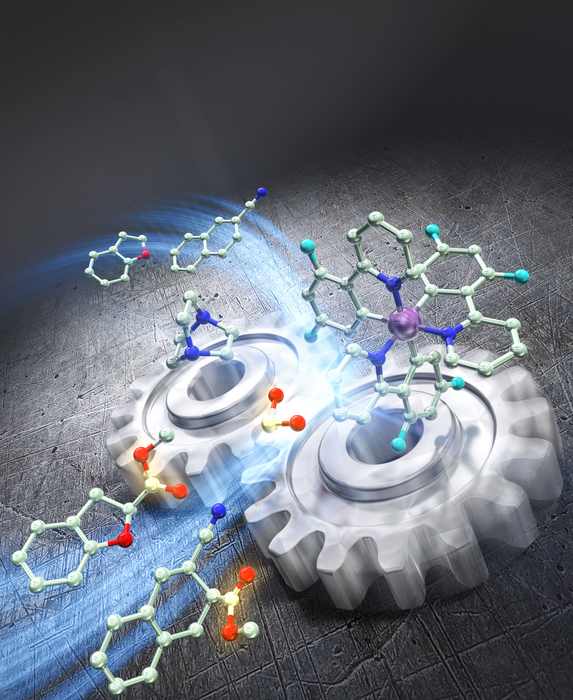
Blue light irradiation and two ‘catalyst gears’ cooperating to enable a reaction

Credit: Tsuyoshi Mita

Two catalysts working in tandem enable inexpensive formate salts to perform difficult dearomative reactions, giving products potentially useful for drug development.

Researchers at the Institute for Chemical Reaction Design and Discovery (WPI-ICReDD) have developed a method that uses cooperating catalysts to carry out challenging dearomative carboxylation reactions. In this process, highly reactive carbon dioxide (CO2) radical anions are derived from inexpensive formate salts and used to produce a variety of products, including α-amino acids, which are potentially useful in drug development. 

Aromatic systems are stable, so carrying out a dearomative reaction, where the aromatic system is disrupted, requires a highly reactive compound. In this study, a formate salt compound is used as the source of highly reactive CO2 radical anions. Researchers designed the reaction such that two separate catalysts, a photoredox catalyst and a hydrogen atom transfer catalyst, cooperate with each other. This cooperation, combined with exposure to blue light, generates highly reactive CO2 radical anions that can add themselves to an aromatic system, disrupting the aromatic system in the process.  

Previous research from this group that used electricity to drive a similar reaction provided inspiration for this study.

“Based on computations from a previous electrochemical reaction that we studied, we suspected a reaction mechanism using CO2 radical anions would be promising,” commented first author Saeesh Mangaonkar.  “This time, we came up with a photochemical approach which is environmentally friendly and suitable for commercially available aromatic compounds.”

In addition to standard all-carbon aromatic rings, this dearomative carboxylation reaction framework was shown to be successful for a wide variety of heteroaromatic rings, which feature an oxygen, nitrogen or sulfur atom in the ring instead of one of the carbon atoms. The resulting carboxylic acid derivatives have non-carbon atoms neighboring the acid part of the molecule, and this is an important structural feature. With additional steps, these types of compounds can be transformed into biologically active structures, making the process developed in this study a highly useful transformation. 

While the previous method adds two CO2 molecules to the substrate, this new method adds only a single CO2 molecule derived from formate salts. With these two complementary methods, chemists can now control whether they add one or two CO2 molecules, enabling greater freedom when designing and synthesizing molecules with carboxyl groups.

“We are hoping this process will prove useful in pharmaceutical development,” added Tsuyoshi Mita. “Creating efficient synthesis methods such as this one is important for working towards a sustainable society.”


Journal

ACS Catalysis

DOI

10.1021/acscatal.2c06192

Method of Research

Experimental study

Subject of Research

Not applicable

Article Title

Photoredox/HAT-catalyzed dearomative nucleophilic addition of the CO2 radical anion to (Hetero)aromatics

Article Publication Date

3-Feb-2023

Share12Tweet8Share2ShareShareShare2

Related Posts

Artificial Intelligence Transforms Material Synthesis Methods

Artificial Intelligence Transforms Material Synthesis Methods

July 10, 2026
Computer Chip Uses Vibrations for Memory Storage

Computer Chip Uses Vibrations for Memory Storage

July 10, 2026

Rapid Screening Advances Discovery of Nanocrystals

July 10, 2026

New Eco-Friendly Method Developed for Alcohol Oxidation

July 10, 2026

POPULAR NEWS

  • Detection of EDCs in Breast Milk and Infant Urine Up to Six Months Highlights Early Exposure Risks

    77 shares
    Share 31 Tweet 19
  • New Drug Candidate Developed at McMaster Shows Potential for Treating Brain Cancer

    58 shares
    Share 23 Tweet 15
  • KTU Researchers Explore Ultrasound’s Role in Enhancing Blood Flow Beyond Diagnostics

    53 shares
    Share 21 Tweet 13
  • 高齢者の骨粗鬆症治療の持続性比較

    51 shares
    Share 20 Tweet 13

About

We bring you the latest biotechnology news from best research centers and universities around the world. Check our website.

Follow us

Recent News

First Clinical Trial of Stem Cell Therapy for Huntington’s Disease Announced

Plant Viruses Boost AI, Machine Learning, and Nanotech in Biotechnology

Stem Cell Therapy Shows One-Year Survival in Retinitis Pigmentosa Patients

Subscribe to Blog via Email

Enter your email address to subscribe to this blog and receive notifications of new posts by email.

Join 84 other subscribers
  • Contact Us

Bioengineer.org © Copyright 2023 All Rights Reserved.

Welcome Back!

Login to your account below

Forgotten Password?

Retrieve your password

Please enter your username or email address to reset your password.

Log In
No Result
View All Result
  • Homepages
    • Home Page 1
    • Home Page 2
  • News
  • National
  • Business
  • Health
  • Lifestyle
  • Science

Bioengineer.org © Copyright 2023 All Rights Reserved.