• HOME
  • NEWS
  • EXPLORE
    • CAREER
      • Companies
      • Jobs
    • EVENTS
    • iGEM
      • News
      • Team
    • PHOTOS
    • VIDEO
    • WIKI
  • BLOG
  • COMMUNITY
    • FACEBOOK
    • INSTAGRAM
    • TWITTER
Wednesday, October 7, 2026
BIOENGINEER.ORG
No Result
View All Result
  • Login
  • HOME
  • NEWS
  • EXPLORE
    • CAREER
      • Companies
      • Jobs
        • Lecturer
        • PhD Studentship
        • Postdoc
        • Research Assistant
    • EVENTS
    • iGEM
      • News
      • Team
    • PHOTOS
    • VIDEO
    • WIKI
  • BLOG
  • COMMUNITY
    • FACEBOOK
    • INSTAGRAM
    • TWITTER
  • HOME
  • NEWS
  • EXPLORE
    • CAREER
      • Companies
      • Jobs
        • Lecturer
        • PhD Studentship
        • Postdoc
        • Research Assistant
    • EVENTS
    • iGEM
      • News
      • Team
    • PHOTOS
    • VIDEO
    • WIKI
  • BLOG
  • COMMUNITY
    • FACEBOOK
    • INSTAGRAM
    • TWITTER
No Result
View All Result
Bioengineer.org
No Result
View All Result
Home NEWS Science News Chemistry

Iso-propagation vortices: optical multiplexing for unprecedented information capacity

Bioengineer by Bioengineer
May 17, 2024
in Chemistry
Reading Time: 3 mins read
0
Iso-propagation vortices promise faster optical communication with enhanced resilience.
Share on FacebookShare on TwitterShare on LinkedinShare on RedditShare on Telegram

The future of optical communications just got brighter. In a groundbreaking development reported in Advanced Photonics, researchers from Nanjing University have introduced iso-propagation vortices (IPVs), a novel concept that offers a solution to a long-standing challenge faced by scientists and engineers: how to increase information processing capacity while overcoming the limitations of traditional vortex beams.
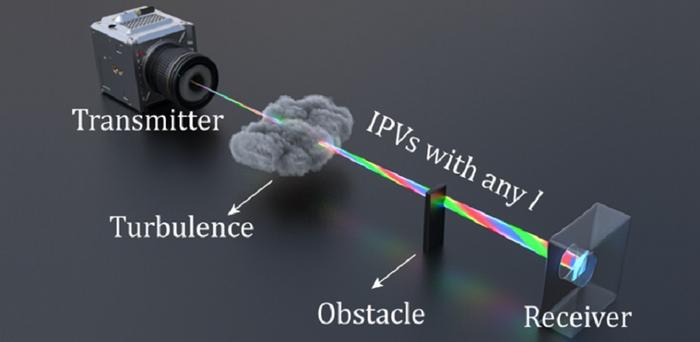
Iso-propagation vortices promise faster optical communication with enhanced resilience.

Credit: Yan et al., doi 10.1117/1.AP.6.3.036002.

The future of optical communications just got brighter. In a groundbreaking development reported in Advanced Photonics, researchers from Nanjing University have introduced iso-propagation vortices (IPVs), a novel concept that offers a solution to a long-standing challenge faced by scientists and engineers: how to increase information processing capacity while overcoming the limitations of traditional vortex beams.

Challenge: divergence and beam size

Multiplexing of optical degrees of freedom, such as polarization and wavelength, has been a staple in enhancing communication capacity. However, spatial mode-division multiplexing, which uses orthogonal spatial modes like orbital angular momentum (OAM) modes (also known as vortex beams), faces a significant hurdle. As these vortex beams propagate through free space, their beam size invariably diverges with OAM, posing constraints on capacity due to the need for larger receivers.

Enter IPVs

IPVs represent a paradigm shift. Unlike conventional vortex beams, IPVs exhibit OAM-independent propagation. In other words, their beam size remains consistent during free-space propagation, regardless of the OAM mode. This breakthrough opens exciting possibilities for spatial mode multiplexing communication, fiber optic data transmission, and even particle manipulation.

Key advantages of IPVs:

  • OAM-independent propagation: IPVs maintain a constant beam size, irrespective of the OAM mode. This feature allows for efficient utilization of spatial modes without requiring excessively large receivers.
  • Resilience to atmospheric turbulence: IPVs demonstrate enhanced transmission dynamics with reduced quality factors. Even under atmospheric turbulence, they remain robust, making them ideal for real-world applications.
  • Experimental capacity improvements: The research team conducted thorough comparisons between IPV multiplexing and existing optical schemes. The results were astounding, with capacity improvements ranging from 300 percent to an astonishing 808 percent.
     

Applications and future prospects

The impact of IPVs extends beyond communication. Imagine faster data transmission rates, more efficient particle manipulation in scientific experiments, and improved fiber optic networks. As we delve deeper into the potential of IPVs, industries ranging from telecommunications to scientific instrumentation stand to benefit significantly.

Dr. Jianping Ding, corresponding author and senior researcher, expressed optimism: “Iso-propagation vortices represent a leap forward in our quest for greater information capacity. We’re excited to explore their applications and collaborate with industry partners.”

Stay tuned for updates as IPVs revolutionizes optical communication.

For details, see the original Gold Open Access article by W. Yan et al., “Iso-propagation vortices with OAM-independent size and divergence toward future faster optical communications,” Adv. Photon. 6(3) 036002 (2024), doi 10.1117/1.AP.6.3.036002.


Journal

Advanced Photonics

DOI

10.1117/1.AP.6.3.036002

Article Title

Iso-propagation vortices with OAM-independent size and divergence toward future faster optical communications

Article Publication Date

17-May-2024

Share13Tweet8Share2ShareShareShare2

Related Posts

Scientists Discover an Umami Peptide from Sea Cucumber That Also Fights Inflammation in Cells

Scientists Discover an Umami Peptide from Sea Cucumber That Also Fights Inflammation in Cells

October 6, 2026
Cellulose-Based Sorbent Pulls Critical Metals from Organic Waste Streams in Minutes

Cellulose-Based Sorbent Pulls Critical Metals from Organic Waste Streams in Minutes

October 6, 2026

Magnetic Mesoporous Organosilica Catalyst Pulls Off Greener Suzuki Couplings in Water

October 6, 2026

Konjac and Carrageenan Team Up to Shield Beta-Carotene in Novel Emulsion Gels

October 6, 2026

POPULAR NEWS

  • Alloys That Shrink Their Own Grains: New PIX Mechanism Refines Metals With Heat Alone

    Alloys That Shrink Their Own Grains: New PIX Mechanism Refines Metals With Heat Alone

    29 shares
    Share 12 Tweet 7
  • Endurance Exercise Reshapes the Liver in Males and Females Through Distinct Molecular Routes

    29 shares
    Share 12 Tweet 7
  • Single Transcription Factor PU.1 Rapidly Converts Fibroblasts into Macrophage-Lineage Cells

    29 shares
    Share 12 Tweet 7
  • New Scale Measures How Ready Nurse Educators Really Are for the AI Era

    29 shares
    Share 12 Tweet 7

About

We bring you the latest biotechnology news from best research centers and universities around the world. Check our website.

Follow us

Recent News

Alloys That Shrink Their Own Grains: New PIX Mechanism Refines Metals With Heat Alone

Endurance Exercise Reshapes the Liver in Males and Females Through Distinct Molecular Routes

Single Transcription Factor PU.1 Rapidly Converts Fibroblasts into Macrophage-Lineage Cells

Subscribe to Blog via Email

Success! An email was just sent to confirm your subscription. Please find the email now and click 'Confirm' to start subscribing.

Join 85 other subscribers
  • Contact Us

Bioengineer.org © Copyright 2023 All Rights Reserved.

Welcome Back!

Login to your account below

Forgotten Password?

Retrieve your password

Please enter your username or email address to reset your password.

Log In
No Result
View All Result
  • Homepages
    • Home Page 1
    • Home Page 2
  • News
  • National
  • Business
  • Health
  • Lifestyle
  • Science

Bioengineer.org © Copyright 2023 All Rights Reserved.