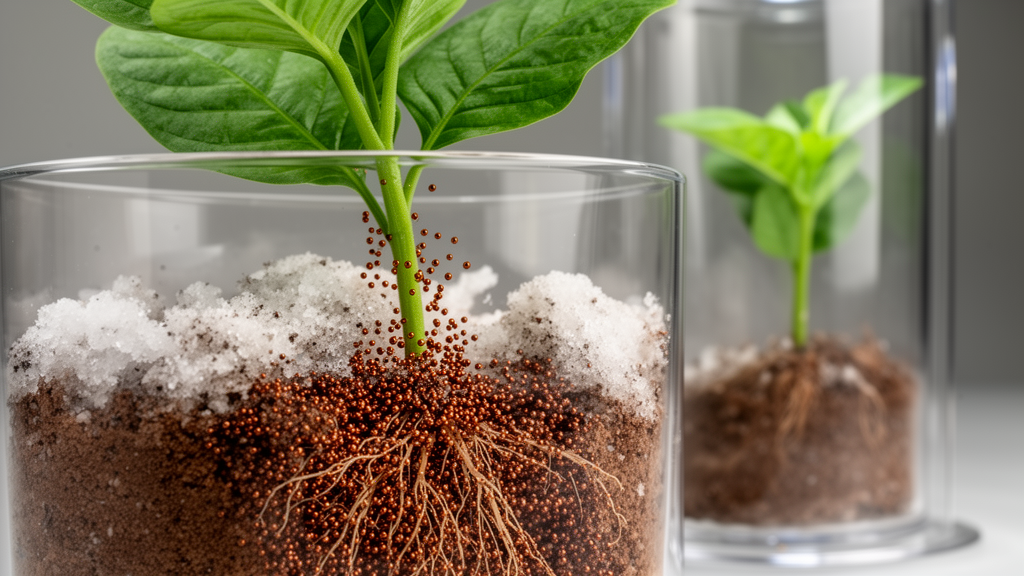
A greenhouse experiment found that applying 100 milligrams per liter of iron oxide nanoparticles substantially protected the medicinal plant Ziziphora clinopodioides from damage caused by 160 millimolar sodium chloride. Compared with untreated plants exposed to the same severe salinity level, nanoparticle-treated plants had 150% more shoot dry weight, 113% greater height, 29.6% higher relative water content and 37.8% more total chlorophyll. The treatment also improved potassium nutrition and sharply reduced the accumulation of sodium and indicators of oxidative stress, according to the peer-reviewed study published in BMC Plant Biology.
The researchers used a randomized complete block design with three replications to test four concentrations of iron oxide nanoparticles—0, 50, 100 and 150 milligrams per liter—alongside three levels of bulk ferric oxide—0, 100 and 150 milligrams per liter. Plants were grown under three sodium chloride concentrations: 0, 80 and 160 millimolar. The experiment assessed growth, relative water content, photosynthetic pigments, potassium and sodium concentrations, hydrogen peroxide, malondialdehyde, phenolic and flavonoid concentrations, phenylalanine ammonia-lyase activity, and essential oil production. It was designed to determine whether nanoscale and bulk forms of iron oxide could mitigate salinity stress and whether nanoparticles provided an advantage over conventional ferric oxide.
Salinity reduced plant performance across multiple measures. Under the severe treatment of 160 millimolar sodium chloride, shoot dry weight fell by 61.1%, plant height by 52.7%, relative water content by 27.9% and total chlorophyll by 37.3% relative to the corresponding nonsaline condition. At that salinity level, sodium accumulation increased by 181.6%, hydrogen peroxide by 129.6% and malondialdehyde by 747.1%. Potassium concentrations and the potassium-to-sodium ratio also declined, indicating both impaired water status and disruption of ionic balance. These are measurements from the experimental plants, and the study does not establish that the same responses would occur in field agriculture or in human consumers.
The most effective nanoparticle treatment was 100 milligrams per liter. Under severe salinity, it increased shoot dry weight from 3.36 to 8.40 grams and plant height from 5.32 to 11.34 centimeters. Relative water content rose from 59.87% to 77.58%, while total chlorophyll increased from 0.37 to 0.51 milligrams per gram fresh weight. Potassium content rose from 0.55 to 0.75 milligrams per gram dry weight, and the potassium-to-sodium ratio increased from 0.22 to 0.60. At the same time, sodium accumulation fell from 2.45 to 1.24 milligrams per gram dry weight. Hydrogen peroxide declined from 0.62 to 0.32 micromoles per gram fresh weight, and malondialdehyde fell from 4.32 to 1.22 nanomoles per gram fresh weight. Moderate nanoparticle and bulk ferric oxide treatments also increased total phenolics, flavonoids, phenylalanine ammonia-lyase activity and essential oil content.
Principal component analysis explained 91.72% of the total measured variation. Growth traits, photosynthetic pigments, secondary metabolites, potassium nutrition and ionic homeostasis were positively associated, whereas sodium, hydrogen peroxide and malondialdehyde were negatively associated with plant performance. The response was not unlimited: the highest nanoparticle concentration, 150 milligrams per liter, produced phytotoxic effects. The findings therefore identify 100 milligrams per liter as the strongest tested condition under this experimental setup rather than as a universally optimal dose. They further indicate that iron oxide nanoparticles alleviated measured salt-induced damage more effectively than bulk ferric oxide, although the experiment does not isolate the mechanism responsible or demonstrate improved crop yields at field scale. Because Z. clinopodioides is a medicinal plant, the results also raise the possibility of maintaining both plant productivity and the quantity of essential oils and other bioactive compounds under saline cultivation conditions, a use that requires further validation.
Subject of Research: Effects of iron oxide nanoparticles on salinity stress, ion homeostasis, growth and essential oils in Ziziphora clinopodioides
Article Title: Iron oxide nanoparticles mitigate salinity stress in Ziziphora clinopodioides by enhancing growth, ion homeostasis, and essential oil content
Article References: Mohammadi, H., Almahdawi, A. F. I., Sardoei, A. S., & Hatami, M. (2026). Iron oxide nanoparticles mitigate salinity stress in Ziziphora clinopodioides by enhancing growth, ion homeostasis, and essential oil content. BMC Plant Biology. https://doi.org/10.1186/s12870-026-09820-z
Image Credits: AI Generated
DOI: 10.1186/s12870-026-09820-z
Keywords: Ziziphora clinopodioides, iron oxide nanoparticles, salinity stress, plant growth, ion homeostasis, oxidative stress, photosynthetic pigments, essential oils, secondary metabolites, nano-fertilization, Iron, oxide
News Source: Alan Morgan. (October 26, 2026). Iron oxide nanoparticles ease salinity damage in a medicinal plant. Scienmag.