Solar photovoltaic systems have become one of the fastest-growing renewable energy technologies, deployed everywhere from utility-scale plants to residential rooftops. Yet their long-term performance is constantly threatened by environmental variability, component deterioration, power-electronic failures and aging effects. A new open-access study published in Discover Electronics on 26 October 2026 proposes a framework that combines low-cost Internet of Things hardware with machine learning to detect developing faults in solar panels before they force a system offline.
The research, authored by Aditi Chatterjee and Nabadeep Patra, addresses a well-known weakness of conventional photovoltaic maintenance. Routine manual inspections are time-consuming, labor-intensive and poorly suited to large or distributed solar farms, and they often fail to catch early-stage problems such as hotspots, soiling, wiring flaws and module degradation. Corrective maintenance, which acts only after a fault appears, adds further downtime and emergency repair costs, while human diagnostic judgments can be subjective and inconsistent.
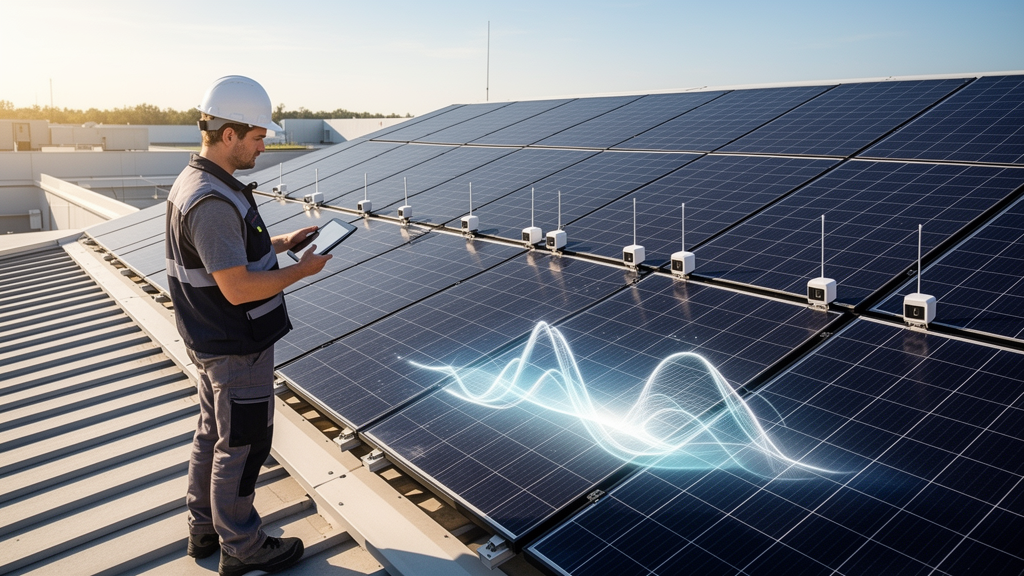
At the heart of the work is a hardware prototype for real-time solar data acquisition. Sensors deployed at the panel measure output voltage, output current and panel surface temperature, with a battery-side voltage sensor tracking terminal voltage to estimate state of charge and state of health, and a third voltage sensor monitoring the load side. A solar charge controller regulates charging, prevents overcharging, blocks reverse current flow at night and protects the battery bank, which operates at 12 volts DC. A buck converter steps this down to the regulated 5 volts required by an ESP32 microcontroller, its sensors and the communication module, while an automatic cut-off circuit guards the battery against deep discharge and overload.
Data leaves the transmitter station over LoRa, a long-range wireless technology that the authors note can transfer data across distances of 2 to 5 kilometers or more while consuming very little power. A second LoRa module at the remote monitoring station receives the packets and passes them to a receiver-side ESP32, which forwards the collected data through a Wi-Fi or internet connection to a cloud server. The team used the Blynk console cloud platform, whose dashboard can be viewed in real time from any internet-connected smartphone, laptop or desktop computer.
On the software side, the researchers assembled a training dataset of roughly 20 features, including temperature, irradiance, humidity, panel age, maintenance count, soiling ratio, voltage, current, module temperature, cloud coverage, wind speed, pressure, efficiency, derived interaction terms such as irradiance squared and an irradiance-temperature interaction, string identifiers and installation type. Raw data from photovoltaic panels and open-source repositories frequently contain noise, missing values and inconsistent measurements, so the team cleaned the data and scaled numeric features using min-max normalization and Z-score standardization to prevent variables of different magnitudes from biasing model training.
Four machine learning models were then implemented for the predictive maintenance task: linear regression, decision tree, random forest and XGBoost. The decision tree splits data at decision nodes using an information gain criterion but risks overfitting; the random forest averages many randomly generated trees to improve precision on large datasets; and XGBoost builds decision trees sequentially, correcting each tree’s errors, with built-in L1 and L2 regularization that makes it more resilient to overfitting than standard gradient boosting.
The study’s central contribution is a hybrid model that applies Bayesian optimization to XGBoost, using the Optuna framework for automatic hyperparameter tuning. XGBoost is highly sensitive to parameters such as learning rate, maximum tree depth, subsample ratio and number of estimators, and traditional tuning by grid search or random search can be computationally expensive and suboptimal. Bayesian optimization instead builds a probabilistic surrogate model of the objective function and uses an acquisition function to decide where to sample next, balancing exploration and exploitation. It converges to good settings faster than exhaustive search, and by optimizing regularization terms it helps the model avoid fitting sensor noise, which the authors argue supports better generalization to unseen test data in real-time monitoring.
In comparative simulations run in Python, the hybrid Bayesian-optimized XGBoost model outperformed the other models, achieving the highest R2 score of 0.98, indicating the highest accuracy among the tested models, along with minimized error values measured as root mean square error, mean absolute error and mean square error. It was also the fastest: the hybrid model computed in 0.32543 seconds, compared with 0.43479 seconds for the standard XGBoost model. The authors attribute this speed advantage to Bayesian optimization’s targeted search of the hyperparameter space rather than brute-force exploration of irrelevant combinations.
The researchers frame the combined system as a shift from reactive to predictive maintenance. In their analysis, reactive maintenance kicks in only after a significant drop in solar efficiency, producing long diagnostic and repair downtimes, energy lost during fault periods and costly emergency interventions. A predictive approach, by contrast, continuously monitors sensor data with machine learning models, detects anomalies early and schedules repairs before failure occurs, keeping assets running at their best condition. Once validated, the model’s predictions allow early detection of potential photovoltaic faults, and any detected anomaly is flagged on the dashboard or through an alert message.
The authors conclude that data-driven, IoT-enabled techniques are a promising option for predictive maintenance of solar panels compared with conventional operation and maintenance methods. The findings come with the usual caveats of an early-stage engineering study: the machine learning comparison was performed in simulation on the assembled dataset, and the hardware prototype demonstrates data acquisition, transmission and cloud monitoring rather than long-term field-deployed fault prediction. The datasets generated and analysed in the study are available from the corresponding author on reasonable request. Even so, the work illustrates how inexpensive sensors, low-power long-range radio and tuned ensemble learning could together form the backbone of smarter solar farm upkeep.
Subject of Research: Predictive maintenance of solar photovoltaic panels using IoT-based real-time monitoring and hybrid machine learning models
Article Title: Prognostic maintenance and smart monitoring of solar panel using IoT devices and hybrid machine learning models
Article References: Chatterjee, A., & Patra, N. (2026). Prognostic maintenance and smart monitoring of solar panel using IoT devices and hybrid machine learning models. Discover Electronics, 3(1), Article 152. https://doi.org/10.1007/s44291-026-00306-8
Image Credits: AI Generated
DOI: 10.1007/s44291-026-00306-8
Keywords: solar photovoltaics, predictive maintenance, Internet of Things, machine learning, XGBoost, Bayesian optimization, LoRa, ESP32, fault detection, renewable energy, cloud monitoring, sensor data
News Source: Teresa Odom. (October 27, 2026). IoT Sensors and Hybrid Machine Learning Model Predict Solar Panel Faults Before They Strike. Scienmag.