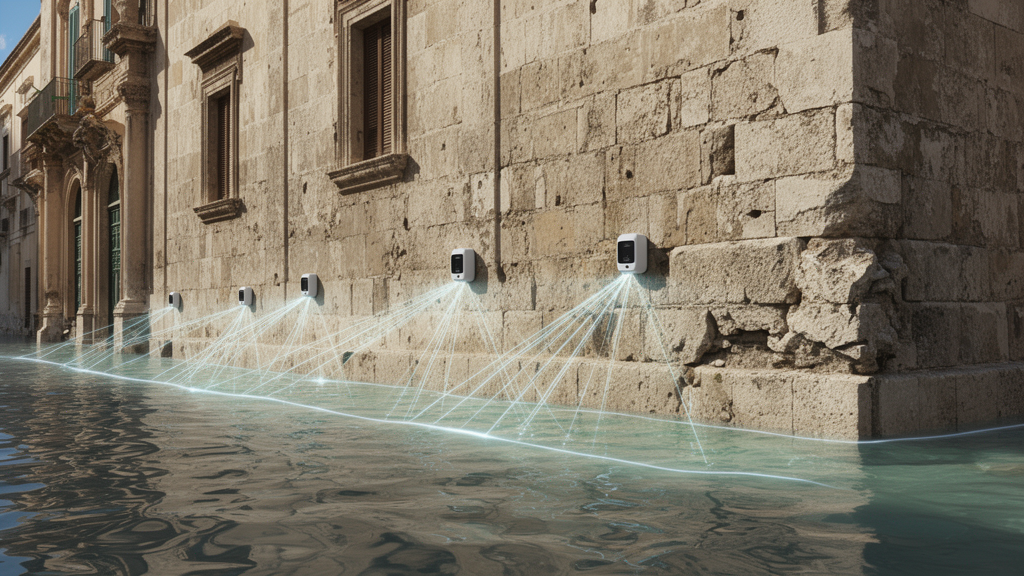
A newly proposed model utilizing IoT-based sensing and advanced fuzzy mathematical algorithms offers a more robust framework for evaluating urban structural flood damage. By integrating IoT-driven data with decision-making methodologies, researchers have developed an algorithmic approach to estimate structural harm in critical infrastructures, with a specific focus on urban flood management in Palermo, Italy. This research aims to address the persistent challenges of scalability, predictability, and data uncertainty often found in current damage assessment models.
Urban resilience currently requires smarter risk analytics to improve the identification and evaluation of flood-related structural damage. Current assessment models frequently fail to account for the changing, often unpredictable conditions that occur throughout and after significant flooding events. The integration of IoT sensing with fuzzy modeling is proposed as a sustainable, uncertainty-aware strategy to classify the severity of damage and monitor recovery processes, ultimately supporting faster and safer decision-making for city officials.
Central to this approach is the use of q-rung orthopair fuzzy Z numbers (q-ROFZNs). This mathematical construct provides a specialized method for analyzing structured datasets, which aids in deciphering the hidden complexities of decision-making under uncertainty. When combined with Aczél-Alsina aggregation operators, these tools allow for improved information fusion, which is critical for assessing damage in complex and unpredictable environments.
The study utilizes the LOPCOW methodology to assign weights to various criteria using logarithmic variation, paired with the EDAS (Evaluation based on Distance from Average Solution) method for ranking potential solutions. The researchers applied this IoT-driven LOPCOW-EDAS algorithm to analyze structural flood damage in Palermo. By identifying practical and sustainable interventions, the model aims to bolster resilience against environmental hazards.
Testing of this algorithm indicates a degree of sensitivity regarding resilience when comparing different mathematical operators and conducting comparative assessments. The implementation of this framework aligns with Sustainable Development Goal 11, which focuses on making cities and human settlements inclusive, safe, and resilient, as well as Sustainable Development Goal 13, which relates to urgent climate action. By refining the accuracy of damage estimation, the model provides a foundation for more effective urban management.
While this research highlights the potential for smarter risk analytics, the authors note that the integration of such models requires careful management of data challenges. The proposed methodology provides a systematic way to handle uncertainty, offering an alternative to traditional, less scalable assessment techniques. Future applications will depend on the successful deployment of these algorithms across diverse urban settings to validate their efficiency and practical decision-making impact in broader climate scenarios.
Subject of Research: Computational urban risk analysis for flood damage estimation.
Article Title: IoT Driven Italy Evidence of Aczél-Alsina Operations Urban Structural Flood Damage Estimation Using q-Rung Orthopair Z-Number LOPCOW-EDAS Fusion Model
Article References: Kanwal, R. S., Qurashi, S. M., Kausar, N., & Salman, M. A. (2026). IoT Driven Italy Evidence of Aczél-Alsina Operations Urban Structural Flood Damage Estimation Using q-Rung Orthopair Z-Number LOPCOW-EDAS Fusion Model. International Journal of Computational Intelligence Systems. https://doi.org/10.1007/s44196-026-01697-y
Image Credits: AI Generated
DOI: 10.1007/s44196-026-01697-y
Keywords: Urban Resilience, Flood Damage Estimation, IoT Sensing, Fuzzy Modeling, Palermo, Risk Analytics, q-Rung Orthopair Z-Numbers, LOPCOW, EDAS, Aczél-Alsina, Sustainable Cities, Climate Action, Decision Making, Structural Engineering, Uncertainty Management
News Source: Violet Maxwell. (November 18, 2026). IoT Model Improves Urban Structural Flood Damage Estimation in Palermo. Scienmag.