• HOME
  • NEWS
  • EXPLORE
    • CAREER
      • Companies
      • Jobs
    • EVENTS
    • iGEM
      • News
      • Team
    • PHOTOS
    • VIDEO
    • WIKI
  • BLOG
  • COMMUNITY
    • FACEBOOK
    • INSTAGRAM
    • TWITTER
Sunday, May 10, 2026
BIOENGINEER.ORG
No Result
View All Result
  • Login
  • HOME
  • NEWS
  • EXPLORE
    • CAREER
      • Companies
      • Jobs
        • Lecturer
        • PhD Studentship
        • Postdoc
        • Research Assistant
    • EVENTS
    • iGEM
      • News
      • Team
    • PHOTOS
    • VIDEO
    • WIKI
  • BLOG
  • COMMUNITY
    • FACEBOOK
    • INSTAGRAM
    • TWITTER
  • HOME
  • NEWS
  • EXPLORE
    • CAREER
      • Companies
      • Jobs
        • Lecturer
        • PhD Studentship
        • Postdoc
        • Research Assistant
    • EVENTS
    • iGEM
      • News
      • Team
    • PHOTOS
    • VIDEO
    • WIKI
  • BLOG
  • COMMUNITY
    • FACEBOOK
    • INSTAGRAM
    • TWITTER
No Result
View All Result
Bioengineer.org
No Result
View All Result
Home NEWS Science News Chemistry

Ion and lipid transporters specialize for their niche

Bioengineer by Bioengineer
September 6, 2025
in Chemistry
Reading Time: 2 mins read
0
IMAGE
Share on FacebookShare on TwitterShare on LinkedinShare on RedditShare on Telegram

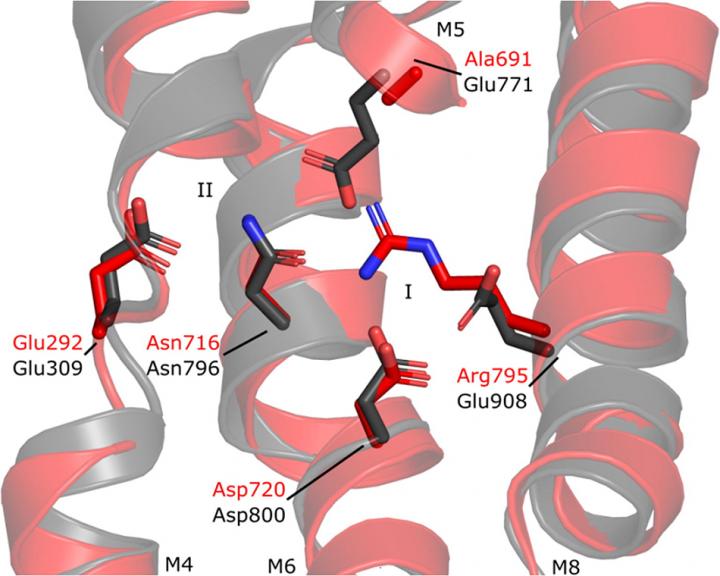
Many bacteria export intracellular calcium using active transporters homologous to the well-described mammalian Ca2+-ATPases such as plasma-membrane Ca2+-ATPase and sarco-endoplasmic reticulum Ca2+-ATPase (PMCA and SERCA, respectively). Crystal structures of Ca2+-ATPase 1 from Listeria monocytogenes (LMCA1) suggest that LMCA1 is pre-organized for dephosphorylation upon Ca2+ release, which can explain the rapid dephosphorylation observed earlier in single-molecule studies.

Also, variation in the architecture of the calcium binding sites explains why LMCA1 transports a single Ca2+ ion similar to PMCA, in contrast to two transported Ca2+ ions in SERCA. The LMCA1 structures provide insight into the evolutionary divergence and conserved features of this important class of ion transporters that also inform us on central mechanisms of mammalian Ca2+ -ATPases and how they can be regulated or affected by pathological conditions.

For the P4-ATPase study, researchers took a different perspective. The transport cycle of a P-type ATPase consist of two half-reactions. Phosphorylation where a phosphate is transferred from ATP to the transporter, and dephosphorylation, where the phosphate is again released. In contrast to ion transporters such as LMCA1, the P4-ATPases transport lipids and are known as lipid flippases. Importantly, the lipid transport is coupled to the dephosphorylation reaction of the cycle, where for ion transporting P-type ATPases it is mainly coupled to the phosphorylation reaction.

Through new structures determined by cryo-electron microscopy (cryo-EM) of a yeast lipid flippase, Drs2p/Cdc50p, it was investigated how the lipid flippases have diverged from ion transporters and have adapted the enzymatic mechanism for the “flipped” purpose. Cryo-EM was a critical technique for this study, and multiple structures of the transport cycle could be determined by locking Drs2p/Cdc50p using different inhibitors and electron microscopy data collected at the electron microscopy infrastructure facility at Aarhus University (EMBION).

The two studies have been spearheaded by PhD student Sara Basse Hansen and Postdoc Milena Timcenko – under the supervision of Professor Poul Nissen (and Sara also of Associate Professor Magnus Kjærgaard) – and are being published in Journal of Molecular Biology.

###

The results have been published in two articles in Journal of Molecular Biology:

The Crystal Structure of the Ca2+-ATPase 1 from Listeria monocytogenes reveals a Pump Primed for Dephosphorylation
Sara Basse Hansen, Mateusz Dyla, Caroline Neumann, Esben Meldgaard Hoegh Quistgaard, Jacob Lauwring Andersen, Magnus Kjaergaard & Poul Nissen

Structural basis of substrate-independent phosphorylation in a P4-ATPase lipid flippase: Milena Timcenko, Cédric Montigny, Thomas Boesen, Joseph A. Lyons, Guillaume Lenoir & Poul Nissen

Media Contact
Professor Poul Nissen
[email protected]

Original Source

https://mbg.au.dk/en/news-and-events/news-item/artikel/ion-and-lipid-transporters-specialize-for-their-niche/

Related Journal Article

http://dx.doi.org/10.1016/j.jmb.2021.167015

Tags: BiochemistryBiologyBiotechnologyCell BiologyGeneticsMicrobiologyMolecular Biology
Share12Tweet8Share2ShareShareShare2

Related Posts

Miniature Sensor Uses Light to Detect Touch — Chemistry

Miniature Sensor Uses Light to Detect Touch

May 8, 2026
Iron Minerals Determine Whether Dissolved Organic Matter Fuels Microbes or Becomes Long-Term Carbon Storage — Chemistry

Iron Minerals Determine Whether Dissolved Organic Matter Fuels Microbes or Becomes Long-Term Carbon Storage

May 8, 2026

Kate Evans Appointed Associate Lab Director for Biological and Environmental Systems Science at ORNL

May 8, 2026

Advancing Multiscale Modeling and Overcoming Operational Challenges in Autothermal CO₂-to-Methanol Reactors

May 8, 2026
Please login to join discussion

POPULAR NEWS

  • Research Indicates Potential Connection Between Prenatal Medication Exposure and Elevated Autism Risk

    840 shares
    Share 336 Tweet 210
  • New Study Reveals Plants Can Detect the Sound of Rain

    727 shares
    Share 290 Tweet 181
  • Scientists Investigate Possible Connection Between COVID-19 and Increased Lung Cancer Risk

    68 shares
    Share 27 Tweet 17
  • Salmonella Haem Blocks Macrophages, Boosts Infection

    61 shares
    Share 24 Tweet 15

About

We bring you the latest biotechnology news from best research centers and universities around the world. Check our website.

Follow us

Recent News

Evaluating Digoxin Use in Patients with Symptomatic Rheumatic Heart Disease

Evaluating the Effectiveness and Safety of Digitalis Glycosides in Treating Heart Failure

Urdu Fall Risk Questionnaire Adapted for Elderly

Subscribe to Blog via Email

Enter your email address to subscribe to this blog and receive notifications of new posts by email.

Join 82 other subscribers
  • Contact Us

Bioengineer.org © Copyright 2023 All Rights Reserved.

Welcome Back!

Login to your account below

Forgotten Password?

Retrieve your password

Please enter your username or email address to reset your password.

Log In
No Result
View All Result
  • Homepages
    • Home Page 1
    • Home Page 2
  • News
  • National
  • Business
  • Health
  • Lifestyle
  • Science

Bioengineer.org © Copyright 2023 All Rights Reserved.