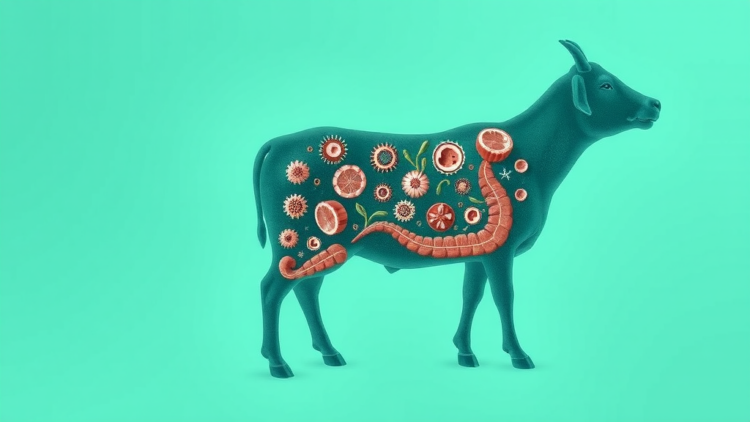
The path from pasture to plate has long been understood as a story of genetics, feed, and husbandry. But a comprehensive review published in Food Science of Animal Resources argues that one of the most powerful determinants of beef and lamb quality has been hiding in plain sight, or rather, out of sight entirely: the trillions of microbes inhabiting the ruminant gut. Yan Jia, Kai-li Liu, and Shu-cheng Huang systematically synthesize the evidence that the gut microbiota, often described as an invisible organ, exerts decisive control over meat color, tenderness, flavor, pH, and water-holding capacity, and that this control can be deliberately steered through targeted interventions ranging from probiotics to methane-suppressing enzyme inhibitors.
The ruminant gastrointestinal tract is not a single environment but a series of specialized fermentation chambers, each hosting distinct microbial communities. The rumen, the primary anaerobic fermenter, is dominated by three core phyla: Bacteroidetes, Firmicutes, and Proteobacteria. These organisms secrete cellulases and hemicellulases that dismantle crude fiber, generating volatile fatty acids, chiefly acetate, propionate, and butyrate, which together supply the majority of the animal’s energy. Propionate is funneled into gluconeogenesis to fuel muscle tissue, while acetate feeds lipid synthesis and butyrate powers epithelial metabolism. Rumen microbes also degrade feed proteins and rebuild them into microbial crude protein, which the host digests downstream as its principal source of amino acids for muscle growth.
Downstream compartments carry out complementary tasks. Bifidobacterium and Lactobacillus in the small intestine participate in protein and amino acid degradation, while Bacteroides and Clostridium in the large intestine finish the job of cellulose breakdown. Some strains synthesize B vitamins, including vitamin B12, which participates in fatty acid beta-oxidation and stimulates propionate production by the rumen bacterium Xylanibacter ruminicola. Crucially, microbial volatile fatty acids activate the G protein-coupled receptors GPR41 and GPR43 on intestinal epithelial cells, promoting tight junction proteins such as Claudin-1 and Occludin and dampening NF-kappaB signaling. A healthy, anti-inflammatory gut environment is thus the metabolic foundation upon which marbling and favorable fatty acid profiles are built.
Meat color, one of the first attributes a shopper judges, hinges on the content and oxidation state of myoglobin, whose synthesis depends on iron, copper, and zinc. The review describes how lactic acid bacteria and bifidobacteria lower intestinal pH, converting insoluble feed iron into absorbable forms, while certain microbes produce iron-scavenging carriers and modulate the host’s iron transporters DMT1 and FPN1. Oxidative stability matters just as much: in sheep, aflatoxin exposure disrupts the microbiota, depletes Clostridium butyricum, raises oxidative stress markers, and measurably reduces redness values. Conversely, gut bacteria that synthesize antioxidants such as vitamin E and glutathione correlate strongly with better color scores, a relationship reported with an R-squared of 0.68, and can extend the window of premium color by two to three days. Butyrate reinforces this defense by activating the Nrf2 pathway, upregulating endogenous antioxidant enzymes including superoxide dismutase and glutathione peroxidase.
Tenderness and juiciness trace back to intramuscular fat, muscle fiber composition, and water retention, all of which respond to microbial signaling. Butyrate activates the peroxisome proliferator-activated receptor gamma, or PPARgamma, pathway, steering adipocyte differentiation and boosting intramuscular fat deposition; sheep carrying more butyrate-producing bacteria show higher marbling. Water-holding capacity is likewise microbially influenced, with ruminal butyrate upregulating myosin expression in muscle cells, stabilizing cellular osmotic pressure, and reducing drip loss. On the flavor front, rumen anaerobes mediate biohydrogenation that governs fatty acid saturation, and greater anaerobic diversity enhances conjugated linoleic acid content, a functional fatty acid prized for both health properties and taste. Acetate upregulates acetyl-CoA carboxylase and fatty acid synthase to promote lipid synthesis, while propionate inhibits fatty acid synthase, trimming fat deposition in bovine muscle and subcutaneous adipocytes.
At the molecular level, short-chain fatty acids act as signaling molecules that reach skeletal muscle through the portal vein and peripheral circulation, binding GPR41 and GPR43 and triggering two core cascades: AMPK-PGC-1alpha and the PPAR family. Activated AMPK promotes fatty acid uptake and oxidation while curbing lipogenesis, and PGC-1alpha, the master regulator of mitochondrial biogenesis, drives the conversion of fast-twitch fibers toward oxidative, slow-twitch Type I fibers, which in turn improves color stability and water-holding capacity. PPARalpha promotes lipid oxidation, PPARgamma supports intramuscular fat and oxidative fiber formation, and PPARdelta, upregulated by butyrate, engages in reciprocal activation with AMPK, forming a positive feedback loop that balances fiber type and fat content, the twin determinants of tenderness, flavor, and nutritional value.
What elevates this review beyond mechanism is its catalog of practical interventions. Dietary strategy remains the first lever: grass-fed systems enrich fiber-degrading microbes such as Fibrobacter and the Christensenellaceae R-7 group, raising omega-3 polyunsaturated fatty acids, vitamin E, and antioxidants in leaner cuts, while grain-fed systems boost Prevotella and intramuscular fat, producing more tender, juicy meat at the cost of a higher saturated fat fraction. Phased feeding that combines both, keeping roughage above fifteen percent to avoid ruminal acidosis, has been shown to optimize outcomes; a concentrate-to-roughage ratio of 70:30 improved slaughter performance and tenderness in Tibetan sheep, whereas an 80:20 ratio increased drip loss. Plant-derived compounds add another layer, with pine nut essential oil reducing intestinal methane emissions and combined inhibitors suppressing methane production by up to 99.2 percent while increasing volatile fatty acid output.
Probiotics and enzyme inhibitors represent the precision end of the spectrum. Bacteroides distasonis F4, a novel strain isolated from calf rumen and validated by whole-genome sequencing, reshapes microbial community structure and elevates short-chain fatty acid production. Supplementation with Lactobacillus at one percent of the diet in Sunit sheep promoted muscle fiber type conversion via the AMPK pathway and improved meat quality. On the inhibitor side, researchers at the Chinese Academy of Agricultural Sciences used metagenomics to identify dominant urease genes in the bovine rumen, traced them to a novel genus within the Acinetobacteraceae family, and developed epiberberine, a plant-derived urease inhibitor that curbs ammonia waste and improves nitrogen use, lean meat yield, and flavor. Methanogenesis can be targeted directly through 2-bromoethanesulfonate, a specific inhibitor of methyl-coenzyme M reductase, which redirects hydrogen flux from methane toward propionate, raising feed conversion efficiency, muscle glycogen reserves, and intramuscular fat deposition.
Husbandry and stress management complete the picture. Exercise promotes propionate-producing Bacteroidetes and improves insulin sensitivity and dressing percentage, though excessive exertion can toughen meat, demanding carefully calibrated protocols. Transport and crowding stress destabilize the gut microbiota, driving abnormal muscle pH and water loss; shortening journeys and administering gamma-aminobutyric acid or probiotic complexes alleviates dysbiosis and preserves color and moisture. The authors also flag the field’s open problems: host-specificity complicates universal rules, multi-omics data integration and causal validation remain immature, and long-term safety assessments, probiotic stability, and precise delivery of metabolic modulators still constrain industrial adoption. Vigilance against antibiotic resistance and pathogen transfer is likewise essential.
The trajectory ahead is unmistakably interdisciplinary. Single-cell sequencing and spatial metabolomics promise to map microbe-to-muscle signaling with unprecedented resolution, while synthetic biology could engineer functional strains and structural biology could yield a new generation of natural inhibitors. Internet-of-Things platforms for dynamic microbial monitoring and precision feeding, combined with artificial intelligence-driven network analysis, point toward personalized interventions tailored to species, breed, and production environment. If the promise holds, the same microbes that ferment grass in the rumen could simultaneously deliver tastier steaks, leaner lambs, lower methane footprints, and more sustainable farms, a convergence of consumer pleasure and planetary benefit that few other levers in animal agriculture can claim.
Subject of Research: Mechanisms by which gut microbiota regulate meat quality in ruminants and microbiota-targeted intervention strategies
Article Title: Gut microbiota and meat quality in ruminants: a review of mechanisms and microbiota-targeted interventions
Article References: Jia, Y., Liu, K.-L., & Huang, S.-C. (2026). Gut microbiota and meat quality in ruminants: a review of mechanisms and microbiota-targeted interventions. Food Science of Animal Resources, 46(1), Article 79. https://doi.org/10.1007/s44463-026-00095-4
Image Credits: AI Generated
DOI: 10.1007/s44463-026-00095-4
Keywords: gut microbiota, ruminants, meat quality, short-chain fatty acids, intramuscular fat, probiotics, enzyme inhibitors, methane reduction, PPAR signaling, AMPK pathway, fatty acid metabolism, sustainable livestock
Cite Scienmag News
APA MLA Chicago
Morgan Morrow. (September 26, 2026). Invisible Organ, Visible Flavor: How Gut Microbes Shape the Quality of Beef and Lamb. Scienmag. https://scienmag.com/invisible-organ-visible-flavor-how-gut-microbes-shape-the-quality-of-beef-and-lamb/
Morgan Morrow. “Invisible Organ, Visible Flavor: How Gut Microbes Shape the Quality of Beef and Lamb.” Scienmag, 26 September 2026, https://scienmag.com/invisible-organ-visible-flavor-how-gut-microbes-shape-the-quality-of-beef-and-lamb/. Accessed 26 September 2026.
Morgan Morrow. “Invisible Organ, Visible Flavor: How Gut Microbes Shape the Quality of Beef and Lamb.” Scienmag. September 26, 2026. https://scienmag.com/invisible-organ-visible-flavor-how-gut-microbes-shape-the-quality-of-beef-and-lamb/
Copy citation Download RIS
Tags: AMPK pathwayenzyme inhibitorsfatty acid metabolismgut microbes and meat tendernessgut microbiotagut microbiota influence on meat qualityimpact of microbial communities on meat color and water-holding capacityintramuscular fatMeat Qualitymethane reductionmicrobial contributions to meat pH regulationmicrobial control of meat flavor developmentmicrobial fermentation in ruminantsmicrobiome diversity in ruminant digestive systemPPAR signalingprobioticsprobiotics and enzyme inhibitors in meat productionrole of volatile fatty acids in beef and lambruminantsshort-chain fatty acidsspecialized fermentation chambers in ruminantsstrategies for microbiota modulation to improve meat qualitysustainable livestock