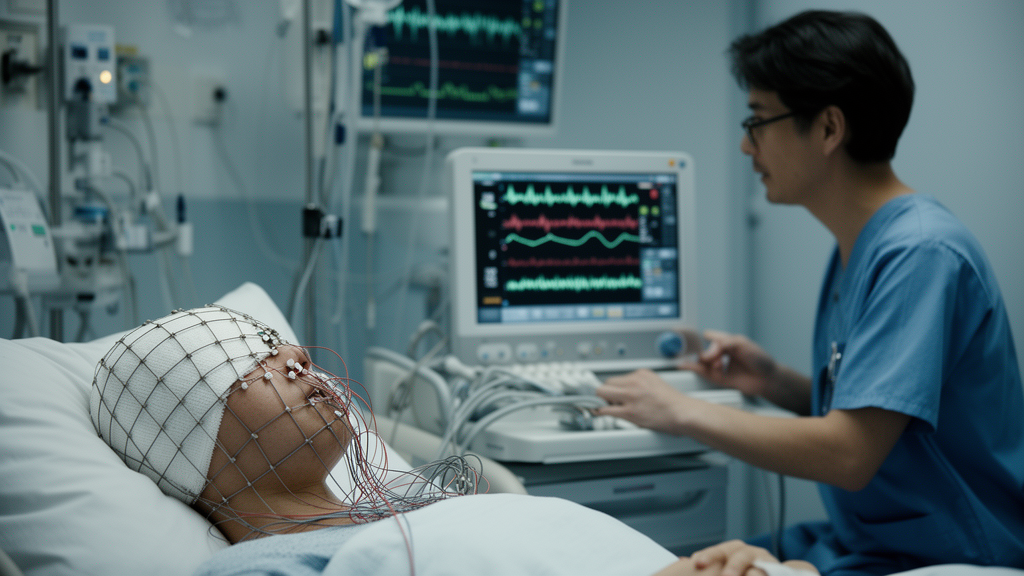
Invasive electroencephalography detects substantially more epileptic activity in patients with acute brain injury than standard surface EEG monitoring, according to a systematic review and meta-analysis published in Neurocritical Care. The finding suggests that electrodes placed directly on or within the brain could become a valuable adjunct to multimodal neuromonitoring in intensive care units.
Their analysis included twelve cohorts totaling 864 participants, comprising patients with aneurysmal subarachnoid hemorrhage (343), traumatic brain injury (351), and mixed etiologies (170). The monitoring techniques were based on strip or depth electrodes.
Whether this greater sensitivity translates into clinical benefit has remained uncertain, which motivated the systematic comparison.
The team harmonized epileptic patterns across studies using the American Clinical Neurophysiology Society Standardized EEG Nomenclature for Critically Ill Patients (ACNS) 2021 terminology, classifying events as seizures or status epilepticus (SZ/SE) and as rhythmic and periodic or ictal–interictal continuum patterns (RPP/IIC). Risk of bias was assessed with the Newcastle–Ottawa scale and custom bias domains, and random-effects meta-analyses were used for pooled proportions and for paired within-patient comparisons.
Pooled incidence rates showed clear differences between the two modalities. Intracranial EEG detected seizures or status epilepticus in 26 percent of patients versus 15 percent for surface EEG, rhythmic and periodic or ictal–interictal continuum patterns in 47 percent versus 34 percent, and clinically relevant epileptic activity in 57 percent versus 37 percent.
Six studies provided paired data in which both modalities were recorded in the same patients, covering 273 individuals. In this paired analysis, intracranial EEG additionally detected seizures or status epilepticus in 16.5 percent of patients and rhythmic and periodic or ictal–interictal continuum patterns in 26 percent of patients at times when surface EEG was negative. The pooled McNemar odds ratios were 3.46 for SZ/SE (95 percent CI 0.51–23.6; I² = 63 percent; p = 0.158) and 4.25 for RPP/IIC (95 percent CI 0.19–96.1; I² = 73 percent; p = 0.236). The authors note that the wide confidence intervals and nonsignificant p values reflect substantial heterogeneity and limited statistical precision across the paired studies, even though the direction of the effect consistently favored intracranial monitoring.
Sensitivity analyses restricted to high-risk studies or accounting for cohort overlap did not alter the results. On safety, no severe adverse events were reported across the included studies, an important consideration for a technique that requires invasive electrode placement in critically ill patients.
The authors conclude that invasive EEG monitoring substantially increased the detection of seizures and rhythmic and periodic patterns compared with surface EEG alone in patients with acute brain injury, and they describe the technique as a promising monitoring adjunct. Because the analysis is based on observational cohorts rather than randomized trials, the findings establish diagnostic yield rather than treatment benefit; whether earlier detection of epileptic activity through intracranial monitoring improves patient outcomes remains a question for future research.
The review also examined correlations with brain injury type and monitoring techniques as secondary objectives, though the headline result concerns detection rates and concordance with surface EEG. The work was published on 22 October 2026 and represents a collaborative effort among researchers including Mariella Segreti, Jeroen Gijs, Geert Meyfroidt, Bart Depreitere, Lauranne Scheldeman, and Tom Theys.
Subject of Research: Intracranial EEG versus surface EEG for detecting epileptic activity in adults with acute brain injury
Article Title: Intracranial EEG for Detecting Epileptic Activity in Acute Brain Injury: A Systematic Review and Meta-analysis
Article References: Smeijers, S., Segreti, M., Gijs, J., Meyfroidt, G., Depreitere, B., Scheldeman, L., & Theys, T. (2026). Intracranial EEG for Detecting Epileptic Activity in Acute Brain Injury: A Systematic Review and Meta-analysis. Neurocritical Care. https://doi.org/10.1007/s12028-026-02675-0
Image Credits: AI Generated
DOI: 10.1007/s12028-026-02675-0
Keywords: intracranial EEG, surface EEG, seizure detection, acute brain injury, subarachnoid hemorrhage, traumatic brain injury, status epilepticus, neuromonitoring, meta-analysis, neurocritical care, rhythmic and periodic patterns, ACNS terminology
News Source: Cassandra Pierce. (October 28, 2026). Intracranial EEG Spots Hidden Seizures in Acute Brain Injury, Meta-analysis Finds. Scienmag.