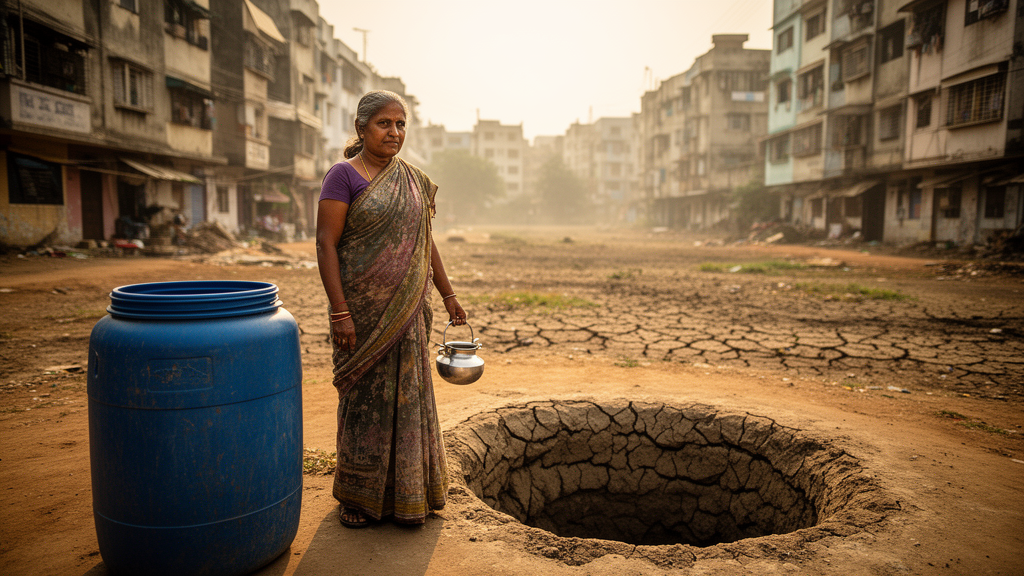
Bengaluru, a city of more than 10 million people that imports 1,450 million liters of water daily from a river roughly 100 kilometers away, is facing severe water stress that researchers say is rooted less in hydrology than in governance. A qualitative study published in Frontiers in Sustainable Cities examined the institutional and organizational barriers to effective water management in the Indian metropolis, and concluded that the crisis is sustained by four interconnected institutional failures: weak governance, siloed administrative processes, institutional inertia, and lock-in.
The research team, led by Shefali Nayak of HafenCity University in Hamburg with collaborators from several German institutions and WRI India, conducted 12 semi-structured interviews with 13 stakeholders between December 2024 and February 2025. The interviewees ranged from municipal decision-makers and engineers to academics, researchers, and government advisors, all with at least five years of professional experience in Bengaluru’s water governance system. The interviews were transcribed and thematically coded using MAXQDA software, with two authors independently coding the full corpus and resolving disagreements through discussion.
Weak governance emerged as the most pervasive theme in the analysis. Twelve of the 13 interviewees highlighted an inability to act on urban water governance mandates due to insufficient human, technical, and informational resources, with capacity deficits coded in 142 segments across 12 interviews. Participants described shortages of staff, gaps in technical expertise, and inadequate funding for data infrastructure. Regulatory frameworks exist on paper, but ten of twelve interview partners said their enforcement is inconsistent or entirely absent, leaving requirements largely aspirational. Interviewees also described reactive, ad hoc decision-making rather than long-term strategic planning, with one participant noting that corporate social responsibility funding tends to demand visible results within a year before moving on to the next project.
Siloed processes were reported by all 13 interviewees as a recurring structural problem. Water governance in Bengaluru is divided among agencies with separate mandates, budgets, reporting lines, and data systems, including the water utility, urban planning bodies, and municipal drainage authorities. Interviewees said there is rarely space for these actors to come together, and that looking beyond administrative boundaries to protect water sources is essential but systematically absent. Stormwater management exemplifies the fragmentation: government policy requires buffer zones alongside stormwater drains, but one interviewee noted these zones do not exist in practice because Bengaluru’s built-up areas have no space left for them. Value misalignment between operational staff and senior decision-makers was reported by 11 of 13 participants, meaning that business-as-usual persisted even when senior officials understood the need for change.
Institutional inertia, described by 11 of 13 interviewees, manifested most clearly in the neglect of operations, maintenance, and monitoring of infrastructure and technology. Interviewees pointed to low survival rates in small urban reforestation projects with no long-term tracking, and to decentralized wastewater reuse that happens only as improvised, building-level workarounds because mandated dual-plumbing systems are absent. Hierarchical decision-making structures, reported by eight of thirteen participants, concentrate decisions at senior levels and prevent frontline monitoring data from reaching relevant actors. The study’s authors connect this inertia to path dependency, noting that Bengaluru’s inertia may stem in part from the absence of a third tier of elected representatives, as municipal elections have not occurred since 2015.
Lock-in, the fourth theme, arises when previous decisions and established structures create path dependencies so robust that change becomes structurally or materially blocked, or achievable only at substantial expense. Interviewees reported that water tariffs stand at approximately seven rupees per thousand liters against an estimated true cost of ninety rupees. One interviewee illustrated the inequity: a household using 20,000 liters pays about 140 rupees monthly, while marginalized residents without formal connections pay roughly 250 rupees per kiloliter at private reverse-osmosis plants, meaning the poor pay a higher price than the rich in the name of subsidies.
The study situates these findings in Bengaluru’s dramatic urban transformation. Over the last 50 years, the built-up share of the city rose from approximately 8 percent in 1973 to 93.3 percent in 2023, while vegetation cover declined by an estimated 66 percent and 80 percent of the city’s 105 water bodies were encroached upon. More than 30 percent of water is lost through leakage and unauthorized consumption, with some estimates placing distribution losses at 40 to 50 percent. Twelve of thirteen interviewees framed pluvial flooding as primarily an infrastructure and planning failure rather than a hydrological inevitability or a consequence of climate change, pointing to new developments where roads and drains have not kept pace with construction.
Based on these findings, the authors propose water circularity, involving resource recovery, nature-based solutions, and treated wastewater reuse, as a framework for institutional reform rather than a ready-made solution. They argue it functions as a diagnostic lens that exposes unfulfilled institutional prerequisites: integrated mandates, enforceable standards, sustained financing, and inter-agency coordination. Rainwater harvesting mandates, for example, currently function as a one-time building-approval formality, with ten of thirteen interviewees reporting no institutional mechanism to ensure structures are maintained or actually used afterward. The authors suggest that reform strategies must address the political economy of urban water, including tariff reform and distributional equity, as a precondition for circularity rather than a co-benefit, and that funding from multilateral institutions should prioritize sustained infrastructural investment with institution-building over short-term pilot projects.
The researchers emphasize important limitations. As a single-case study with 13 key informants, the findings lack statistical generalizability and reflect the perceptions of professionals rather than direct measurement of institutional performance. The sample was dominated by researchers, consultants, and government advisors, and did not include informal sector workers, women’s groups, or residents of underserved peripheral wards, whose underrepresentation may have shaped the prominence of some challenges. The interviews also captured only a temporal snapshot taken soon after the completion of the fifth phase of the Cauvery water supply expansion, and the analysis was constrained by a pre-established codebook that could not surface themes outside its four predefined categories. The authors call for comparative studies across South Asian megacities such as Chennai, Dhaka, and Lahore, and for tracking how Bengaluru’s ongoing governance restructuring, including the transition from the BBMP to the Greater Bengaluru Authority, reshapes these institutional dynamics.
Within Bengaluru specifically, the study concludes that advancing circular water management may depend less on technical innovation than on infrastructural investment and organizational rebuilding capable of reshaping the feedback loop between weak governance and lock-in. The interviewees’ accounts, the authors write, point to institutional dynamics playing a significant role in the city’s water crisis alongside hydrological factors the study was not designed to assess, suggesting that the path toward a water-secure Bengaluru runs through governance reform as much as through pipes and treatment plants.
Subject of Research: Institutional and organizational barriers to sustainable urban water governance in Bengaluru, India
Article Title: Institutional dynamics of circular and climate-adaptive water governance in Bengaluru
Article References: Nayak, S., Döring, M., Bhattacharya, S., Ekmekcioglu, R., Knieling, J., & Poschlod, B. (2026). Institutional dynamics of circular and climate-adaptive water governance in Bengaluru. Frontiers in Sustainable Cities, 8, Article 1920960. https://doi.org/10.3389/frsc.2026.1920960
Image Credits: AI Generated
DOI: 10.3389/frsc.2026.1920960
Keywords: Bengaluru, urban water governance, water circularity, institutional inertia, lock-in, qualitative interviews, water scarcity, siloed processes, tariff reform, India, climate adaptation, Frontiers in Sustainable Cities
News Source: Denise Maddox. (October 28, 2026). Interviews reveal institutional failures behind Bengaluru’s water crisis. Scienmag.