• HOME
  • NEWS
  • EXPLORE
    • CAREER
      • Companies
      • Jobs
    • EVENTS
    • iGEM
      • News
      • Team
    • PHOTOS
    • VIDEO
    • WIKI
  • BLOG
  • COMMUNITY
    • FACEBOOK
    • INSTAGRAM
    • TWITTER
Monday, October 5, 2026
BIOENGINEER.ORG
No Result
View All Result
  • Login
  • HOME
  • NEWS
  • EXPLORE
    • CAREER
      • Companies
      • Jobs
        • Lecturer
        • PhD Studentship
        • Postdoc
        • Research Assistant
    • EVENTS
    • iGEM
      • News
      • Team
    • PHOTOS
    • VIDEO
    • WIKI
  • BLOG
  • COMMUNITY
    • FACEBOOK
    • INSTAGRAM
    • TWITTER
  • HOME
  • NEWS
  • EXPLORE
    • CAREER
      • Companies
      • Jobs
        • Lecturer
        • PhD Studentship
        • Postdoc
        • Research Assistant
    • EVENTS
    • iGEM
      • News
      • Team
    • PHOTOS
    • VIDEO
    • WIKI
  • BLOG
  • COMMUNITY
    • FACEBOOK
    • INSTAGRAM
    • TWITTER
No Result
View All Result
Bioengineer.org
No Result
View All Result
Home NEWS Science News Chemistry

Interfacial chemistry improves rechargeability of Zn batteries

Bioengineer by Bioengineer
December 18, 2019
in Chemistry
Reading Time: 2 mins read
0
IMAGE
Share on FacebookShare on TwitterShare on LinkedinShare on RedditShare on Telegram

IMAGE

Credit: ZHAO Jingwen, ZHAO Zhiming and QIU Huayu

With strong interest in environmentally benign and e?cient resource utilization, green and safe battery systems are in demand and improving rechargeability is a goal. Since the surface chemistry of the solid-electrolyte interphase (SEI) is a critical factor governing the cycling life of rechargeable batteries, it is a key research focus.

Zn batteries (ZBs) are characterized by low cost, superior volumetric energy output and cost-effective raw materials, making them a promising candidate to meet the demand for rechargeable batteries. However, some characteristics of the Zn-electrolyte interface restrict the development of rechargeable ZBs and their application.

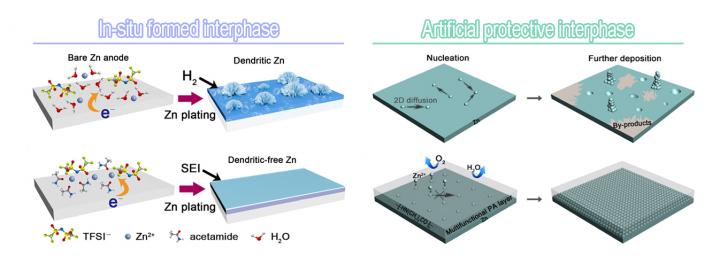
Prof. CUI Guanglei’s group from the Qingdao Institute of Bioenergy and Bioprocess Technology of the Chinese Academy of Sciences has proposed new concepts concerning in situ formed and artificial SEIs as a means of fundamentally modulating the electrochemical characteristics of Zn.

By manipulating the decomposition of a eutectic liquid with a peculiar anion-associated cation solvation structure, the researchers observed zinc ?uoride-rich organic/inorganic SEI on a Zn anode for the first time.

A combination of experimental and modeling investigations revealed that the presence of anion-complexing Zn species with markedly lowered decomposition energies contributed to the in-situ formation of the interphase.

“The protective interphase enables reversible and dendrite-free Zn plating/stripping even at high areal capacities. This is due to the fast ion migration coupled with high mechanical strength,” said Prof. CUI.

With this interfacial design, the assembled Zn batteries exhibited excellent cycling stability with negligible capacity loss at both low and high rates.

In addition, coating the Zn surface with an artificial protective polyamide layer is easy to implement. The polyamide layer has all the desirable characteristics for supporting highly reversible Zn chemistry with enhanced cycling performance of Zn anodes at neutral pH, even at a high depth of discharge.

The study offers new insights into the rational regulation of Zn anodes and provides an unprecedented avenue for tackling the dilemmas raised by the intrinsic properties of multivalent metal anodes.

###

The study was published in Nature Communications.

Media Contact
CHENG Jing
[email protected]

Original Source

http://english.cas.cn/

Related Journal Article

http://dx.doi.org/10.1038/s41467-019-13436-3

Tags: Chemistry/Physics/Materials SciencesEnergy/Fuel (non-petroleum)Materials
Share12Tweet8Share2ShareShareShare2

Related Posts

Aluminum Doping Supercharges Lithium Transport in Low-Temperature Argyrodite Electrolyte

Aluminum Doping Supercharges Lithium Transport in Low-Temperature Argyrodite Electrolyte

October 5, 2026
New Coumarin Compounds Show Powerful Multitarget Potential Against Skin Aging

New Coumarin Compounds Show Powerful Multitarget Potential Against Skin Aging

October 4, 2026

Frog Egg Byproduct Inspires Smart Food Wrap That Changes Color as Food Spoils

October 4, 2026

Solvent Polarity Steers Double Proton Transfer in a Promising OLED Fluorophore

October 4, 2026
Please login to join discussion

POPULAR NEWS

  • Alloys That Shrink Their Own Grains: New PIX Mechanism Refines Metals With Heat Alone

    Alloys That Shrink Their Own Grains: New PIX Mechanism Refines Metals With Heat Alone

    29 shares
    Share 12 Tweet 7
  • Endurance Exercise Reshapes the Liver in Males and Females Through Distinct Molecular Routes

    29 shares
    Share 12 Tweet 7
  • Single Transcription Factor PU.1 Rapidly Converts Fibroblasts into Macrophage-Lineage Cells

    29 shares
    Share 12 Tweet 7
  • New Scale Measures How Ready Nurse Educators Really Are for the AI Era

    29 shares
    Share 12 Tweet 7

About

We bring you the latest biotechnology news from best research centers and universities around the world. Check our website.

Follow us

Recent News

Alloys That Shrink Their Own Grains: New PIX Mechanism Refines Metals With Heat Alone

Endurance Exercise Reshapes the Liver in Males and Females Through Distinct Molecular Routes

Single Transcription Factor PU.1 Rapidly Converts Fibroblasts into Macrophage-Lineage Cells

Subscribe to Blog via Email

Success! An email was just sent to confirm your subscription. Please find the email now and click 'Confirm' to start subscribing.

Join 85 other subscribers
  • Contact Us

Bioengineer.org © Copyright 2023 All Rights Reserved.

Welcome Back!

Login to your account below

Forgotten Password?

Retrieve your password

Please enter your username or email address to reset your password.

Log In
No Result
View All Result
  • Homepages
    • Home Page 1
    • Home Page 2
  • News
  • National
  • Business
  • Health
  • Lifestyle
  • Science

Bioengineer.org © Copyright 2023 All Rights Reserved.