Fluid flow engineers and electrical engineers are jointly developing turbine blades with special integrated drives
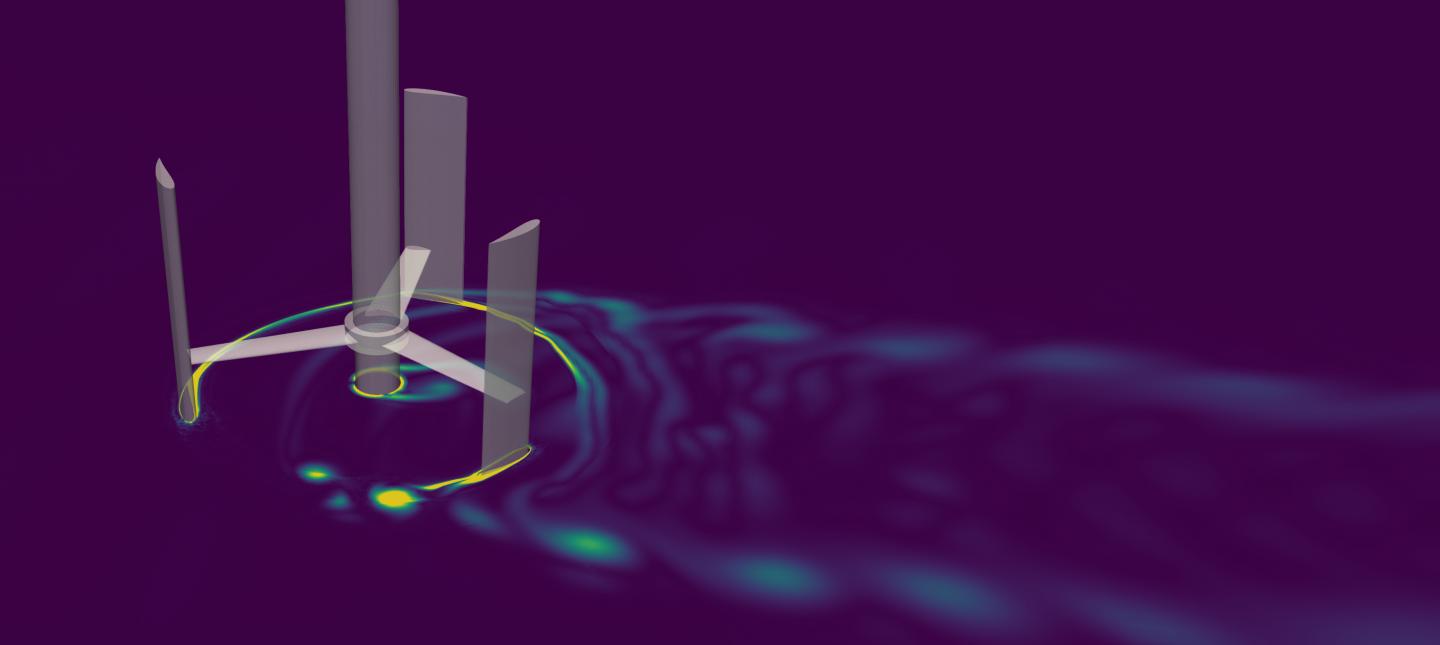
Credit: Stefan Hoerner
Tidal hydroelectric power plants of the future will be able to generate “green” electricity significantly more efficient by using optimized turbines. Engineers from the University Otto von Guericke of Magdeburg are developing turbine blades with built-in motors. These integrated drives ensure that during each revolution, the turbine blades adjust optimally to the water flow, and thus avoid the dangerous stall condition.
This term describes the separation of flow away from the surface of turbine blades, airplane wings or rotor blades. Stall means that lift forces that power the turbines or keep a plane in the air suddenly drop, while the drag forces increase dramatically. In turbines, this leads to a loss of efficiency, and over longer periods of time, to material failures and fatigue fractures in the turbine rotors.
“Until now, those stresses had to be compensated for with stronger components, using more or high-performance materials,” explains fluid engineer Dr. Stefan Hoerner from the Institute of Fluid Dynamics and Thermodynamics. “From the economical and ecological points of view, both are rather expensive. With the new technology, it should become possible to actively control the flow around the blades and as a result design turbines to be lighter, more durable and thus more efficient.”
Through the movement of the blades, the integrated drives are able to influence and optimize the flow in such a way that they achieve maximum efficiency with minimum strain. “This translates in higher electrical output, and at the same time the structure can be designed to be more slender. In turn this helps to save materials and to increase the lifespan of the turbines in sustainable tidal or run-of-river power plants.”
The specially-developed drives are being designed and integrated into the turbine blades by the interdisciplinary team led by Dr. Hoerner and Professor Roberto Leidhold from the Institute of Electrical Energy Systems in the university’s Faculty of Electrical Engineering and Information Technology. Dr. Hoerner explains that they will be integrated within the blade itself. “In fluid mechanics terms this is useful, as in this way they do not generate any additional drag. In the model that we intend to test in our flow channel, it will be an additional challenge to design the motors so that they are very small and yet still strong enough. At their thickest point the blades are only a little thicker than a centimeter.”
For this reason, the design and stability of the reduced-weight turbine model will be tested with computer simulations before the practical test takes place in the water channel.
“If this undesirable effect — blade stall — can be controlled and we are able to significantly increase the efficiency and lifespan of the turbines, we anticipate great interest in a broad industrial application of the technology in the pioneering industry of tidal energy,” explains Dr. Hoerner. “The ecosystems of the sea coasts and rivers are already very heavily exploited by man. For this reason, every additional square meter on which we build must be utilized as well, and at the same time as sustainably, as possible. This will help to combat climate change and to sustainably use a source of renewable energy — hydropower — that until now has only be used to a limited extent.”
Dr. Hoerner also states that until now, conventional hydropower has often not truly been sustainable, since dam systems have great potential for ecological and social harm, such as loss of biodiversity, injuries to fish, disruption of sediment transport, and land loss. “This is why we are working on an unconventional technology that functions more like a wind turbine and is therefore considerably more sustainable.”
A lab-scaled demonstrator of this unconventional turbine should be available and tested within the next three years. The German Research Foundation (DFG) is funding the research project, which is entitled “Improved performance and fatigue strength of vertical-axis water turbines through active blade adjustment”, to the tune of almost 700,000 euros.
###
Media Contact
Dr. Stefan Hoerner
[email protected]