• HOME
  • NEWS
  • EXPLORE
    • CAREER
      • Companies
      • Jobs
    • EVENTS
    • iGEM
      • News
      • Team
    • PHOTOS
    • VIDEO
    • WIKI
  • BLOG
  • COMMUNITY
    • FACEBOOK
    • INSTAGRAM
    • TWITTER
Saturday, May 16, 2026
BIOENGINEER.ORG
No Result
View All Result
  • Login
  • HOME
  • NEWS
  • EXPLORE
    • CAREER
      • Companies
      • Jobs
        • Lecturer
        • PhD Studentship
        • Postdoc
        • Research Assistant
    • EVENTS
    • iGEM
      • News
      • Team
    • PHOTOS
    • VIDEO
    • WIKI
  • BLOG
  • COMMUNITY
    • FACEBOOK
    • INSTAGRAM
    • TWITTER
  • HOME
  • NEWS
  • EXPLORE
    • CAREER
      • Companies
      • Jobs
        • Lecturer
        • PhD Studentship
        • Postdoc
        • Research Assistant
    • EVENTS
    • iGEM
      • News
      • Team
    • PHOTOS
    • VIDEO
    • WIKI
  • BLOG
  • COMMUNITY
    • FACEBOOK
    • INSTAGRAM
    • TWITTER
No Result
View All Result
Bioengineer.org
No Result
View All Result
Home NEWS Science News Chemistry

Integrating nanomaterial with light-absorbing molecule powers hydrogen production from water and sun

Bioengineer by Bioengineer
June 8, 2020
in Chemistry
Reading Time: 3 mins read
0
IMAGE
Share on FacebookShare on TwitterShare on LinkedinShare on RedditShare on Telegram

IMAGE

Credit: Tokyo Tech

In line with the depletion of fossil fuels and the environmental problems our planet faces due to their combustion, developing technology for clean energy generation is a topic of global interest. Among the various methods proposed to generate clean energy, photocatalytic water splitting is showing much promise. This method utilizes solar energy to split water (H2O) molecules and obtain dihydrogen (H2). The H2 can then be used as a carbon-free fuel or as raw material in the production of many important chemicals.

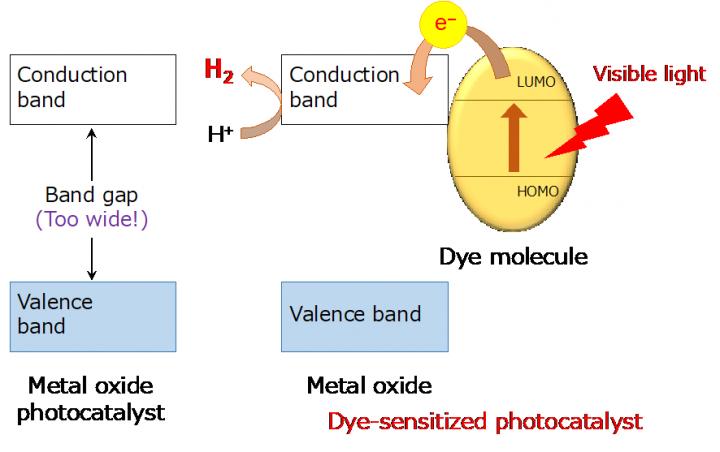
Now, a research team led by Kazuhiko Maeda at Tokyo Tech has developed a new photocatalyst consisting of nanoscale metal oxide sheets and a ruthenium dye molecule, which works according to a mechanism similar to dye-sensitized solar cells. While metal oxides that are photocatalytically active for overall water splitting into H2 and O2 have wide band gaps, dye-sensitized oxides can utilize visible light, the main component of sunlight (Figure 1). The new photocatalyst is capable of generating H2 from water with a turnover frequency of 1960 per hour and an external quantum yield of 2.4%.

These results are the highest recorded for dye-sensitized photocatalysts under visible light, bringing Maeda’s team a step closer to the goal of artificial photosynthesis — replicating the natural process of using water and sunlight to sustainably produce energy.

The new material, reported in Journal of the American Chemical Society, is constructed from high-surface-area calcium niobate nanosheets (HCa2Nb3O10) intercalated with platinum (Pt) nanoclusters as H2-evolving sites. However, the platinum-modified nanosheets do not work alone, as they do not absorb sunlight efficiently. So a visible light-absorbing ruthenium dye molecule is combined with the nanosheet, enabling solar-driven H2 evolution (Figure 2).

What makes the material efficient is the use of nanosheets, which can be obtained by chemical exfoliation of lamellar HCa2Nb3O10. The high-surface-area and structural flexibility of the nanosheets maximize dye-loadings and density of H2 evolution sites, which in turn improve H2 evolution efficiency. Also, to optimise performance, Maeda’s team modified the nanosheets with amorphous alumina, which plays an important role in improving electron transfer efficiency. “Unprecedentedly, the alumina modification for nanosheets promotes dye-regeneration during the reaction, without hindering electron injection from the excited-state dye to the nanosheet ¬– the primary step of dye-sensitized H2 evolution,” Maeda says.

“Until just recently, it was considered very difficult to achieve H2 evolution via overall water splitting under visible light using a dye-sensitized photocatalyst with high efficiency,” explains Maeda. “Our new result clearly demonstrates that this is indeed possible, using a carefully designed molecule-nanomaterial hybrid.”

More research still needs to be done, as it will be necessary to further optimize the design of the hybrid photocatalyst to improve the efficiency and long-term durability. Photocatalytic water splitting may be a crucial means of meeting society’s energy demands without further harming the environment, and studies like this one are essential stepping stones to reaching our goal of a greener future.

###

Media Contact
Kazuhide Hasegawa
[email protected]

Original Source

https://www.titech.ac.jp/english/news/2020/046934.html

Related Journal Article

http://dx.doi.org/10.1021/jacs.0c02053

Tags: Biomedical/Environmental/Chemical EngineeringChemistry/Physics/Materials SciencesEnergy/Fuel (non-petroleum)
Share12Tweet8Share2ShareShareShare2

Related Posts

New Drexel Study Reveals Key to Keeping Students on Track in Physics Learning — Chemistry

New Drexel Study Reveals Key to Keeping Students on Track in Physics Learning

May 15, 2026
Reversible Glue Technology Powers Up with Electric Activation — Chemistry

Reversible Glue Technology Powers Up with Electric Activation

May 15, 2026

Sweet as Honey: Unveiling a New Heat Transport Regime in Ultrathin Semiconductors

May 15, 2026

High-Precision Boltzmann Luminescent Nanothermometry Achieved Through Predictive Rules

May 15, 2026
Please login to join discussion

POPULAR NEWS

  • Research Indicates Potential Connection Between Prenatal Medication Exposure and Elevated Autism Risk

    843 shares
    Share 337 Tweet 211
  • New Study Reveals Plants Can Detect the Sound of Rain

    730 shares
    Share 291 Tweet 182
  • Salmonella Haem Blocks Macrophages, Boosts Infection

    62 shares
    Share 25 Tweet 16
  • Breastmilk Balances E. coli and Beneficial Bacteria in Infant Gut Microbiomes

    58 shares
    Share 23 Tweet 15

About

We bring you the latest biotechnology news from best research centers and universities around the world. Check our website.

Follow us

Recent News

New Kitasatospora Species and Synonym Proposed

Mental Health in Older Adults: Impact of Loneliness

Vertical Migration and Oceanography Shape Antarctic Krill Plastic Exposure

Subscribe to Blog via Email

Enter your email address to subscribe to this blog and receive notifications of new posts by email.

Join 82 other subscribers
  • Contact Us

Bioengineer.org © Copyright 2023 All Rights Reserved.

Welcome Back!

Login to your account below

Forgotten Password?

Retrieve your password

Please enter your username or email address to reset your password.

Log In
No Result
View All Result
  • Homepages
    • Home Page 1
    • Home Page 2
  • News
  • National
  • Business
  • Health
  • Lifestyle
  • Science

Bioengineer.org © Copyright 2023 All Rights Reserved.