Wearable electronics have expanded rapidly across personal physiological monitoring, motion tracking, and interactive haptic interfaces, yet commercial manufacturing continues to struggle with fundamental conflicts between rigid circuit hardware and pliable apparel textiles. Conventional electronic manufacturing relies on stiff printed circuit boards with soldered joints that frequently fracture under repeated mechanical bending, twisting, and stretching during daily wear. While flexible alternatives like conductive inks, flexible printed circuit boards, and conductive threads improve mechanical compliance, they introduce significant technical drawbacks, including elevated electrical resistance, signal attenuation, and degradation after laundering. More critically, permanently embedding conductive components directly inside fabric assemblies prevents modular upgrades, repairs, or component reuse, meaning an electrical fault in a single sensor routinely forces the disposal of an entire garment. Although detachable connection mechanisms like metallic garment snaps and conductive hook-and-loop fasteners have been evaluated in earlier research, they have historically lacked the physical durability and stable electrical conductivity required for dependable real-world performance.
To overcome these persistent production bottlenecks, researchers have introduced an integrated platform that synergistically unites modular physical hardware with a specialized design software pipeline. The production workflow addresses structural disconnects between conventional fashion pattern cutting and embedded circuit engineering by connecting two-dimensional flat pattern generation directly to three-dimensional ergonomic simulation. Historically, smart garment development has been fragmented into isolated engineering, textile design, and firmware programming silos, creating steep barriers for fashion designers and technical developers who lack specialized multi-disciplinary training. Earlier software initiatives, such as two-dimensional circuit arrangers with automated microcontroller script generation, could not account for three-dimensional body topography, curved wire routing, or computerized apparel fabrication equipment. Similarly, physical connector investigations often explored communication protocols or planar connector layouts without considering how complex body curvature influences garment fit, mechanical stability, and manufacturing scalability. The newly developed system resolves these gaps by establishing an end-to-end design environment that models circuit routing and module stability directly across curved three-dimensional garment geometries.
The physical hardware architecture relies on detachable functional modules secured by a magnetic pogo-pin interface designed to preserve stable electrical continuity through dynamic movement. Each modular connector incorporates a four-pin spring-loaded pogo-pin array with a 2.2-millimeter pitch, paired with neodymium magnets on both connector ends that generate more than 400 grams of holding force. This magnetic latching mechanism permits rapid attachment and detachment while maintaining steady electrical contact under active body motion. The internal electrical network utilizes a four-wire Inter-Integrated Circuit bus topology managed by a dedicated multiplexer, which allows multiple connected peripherals sharing identical digital communication addresses to operate seamlessly under a single master processor without spatial wiring congestion. The physical enclosure shells for both the modules and mating connectors feature smooth convex oval profiles designed to distribute mechanical pressure and prevent sharp edges from snagging on external clothing or creating localized discomfort against the skin. Individual module dimensions were measured at 40 by 75.4 by 15 millimeters, constrained by an internal off-the-shelf microcontroller board measuring 25.4 by 25.4 by 5.2 millimeters and an overall connector stack height of 13.63 millimeters.
Digital pattern pieces and three-dimensional apparel meshes exported from external modeling tools are imported into the environment, where users position hardware components onto flat textile patterns using standard drag-and-drop operations and route connecting traces using interactive line-drawing tools. To project these planar layouts accurately onto three-dimensional body surfaces in real time, the platform executes barycentric coordinate mapping. For any triangular surface mesh defined by vertices a, b, and c containing the center of a placed module on the two-dimensional pattern, the software calculates barycentric weighting coefficients to compute the corresponding spatial coordinates on the three-dimensional garment. The program subsequently interpolates the normal vectors of the mesh vertices to derive an exact surface normal vector for the module location, ensuring continuous spatial conformity between flat design representations and simulated garments.
Achieving realistic alignment on curved fabric surfaces requires the software to execute two sequential rotational transformations. The system first rotates the module about its local z-axis according to its planar rotation angle from the two-dimensional pattern space, preserving its relative orientation across the fabric cut. To verify physical attachment stability, the platform projects vertical lines from the outer perimeter edges of the module shell down to the garment surface, measuring the maximum vertical distance as an objective stability metric. If this measured gap exceeds a specified safety threshold, the software flags the placement site as unsuitable by highlighting the module in red. Furthermore, an integrated optimization function can automatically adjust an initial manual placement, systematically evaluating adjacent positions within a user-defined search radius at defined search step increments to minimize edge displacement.
Physical fabric manufacturing begins once the digital layout passes three-dimensional stability checks, producing machine-readable production data for digital textile printing and computerized embroidery. The software exports composite high-resolution graphic files that outline the complete pattern boundaries, exact connector positions, and connecting wire trajectories, which are printed directly onto 53-inch-wide yardage via digital textile printers. To embed electrical conductors securely into the cloth, the software creates specialized stitch data files based on Tailored Fiber Placement techniques. Because computerized embroidery machines operate within bounded mechanical working frames, the platform superimposes designated embroidery frame boundaries across the printed design to ensure accurate spatial alignment during automated stitching. Flexible electrical wires are temporarily positioned along the printed guides using adhesive tape and subsequently anchored to the textile substrate by computerized embroidery stitching, producing highly reproducible conductive paths that exhibit superior dimensional stability and aesthetic refinement compared to manual assembly.
To evaluate the platform’s stability optimization capabilities, the researchers conducted a controlled one-group pretest-posttest experiment comparing automated positioning against expert manual placement. The investigation utilized a standardized three-dimensional female avatar derived from the 8th Size Korea anthropometric dataset for adult females aged 25 to 29 years, featuring standardized chest, waist, and hip circumferences of 875 millimeters, 736 millimeters, and 941 millimeters. Digital clothing models comprising a raglan t-shirt and form-fitting leggings were fitted to the avatar. The testing matrix examined two distinct component dimensions, designated as small and large modules, distributed across five anatomical zones: waist, chest, wrist, thigh, and ankle. To mitigate experimental sequence bias, the testing order across anatomical positions was fully randomized. A digital garment design expert with over five years of professional experience manually positioned each module size five times per anatomical site to establish baseline pre-test values, after which the platform’s computational stability algorithm recalculated optimal module coordinates for post-test comparison.
The quantitative evaluation measured three distinct physical fit indicators: maximum gap distance, reflecting worst-case edge lift; average gap distance, representing overall surface fit; and gap uniformity, defined as the standard deviation of gap distances along the module perimeter to indicate contact evenness. In the baseline manual assessments, larger modules consistently exhibited higher initial maximum gap distances than smaller modules, particularly when placed on limb locations characterized by steep anatomical curvature such as the wrist and ankle. Across the experimental dataset, computational optimization achieved statistically significant reductions in placement instability for both small modules (p = .009) and large modules (p = .007). Absolute reductions across maximum gap, average gap, and gap uniformity were substantially greater for large modules than for small ones, demonstrating that the platform provides its greatest ergonomic benefit when resolving severe physical design constraints. Across the five anatomical sites, the wrist showed the smallest stability improvements for both module dimensions, an outcome attributed to high surface curvature restricting the availability of flatter adjacent relocation coordinates.
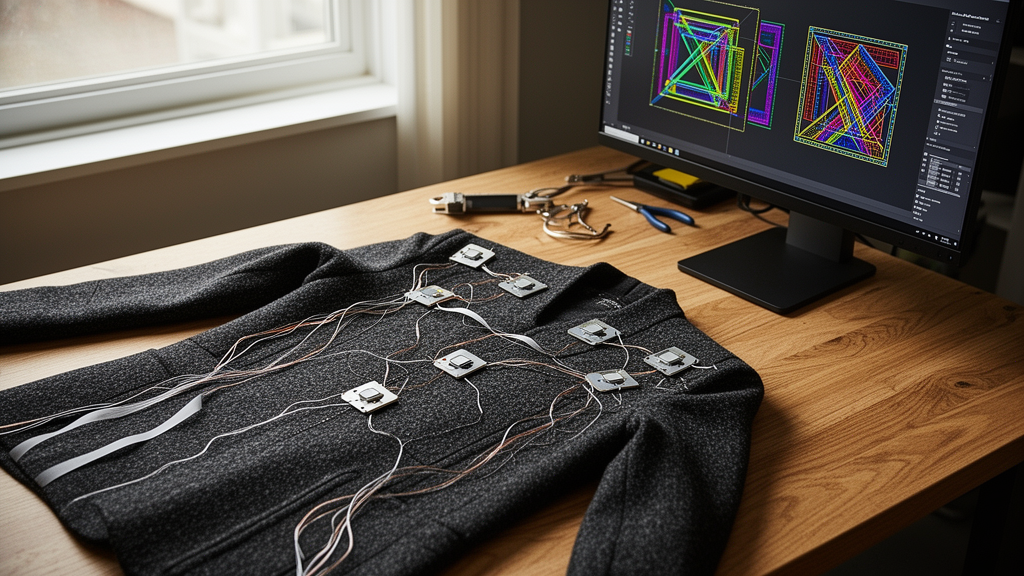
To confirm the practical manufacturability of the digital pipeline, the researchers fabricated a functional modular smart garment structured as a nine-piece zip-up outerwear jacket. Outerwear silhouettes of this type represent common commercial garment assemblies with multi-panel seams that traditionally complicate continuous electrical wiring. The physical prototype integrated ten discrete module connection points, an I2C multiplexer module, a main central processor, and an onboard battery. Anatomical attachment locations were positioned across the wrists, outer forearms where hardware does not restrict articulating joints, front and rear shoulder panels for postural tracking, and the lower front collar, which provides a relatively flat structural surface situated at an appropriate distance from the mouth for environmental air quality monitoring and acoustic voice reception.
Module enclosures and connector housings were digitally modeled using Blender and manufactured on an Ultimaker 7 fused-filament fabrication three-dimensional printer before being soldered to four-conductor wiring harness assemblies. The circuit paths were printed onto 53-inch fabric using digital textile printing and permanently fixed using a Brother PR-760e computerized embroidery machine. During physical testing of the completed jacket, the magnetic pogo-pin connectors demonstrated secure physical and electrical engagement, permitting modules to be detached with moderate pulling force while maintaining electrical continuity throughout dynamic body movements. Across more than twenty repeated attachment and detachment cycles, every module maintained proper functional operation without recording electrical connection interruptions, intermittent contact drops, or detectable signal degradation.
The researchers evaluated real-time data streaming and hardware reconfigurability using the lightweight MQTT messaging protocol paired with a Node-RED visual dashboard framework. Operating over a publish-subscribe communication architecture, the system routed module data through standardized hierarchical topics formatted as generalized strings before the Node-RED middleware remapped incoming data payloads to location-specific topic endpoints based on each device’s physical connection channel. When an operator issued the spoken command to read current posture, inertial measurement units mounted on both shoulders streamed real-time pitch, roll, and heading values to interface dashboard gauges. If measured shoulder tilt angles exceeded pre-programmed angular thresholds, the system immediately triggered the corresponding lateral haptic actuator while displaying a red alert indicator on the supervisory interface.
Subject of Research: Integrated design and manufacturing platform for modular smart garments
Article Title: Development of an integrated platform for modular smart garments
Article References: Ahn, J., Lee, Y., Park, S., & Kim, S. (2025). Development of an integrated platform for modular smart garments. Fashion and Textiles, 12(1), Article 39. https://doi.org/10.1186/s40691-025-00447-6
Image Credits: AI Generated
DOI: 10.1186/s40691-025-00447-6
Keywords: smart garments, wearable technology, modular electronics, computer-aided design, tailored fiber placement, ergonomic optimization, pogo pin connectors, digital textile printing, Development, integrated, platform, modular
News Source: Denise Maddox. (November 10, 2026). Integrated Design Platform Bridges Digital Garment Patterns With Modular Wearable Electronics. Scienmag.