• HOME
  • NEWS
  • EXPLORE
    • CAREER
      • Companies
      • Jobs
    • EVENTS
    • iGEM
      • News
      • Team
    • PHOTOS
    • VIDEO
    • WIKI
  • BLOG
  • COMMUNITY
    • FACEBOOK
    • INSTAGRAM
    • TWITTER
Monday, August 17, 2026
BIOENGINEER.ORG
No Result
View All Result
  • Login
  • HOME
  • NEWS
  • EXPLORE
    • CAREER
      • Companies
      • Jobs
        • Lecturer
        • PhD Studentship
        • Postdoc
        • Research Assistant
    • EVENTS
    • iGEM
      • News
      • Team
    • PHOTOS
    • VIDEO
    • WIKI
  • BLOG
  • COMMUNITY
    • FACEBOOK
    • INSTAGRAM
    • TWITTER
  • HOME
  • NEWS
  • EXPLORE
    • CAREER
      • Companies
      • Jobs
        • Lecturer
        • PhD Studentship
        • Postdoc
        • Research Assistant
    • EVENTS
    • iGEM
      • News
      • Team
    • PHOTOS
    • VIDEO
    • WIKI
  • BLOG
  • COMMUNITY
    • FACEBOOK
    • INSTAGRAM
    • TWITTER
No Result
View All Result
Bioengineer.org
No Result
View All Result
Home NEWS Science News Chemistry

Integrate micro chips for electronic skin

Bioengineer by Bioengineer
January 22, 2020
in Chemistry
Reading Time: 2 mins read
0
IMAGE
Share on FacebookShare on TwitterShare on LinkedinShare on RedditShare on Telegram

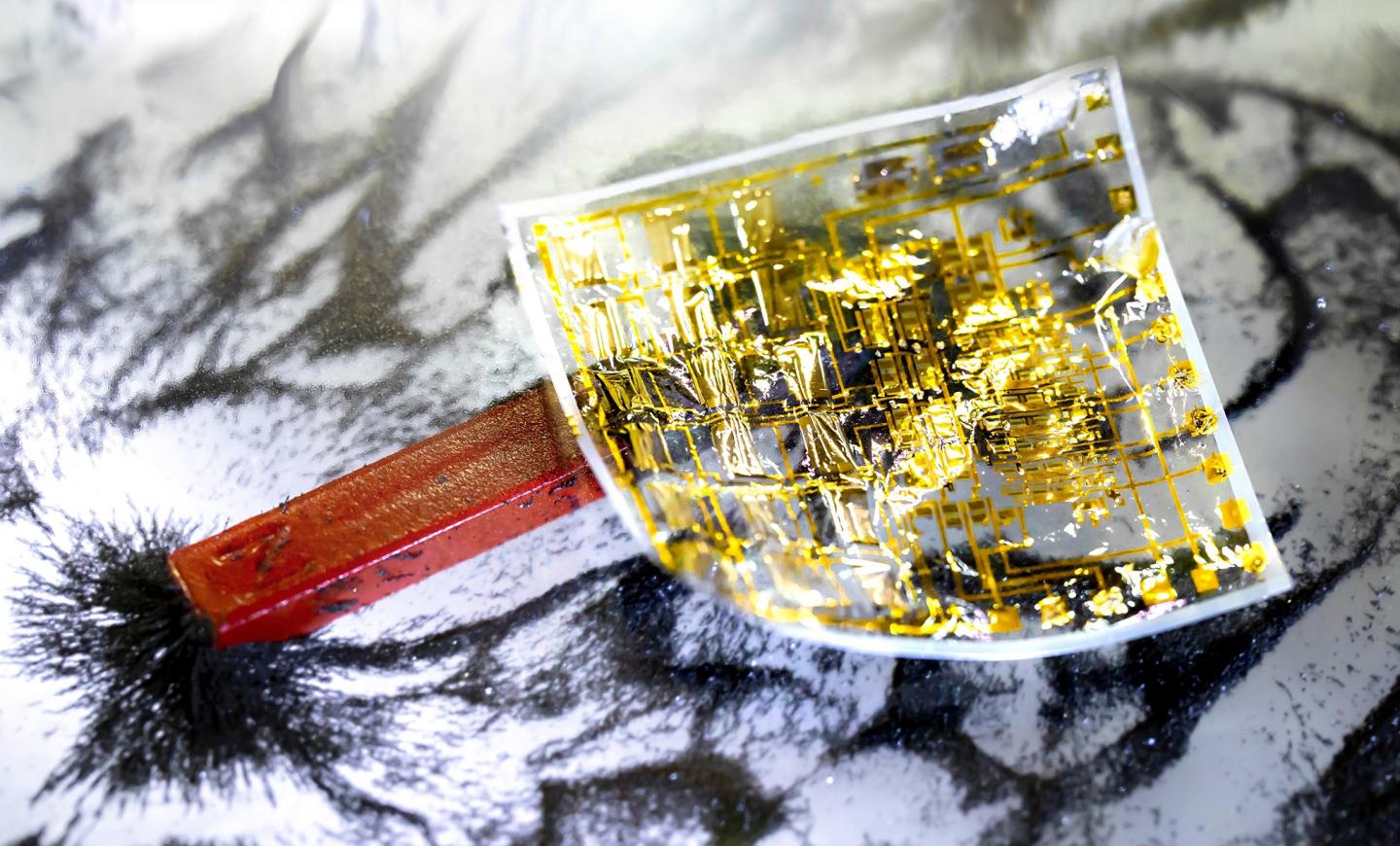
Researchers from Dresden and Osaka present the first fully integrated flexible electronics made of magnetic sensors and organic circuits which opens the path towards the development of electronic skin
IMAGE

Credit: Photo: Masaya Kondo

Human skin is a fascinating and multifunctional organ with unique properties originating from its flexible and compliant nature. It allows for interfacing with external physical environment through numerous receptors interconnected with the nervous system. Scientists have been trying to transfer these features to artificial skin for a long time, aiming at robotic applications. Operation of robotic systems heavily rely on electronic and magnetic field sensing functionalities required for positioning and orientation in space. A lot of research and development have been devoted into implementation of these functionalities in a flexible and compliant form. The recent advancements in flexible sensors and organic electronics provided important prerequisites. These devices can operate on soft and elastic surfaces, whereas sensors perceive various physical properties and transmit them via readout circuits.

To closely replicate natural skin, it is however necessary to interconnect a big number of individual sensors. This challenging task became a major obstacle in realizing electronic skin. First demonstrations were based on an array of individual sensors addressed separately, which unavoidably resulted into a tremendous number of electronic connections. In order to reduce the necessary wiring, an important technology step had to be done. Namely, complex electronic circuits, such as shift registers, amplifiers, current sources and switches must be combined with individual magnetic sensors to achieve fully integrated devices.

Researchers from Dresden, Chemnitz and Osaka could overcome this obstacle in a pioneering active matrix magnetic sensor system presented in a recent article of the journal Science Advances. The sensor system consists of a 2 x 4 array of magnetic sensors, an organic bootstrap shift register, required for controlling the sensor matrix, and organic signal amplifiers. The special feature is that all electronic components are based on organic thin-film transistors and are integrated within a single platform. The researchers demonstrate that the system has a high magnetic sensitivity and can acquire the two-dimensional magnetic field distribution in real time. It is also very robust against mechanical deformation, such as bending, creasing or kinking. In addition to full system integration, the use of organic bootstrap shift registers is a very important development step towards active matrix electronic skin for robotic and wearable applications.

Prof. Dr. Oliver G. Schmidt, Director at the Leibniz Institute for Solid State and Materials Research Dresden and Dr. Daniil Karnaushenko on the next steps: “Our first integrated magnetic functionalities prove that thin-film flexible magnetic sensors can be integrated within complex organic circuits. Ultra-compliant and flexible nature of these devices is indispensable feature for modern and future applications such as soft-robotics, implants and prosthetics. The next step is to increase the number of sensors per surface area as well as to expand the electronic skin to fit larger surfaces.”

###

Media Contact
Daniil Karnaushenko
[email protected]
49-351-465-9766

Related Journal Article

http://dx.doi.org/10.1126/sciadv.aay6094

Tags: Biomedical/Environmental/Chemical EngineeringBiotechnologyElectrical Engineering/ElectronicsNanotechnology/MicromachinesRobotry/Artificial IntelligenceTechnology/Engineering/Computer Science
Share12Tweet8Share2ShareShareShare2

Related Posts

Butterfly-Inspired Technology Could Transform Air Quality Monitoring

August 15, 2026
Artesunate Targets GBA, Triggering Apoptosis in Liver Cancer Cells

Artesunate Targets GBA, Triggering Apoptosis in Liver Cancer Cells

August 15, 2026

New molecule may enable cleaner, more efficient metal recovery

August 15, 2026

Controlled sulfidation enhances supercapacitor electrode performance

August 15, 2026
Please login to join discussion

POPULAR NEWS

  • KAIST develops semiconductor neuron that harnesses noise to selectively process signals

    29 shares
    Share 12 Tweet 7
  • Imagining natural and extra robotic thumbs together strengthens kinesthetic sensorimotor networks

    29 shares
    Share 12 Tweet 7
  • PARP1 Drives Neuropathic Pain Through GPX4-Dependent Ferroptosis in Injured Mice’s Sensory Neurons

    29 shares
    Share 12 Tweet 7
  • Strubbelig–NHL3 Receptor Complex Helps Arabidopsis Respond to Cellulose Deficiency

    29 shares
    Share 12 Tweet 7

About

We bring you the latest biotechnology news from best research centers and universities around the world. Check our website.

Follow us

Recent News

KAIST develops semiconductor neuron that harnesses noise to selectively process signals

Imagining natural and extra robotic thumbs together strengthens kinesthetic sensorimotor networks

PARP1 Drives Neuropathic Pain Through GPX4-Dependent Ferroptosis in Injured Mice’s Sensory Neurons

Subscribe to Blog via Email

Success! An email was just sent to confirm your subscription. Please find the email now and click 'Confirm' to start subscribing.

Join 85 other subscribers
  • Contact Us

Bioengineer.org © Copyright 2023 All Rights Reserved.

Welcome Back!

Login to your account below

Forgotten Password?

Retrieve your password

Please enter your username or email address to reset your password.

Log In
No Result
View All Result
  • Homepages
    • Home Page 1
    • Home Page 2
  • News
  • National
  • Business
  • Health
  • Lifestyle
  • Science

Bioengineer.org © Copyright 2023 All Rights Reserved.