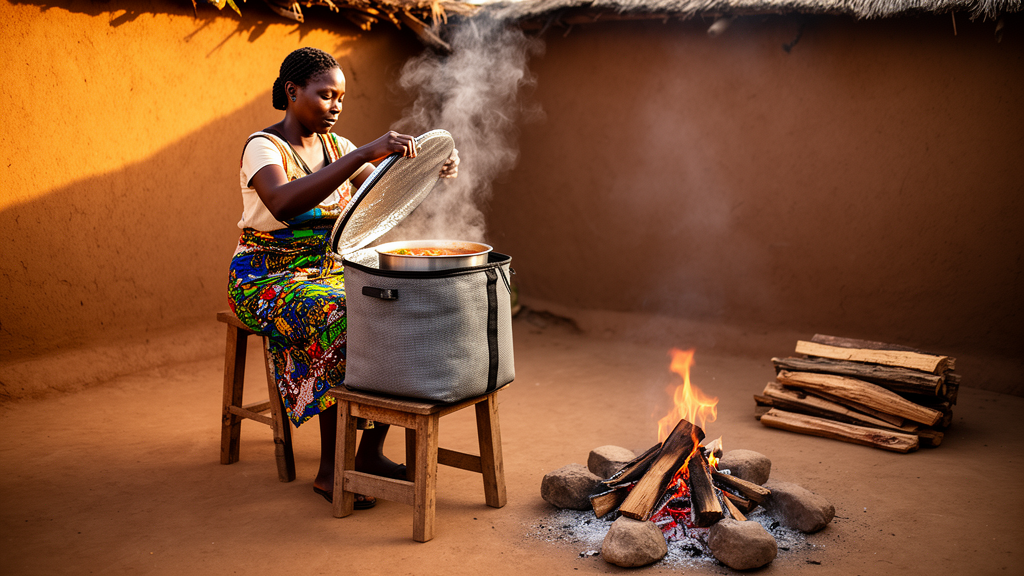
In seven firewood-dependent communities in Ghana’s Upper West Region, a simple insulated bag that lets food finish cooking off the fire cut firewood consumption by 46 percent and charcoal consumption by 35 percent per cooking session, according to an exploratory mixed-methods study published in Green Technology, Resilience, and Sustainability. The device, known locally as the Cooking Bag, is a passive heat-retention cooker sewn from durable cloth and padded with silt cotton harvested from the Kapok tree, a material whose insulating properties allow a pot brought to a rolling boil to continue cooking without any further fuel.
The research, led by Cornelius K. A. Pienaah with Daniel Amoak and Issah Baddianaah, was conducted in the Nadowli-Kaleo District, where roughly 98 percent of households rely on firewood and charcoal as their primary cooking fuels despite being connected to the national electricity grid. Electricity in these communities is used mainly for lighting, and liquefied petroleum gas is not readily available; the nearest access points lie in the district capital Nadowli and the regional capital Wa, making LPG impractical for most families because of distance and transport costs.
The experimental component involved controlled cooking tests carried out concurrently across all seven communities by trained data-collection teams. Researchers selected two staple foods, rice and cowpea, and replicated each cooking test three times per community, producing 42 trials in total. Each food was cooked two ways: with a traditional open-fire method using a three-stone fire for firewood or a metal stove for charcoal, and with the same method followed by transfer of the pot into the Cooking Bag once the food reached a full boil. Fuel was weighed with calibrated digital scales before cooking began and again immediately after the pot was removed from the fire, and a digital stopwatch recorded both active and passive cooking durations.
The results showed that cowpea cooked with firewood consumed 1.80 kilograms of fuel during the active phase, down from the 3.95 kilograms weighed out beforehand, with the remaining firewood weighing 2.15 kilograms when the pot entered the bag. The cowpeas finished cooking inside the bag after 48 minutes and 54 seconds, approximately 49 minutes, with no further energy input. In the charcoal trials, rice consumed 0.45 kilograms of charcoal, from an initial 1.30 kilograms down to 0.85 kilograms, and completed cooking in 27 minutes and 8 seconds. Statistical analysis in Stata 19 confirmed that both reductions were significant: for cowpea, t(40) = 21.02, p < 0.001, with a Cohen’s d of 4.94, and for rice, t(40) = 8.98, p < 0.001, with a Cohen’s d of 2.79. The reported figures represent averages across the repeated trials.
To estimate the climate benefit, the team applied the Tier 1 methodology from the 2006 IPCC Guidelines for National Greenhouse Gas Inventories, using default emission factors of 1.83 kilograms of CO2 per kilogram of dry firewood and 6.5 kilograms of CO2 per kilogram of charcoal, the latter including production and combustion emissions. The researchers then applied a conservative adjustment using a fraction of non-renewable biomass of 0.80, based on regional estimates for Ghana and sub-Saharan Africa, to avoid overestimating mitigation potential. The adjusted calculations yielded estimated savings of 2.63 kilograms of CO2 per firewood-based cooking session and 2.34 kilograms per charcoal-based session. The authors stress that these figures are indicative estimates derived from standardized emission factors rather than direct measurements of emissions.
The qualitative half of the study drew on 35 randomly selected households, five in each community, whose members had cooked with the bag under real-life conditions. Interviews, participant observations and live-use demonstrations were analyzed through manual thematic analysis following Braun and Clarke’s framework, with member checking and reflexivity built into the process. Time savings emerged as the most frequently reported benefit: about 86 percent of participants, 30 of 35, said the bag allowed them to step away from the fire and attend to other tasks, and 25 participants said they no longer had to monitor the fire constantly. One household member explained, “After putting the food in the Bag, I can go and fetch water or do other things,” while another said, “I can prepare other things for the family while the food is cooking itself.”
Perceptions of fuel savings tracked the measured results closely. According to the study, 85.7 percent of respondents, 30 of 35, reported reduced firewood usage, and 71.4 percent, 25 of 35, noted that their charcoal lasted longer. Twenty-five participants mentioned collecting firewood less often, and 20 said they saved firewood for use on other days. On the health side, 30 of 35 participants reported a substantial reduction in smoke exposure, 57.1 percent said the bag reduced the intensity of heat in the kitchen, and 42.9 percent observed that children could remain nearby without discomfort or coughing. Every one of the 35 participants said the device was easy to use, and 85.7 percent said it worked well for dishes such as rice and cowpea, requiring no special training, electricity, or changes to standard food preparation.
The economic analysis suggested the device pays for itself quickly. Assuming an average of 10 cooking sessions per week, the measured per-session savings translate into roughly 4.5 kilograms of charcoal or 18 kilograms of firewood saved weekly. At prevailing local prices of 4.00 Ghanaian cedi per kilogram of charcoal and 2.00 cedi per kilogram of firewood, that amounts to about 18.00 cedi per week for charcoal users and 36.00 cedi per week for firewood users. With a locally produced bag costing approximately 90 cedi to make, the estimated payback period is about five weeks for charcoal users and two and a half weeks for firewood users, though the authors caution that actual savings will vary with household size, cooking frequency and fuel prices. Willingness to adopt was high, with 85.7 percent of respondents saying they would use the bag if it were available for purchase, but 20 of 35 participants flagged affordability and local market availability as potential barriers.
The authors are candid about the study’s limits. The sample was small and localized, limiting generalizability, and the experimental trials covered only two staple foods, so the findings may not capture the full range of thermal loads found in rural kitchens. Data were recorded and analyzed in aggregated form, meaning variability across individual trials and inter-community differences could not be formally assessed. The emissions estimates rest on standardized IPCC factors rather than direct monitoring, and the face-to-face interviews, conducted immediately after use of a novel technology, may have invited social desirability bias, which the authors say cannot be ruled out. They also note that nutritional composition and taste were not directly measured, although retained heat cooking may support improved nutrient preservation and acceptable sensory outcomes, a question they flag for further investigation.
Despite these constraints, the study argues that the Cooking Bag offers a rare combination of measured fuel savings, estimated emission reductions, household-level economic relief and cultural fit, all at a production cost low enough for local artisans to replicate using materials and tailoring skills available in many rural communities. The authors recommend integrating the technology into Ghana’s national clean cooking and climate policies, supporting local production and distribution networks through training and women’s groups, introducing financing mechanisms such as microloans or subsidies to address affordability, and pursuing longitudinal studies and randomized impact evaluations to assess sustained use, durability and health outcomes over time. As the paper concludes, the bag’s alignment with existing cooking habits may be what sets it apart: households can prepare food the usual way, bring it to a boil as always, and then simply let the insulated bag finish the work.
Subject of Research: Evaluation of a passive heat-retention Cooking Bag for reducing biomass fuel use and CO2 emissions in rural Ghana
Article Title: Towards cleaner cooking: evaluating biomass savings, emissions reduction, and household perceptions of a passive Cooking Bag in Ghana
Article References: Pienaah, C. K. A., Amoak, D., & Baddianaah, I. (2026). Towards cleaner cooking: evaluating biomass savings, emissions reduction, and household perceptions of a passive Cooking Bag in Ghana. Green Technology, Resilience, and Sustainability, 6(1), Article 7. https://doi.org/10.1007/s44173-026-00032-0
Image Credits: AI Generated
DOI: 10.1007/s44173-026-00032-0
Keywords: Ghana, cooking bag, retained heat cooking, biomass fuel, firewood, charcoal, CO2 emissions, clean cooking, energy poverty, household perceptions, Nadowli-Kaleo District, IPCC emission factors
News Source: Denise Maddox. (October 29, 2026). Insulated Cooking Bag Cuts Firewood Use by 46 Percent in Rural Ghana. Scienmag.