


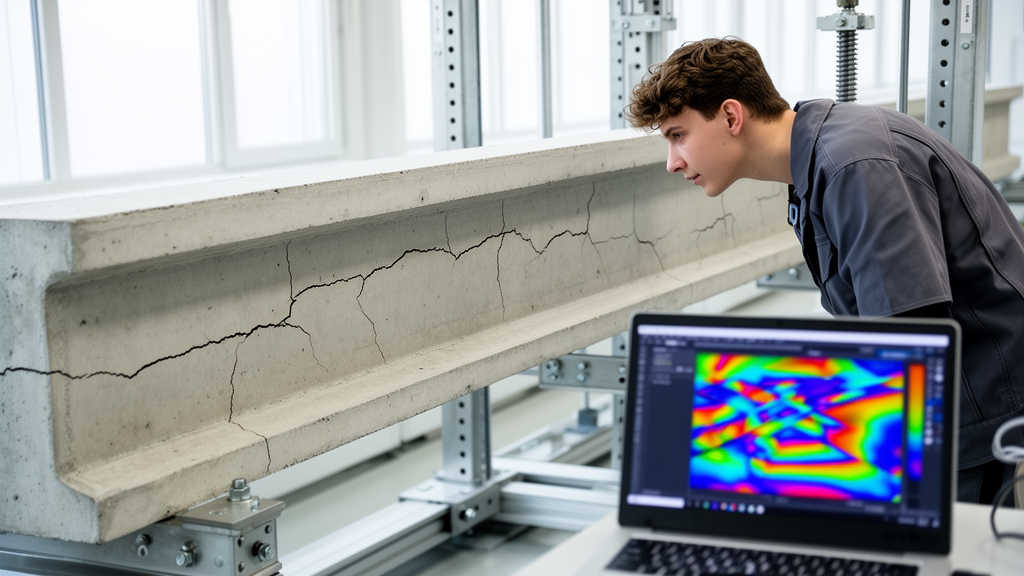
Machine learning models trained on experimental data can predict the spacing of primary cracks in reinforced concrete flexural members more accurately than widely used empirical design approaches, according to a new study published in Advanced Modeling and Simulation in Engineering Sciences. The research, led by Ahed Habib with colleagues including Maan Habib, M. Talha Junaid, Salah Altoubat, Mohamed Maalej and Ausamah A. L. Houri, evaluated eleven regression-based machine learning models combined with nine preprocessing strategies, and found that extremely randomized trees delivered the most consistent generalization performance on held-out data.
The study draws on a database of 96 rectangular reinforced concrete beam and slab sections that had been tested experimentally and previously compiled from the literature by Kaklauskas. From each record, the researchers extracted inputs describing member geometry, including height, section width, and top and bottom concrete cover; reinforcement content, expressed as the areas of tensile and compressive bars; and material properties, including the elastic moduli of concrete and steel, concrete compressive strength and concrete tensile strength. Member heights in the database range from 0.14 to 1.20 meters, section widths from 0.12 to 0.91 meters, and compressive strengths from 13.10 to 118.30 MPa, spanning both lightly and heavily reinforced members and a wide range of concrete classes.
Crack spacing matters for more than appearance. Because concrete cracks inevitably under load due to its brittle nature, controlling crack width and spacing is central to serviceability assessment, durability and the long-term safety of reinforced concrete structures. Primary crack spacing in flexural members influences structural performance and durability-related decision making, which is why design codes such as Eurocode 2 and the CEB-FIP Model Code include standardized empirical formulas for crack prediction and control. The authors note that most prior machine learning work in this area has focused on image-based crack detection or crack width prediction rather than estimating primary crack spacing directly from section geometry and material properties.
To address that gap, the team assembled a broad comparative framework. Five of the eleven models were linear regression-based approaches: multiple linear regression, ridge regression, lasso regression, ElasticNet and Bayesian ridge regression. The remaining six were tree-based ensemble methods: decision trees, random forests, extremely randomized trees, adaptive boosting, gradient boosting and extreme gradient boosting. Each model was paired with nine preprocessing strategies, including standardization, normalization, discretization, polynomial feature transformation, principal component analysis, kernel PCA, backward elimination, forward selection and the use of original untransformed data. A systematic grid-search hyperparameter optimization across these combinations produced approximately 3,500 trained model instances.
The dataset was split with 70 percent of observations used for training and 30 percent reserved for independent testing under a fixed random seed, and hyperparameter selection was carried out through internal k-fold cross-validation within the training subset so that choices were not driven by the held-out test set. Performance was assessed with three complementary metrics: the correlation coefficient R, the normalized root mean square error, and the normalized mean absolute error, the latter two normalized against the data range. The authors emphasize that because the database contains only 96 observations, the reported results should be read as reproducible fixed-split estimates rather than repeated-resampling statistics.
The standout performer was extremely randomized trees, an ensemble method that injects additional randomness into tree construction by selecting split points randomly rather than optimizing them with standard impurity-based criteria. Combined with original, standardized, normalized or forward-selection preprocessing, this model achieved testing correlation coefficients of up to 0.97, with normalized root mean square error as low as 5 percent and normalized mean absolute error as low as 4 percent, depending on the preprocessing route. The original and standardized versions of the model reached training R values of 0.98 and testing R values of 0.97, with corresponding error metrics of 3 and 5 percent for NRMSE and 2 and 4 percent for NMAE. Predicted-versus-measured plots showed the best models clustering tightly around the equality line, and residual analysis found their errors centered near zero with no systematic bias.
Not every combination fared well. Polynomial feature transformation paired with decision trees showed classic overfitting: strong training performance collapsed in testing, where the combination managed only an R of 0.6, a normalized root mean square error of 20 percent and a normalized mean absolute error of 12 percent. The authors point to this case as evidence that preprocessing choices can amplify model variance when data are limited. At the other end of the complexity spectrum, simpler models held their own in places: multiple linear regression and ridge regression maintained competitive testing error under certain preprocessing techniques, and the benchmarking analysis against a plain multiple linear regression baseline showed that complexity does not always guarantee better generalization.
The most consequential comparison pitted the best machine learning cases against established empirical approaches: Eurocode 2, the fib Model Code 2010, Reineck’s approach and the strain compliance method proposed by Ramanauskas. Within the parameter range represented in the database, the empirical code-based formulas of Eurocode 2, the fib Model Code and Reineck’s approach showed very poor agreement with the experimental crack spacing measurements. The strain compliance method performed considerably better than the other empirical approaches but still fell short of the machine learning models. The extremely randomized trees-based cases aligned most closely with the experimental measurements, outperforming both the simple linear baseline and all of the traditional empirical methodologies for the investigated dataset.
The authors are careful to frame the scope of these findings. The conclusions remain confined to the member types, testing conditions and parameter domains documented in the literature-based dataset, and predictions outside the summarized parameter ranges should be avoided. The study does not explicitly model time-dependent or environmental effects such as shrinkage evolution, sustained loading or exposure conditions, which can influence crack development in real structures. The fixed train-test split, rather than repeated or nested cross-validation, is another acknowledged limitation, and no explainable machine learning analysis was included because the best-performing preprocessing pathways transformed or reduced the original features in ways that complicate stable feature-attribution mapping. Future work, the authors write, should expand to larger multi-source crack-spacing databases, broader member configurations and reinforcement layouts, and stronger external validation.
Even with those caveats, the practical implications are tangible. Once trained, tree-ensemble models such as extremely randomized trees produce predictions with negligible computational effort per case, supporting rapid screening of design alternatives and assessment scenarios; the offline hyperparameter search for a dataset of this size is expected to complete within minutes to an hour on a typical modern workstation. The authors recommend the best-performing models as decision-support tools that complement rather than replace code-based checks, suitable for serviceability assessment, rapid screening of design alternatives and prioritization of inspection and maintenance decisions, until broader external validation on expanded databases becomes available.
Subject of Research: Machine learning prediction of primary crack spacing in flexural reinforced concrete components
Article Title: A comprehensive study on estimating the primary crack spacing of flexural reinforced concrete components using machine learning techniques
Article References: Habib, A., Habib, M., Junaid, M. T., Altoubat, S., Maalej, M., & Houri, A. A. L. (2026). A comprehensive study on estimating the primary crack spacing of flexural reinforced concrete components using machine learning techniques. Advanced Modeling and Simulation in Engineering Sciences, 13(1), Article 12. https://doi.org/10.1186/s40323-026-00330-z
Image Credits: AI Generated
DOI: 10.1186/s40323-026-00330-z
Keywords: reinforced concrete, crack spacing, machine learning, extremely randomized trees, Eurocode 2, serviceability, regression models, data preprocessing, structural engineering, hyperparameter tuning, flexural members, durability
News Source: Teresa Odom. (October 29, 2026). Machine Learning Outperforms Design Codes at Predicting Concrete Crack Spacing. Scienmag.



