


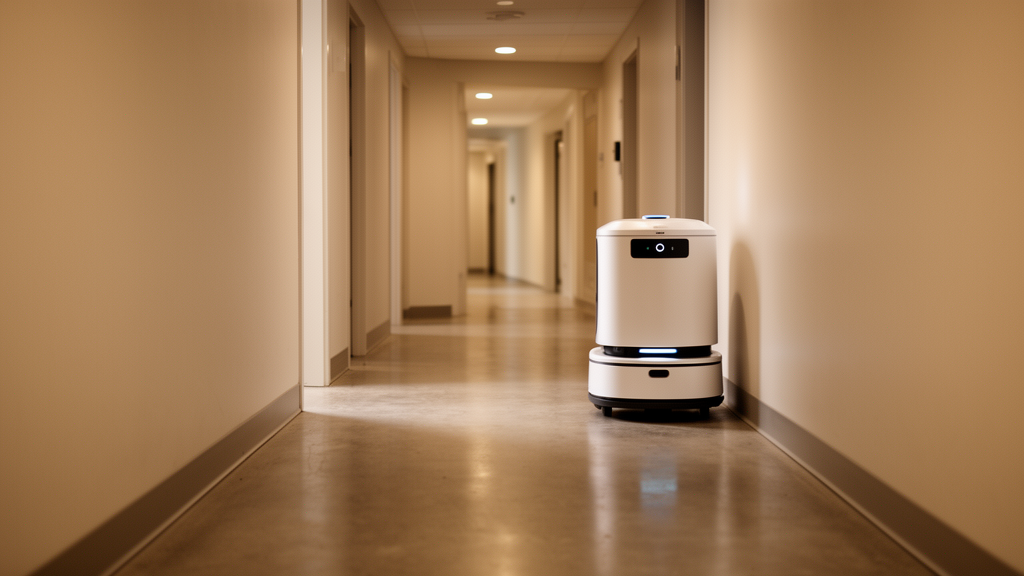
When a mobile robot glides down a corridor shared with people, the route it takes matters as much as how fast it moves. A new study from Keio University and Italy’s National Research Council reports that in corridors whose width changes along the way, the most comfortable option for both riders and bystanders was the simplest one: a straight path that hugs the wall and involves no turning at all. The finding, published in Frontiers in Robotics and AI, offers some of the first empirical evidence on how people judge robot paths in spaces that are more complicated than the uniform, straight corridors examined in most earlier work.
The research team, led by Fumiya Ohnishi, Gloria Beraldo and Masaki Takahashi, set out to address a gap in the literature on socially aware robot navigation. Previous studies of comfort-oriented path design in corridors have largely focused on straight passages of constant width, showing, for example, that wheelchair passengers prefer a lateral position roughly 35 percent of the corridor width from the edge rather than the centerline, and that observers rate wall-following motion more favorably than shortest-path travel. Real indoor spaces, however, are rarely so tidy. Hallways open into wider areas, walls bend, and static obstacles force width to change, sometimes abruptly and sometimes gradually. How these geometric transitions alter comfort judgments, and whether passengers and bystanders even agree about them, had remained largely untested.
To probe the question, the researchers ran an in-person experiment with 35 participants, all Japanese students aged 20 to 30, of whom 28 were male and 7 female. The scenario imagined an autonomous wheelchair in a human-shared environment such as an airport or hospital. Each participant experienced every combination of three candidate paths, two corridor layouts and two perspectives, riding the wheelchair in the passenger role and watching it from a fixed external position in the observer role. The within-subjects design produced 12 conditions per person and 420 navigation trials in total, with the order of blocks and paths randomized across participants.
The three paths were deliberately practical rather than factorial. Path 1 followed the wall with no change in wall shape and no heading change. Path 2 ran through the corridor center and involved a 14-degree heading change. Path 3 followed the wall but included a larger 28-degree heading change where the corridor widened, after which it held the same distance from the wall as before the widening. The turning angles were chosen so that the forward distance traveled during each turn matched the original corridor width. A WHILL Model CR wheelchair executed the paths at a constant speed of 0.5 meters per second using pure pursuit path tracking, with global paths supplied in advance.
The two environments differed in how the corridor widened. Environment A featured a sudden change in width, which interrupted wall following mid-course, while Environment B featured gradual changes that allowed continuous wall following. Participants ranked the three paths from most to least comfortable after experiencing them in each environment-perspective block, with no ties allowed. Comfort was defined, consistent with earlier work, as the absence of annoyance and stress in interactions with robots, and participants were told not to judge ride quality, speed, or hypothetical pedestrians emerging from doors.
Because every response was a complete ranking of three alternatives, the team analyzed the data with a Plackett-Luce ranking model rather than reducing it to first-place counts. The model estimated latent utilities for each path, with Path 1 as the reference, and all odds ratios, confidence intervals and tests derived from it. Since each participant contributed multiple rankings, the researchers used a participant-clustered sandwich covariance estimator for all Wald tests, and omnibus tests were followed by Holm-corrected pairwise contrasts. Descriptive Borda scores under the 3/2/1 rule summarized the observed rankings and allowed a visual check of model fit.
The headline result was unambiguous at the aggregate level. Path 1, the straight wall-following route with no heading change, received the highest mean Borda score in every one of the four environment-perspective conditions, and omnibus tests confirmed significant path differences in all four. Post hoc contrasts showed Path 1 preferred over both alternatives in each condition. Notably, the center-oriented Path 2, the kind of route favored by clearance-maximizing planners such as obstacle-inflated cost maps or Voronoi-based planners, was never the most comfortable option in any condition. The authors suggest that comfort-oriented planning in varying-width corridors may need criteria beyond geometric clearance alone, including path simplicity, predictability, side positioning and perceived collision risk.
The more nuanced finding concerned who was doing the judging. In Environment A, the sudden-width-change layout, path preferences differed significantly between perspectives. Passengers preferred the center path with the small heading change over the wall-following path with the larger 28-degree turn, whereas observers showed no such preference and rated the larger-turn path relatively higher. Post hoc contrasts indicated that, relative to Path 1, observers favored Path 3 more than passengers did, and that observers showed a significantly weaker preference for Path 2 over Path 3. In Environment B, by contrast, the perspective effect was not statistically significant. No significant environment effect emerged for either perspective, and the three-way interaction among path, perspective and environment fell short of significance at the 0.05 level, though the authors describe the result as suggestive.
Optional free-text comments from 26 of the 35 participants helped contextualize these patterns, though the authors stress the analysis was exploratory rather than confirmatory. The most frequent comment categories concerned layout-change geometry and wall-continuity interpretation, perspective-specific attention, and motion simplicity. Passenger comments tended to emphasize local visual information, wall proximity and the bodily experience of heading changes, while observer comments more often referred to lateral placement, corridor-wide geometry and possible obstruction to other users, with several describing center-aligned motion as obstructive or spatially ambiguous. Seventeen participants favored straight, stable motion with little unnecessary movement, broadly consistent with the high rankings for Path 1, and nine explicitly reported weak or absent differences between the two environments, a caution against overinterpreting the non-significant environment effect.
The authors are careful about scope. The forced-ranking procedure may have amplified small differences and captures preference order rather than interval-scale comfort. The paths were not designed to isolate individual geometric features, so heading change, lateral position and wall-following cannot be assigned independent causal contributions. The environmental manipulation may have been subtle, the sample was limited to young Japanese students at a single university with a gender imbalance, and because all layouts were unmirrored, the study cannot separate geometric comfort from side-of-corridor preference. As an initial, exploratory study, the work suggests two design implications for the tested scenarios: paths with minimal heading change can serve as a useful default, and less center-aligned motion may merit consideration when observer comfort is a priority. Future work, the authors note, should vary observer position and model individual differences to support personalized path planning.
Subject of Research: Comfort preferences for robot navigation paths in varying-width corridors from passenger and observer perspectives
Article Title: Evaluating the comfort of robot paths in varying-width corridors: passenger vs. observer perspectives
Article References: Ohnishi, F., Beraldo, G., & Takahashi, M. (2026). Evaluating the comfort of robot paths in varying-width corridors: passenger vs. observer perspectives. Frontiers in Robotics and AI, 13, 1971439. https://doi.org/10.3389/frobt.2026.1971439
Image Credits: AI Generated
DOI: 10.3389/frobt.2026.1971439
Keywords: robot navigation, human-robot interaction, comfort, path planning, wheelchair, corridors, Plackett-Luce model, passenger perspective, observer perspective, socially aware navigation, Keio University, empirical study
News Source: Denise Maddox. (October 29, 2026). Straight wall-following path wins comfort test in varying-width corridors. Scienmag.



