• HOME
  • NEWS
  • EXPLORE
    • CAREER
      • Companies
      • Jobs
    • EVENTS
    • iGEM
      • News
      • Team
    • PHOTOS
    • VIDEO
    • WIKI
  • BLOG
  • COMMUNITY
    • FACEBOOK
    • INSTAGRAM
    • TWITTER
Saturday, February 7, 2026
BIOENGINEER.ORG
No Result
View All Result
  • Login
  • HOME
  • NEWS
  • EXPLORE
    • CAREER
      • Companies
      • Jobs
        • Lecturer
        • PhD Studentship
        • Postdoc
        • Research Assistant
    • EVENTS
    • iGEM
      • News
      • Team
    • PHOTOS
    • VIDEO
    • WIKI
  • BLOG
  • COMMUNITY
    • FACEBOOK
    • INSTAGRAM
    • TWITTER
  • HOME
  • NEWS
  • EXPLORE
    • CAREER
      • Companies
      • Jobs
        • Lecturer
        • PhD Studentship
        • Postdoc
        • Research Assistant
    • EVENTS
    • iGEM
      • News
      • Team
    • PHOTOS
    • VIDEO
    • WIKI
  • BLOG
  • COMMUNITY
    • FACEBOOK
    • INSTAGRAM
    • TWITTER
No Result
View All Result
Bioengineer.org
No Result
View All Result
Home NEWS Science News Biology

Insight into the synapses

Bioengineer by Bioengineer
April 16, 2020
in Biology
Reading Time: 2 mins read
0
IMAGE
Share on FacebookShare on TwitterShare on LinkedinShare on RedditShare on Telegram

IMAGE

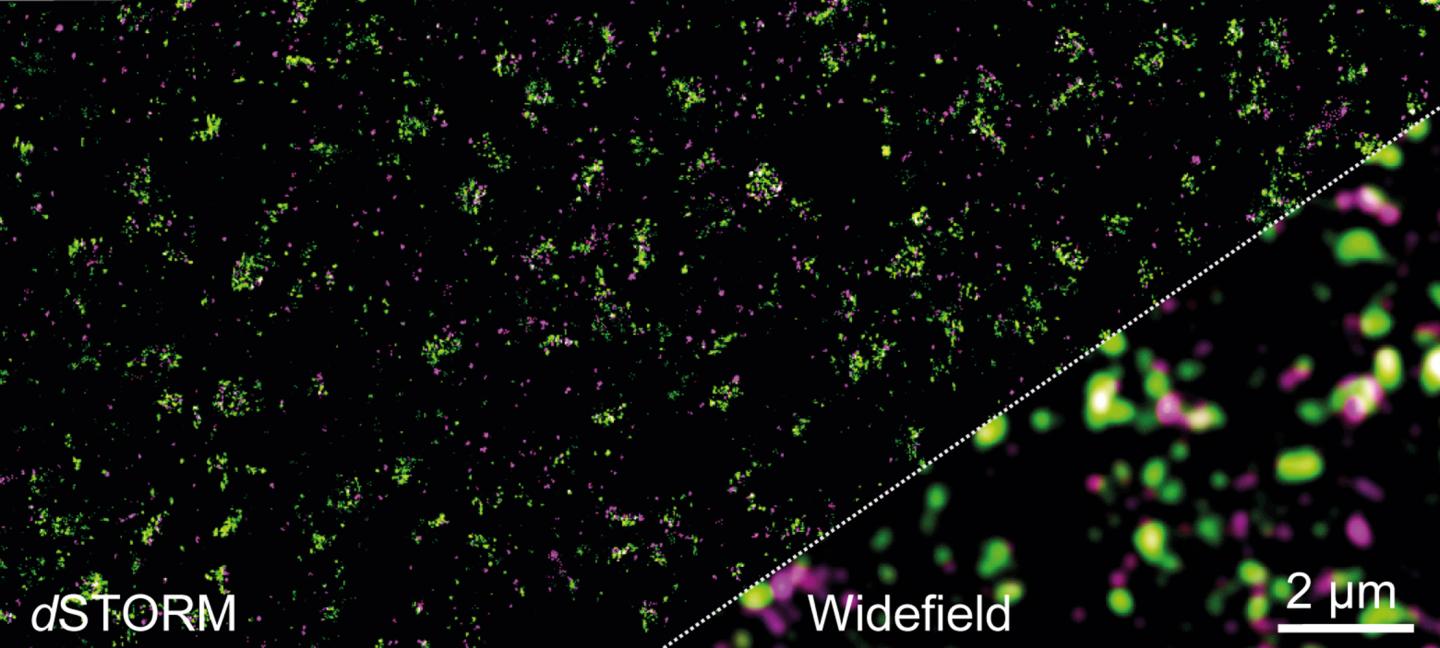
Credit: (Picture: Chair Markus Sauer / University of Würzburg)

When people think of glutamate, the first thing they remember is the flavour enhancer that is often used in Asian cuisine. Glutamate is also an important messenger substance in the nervous system of humans. There it plays a role in learning processes and memory. Some Alzheimer drugs, for example, slow down the progression of the disease by inhibiting the effect of glutamate.

In the nervous system, glutamate acts as a signal transmitter at the synapses. There, it binds to specific receptors of which there are several types. The metabotropic glutamate receptor of type 4 (mGluR4) plays a decisive role in this system.

Direct contact to other proteins

Until now, not much was known about the distribution of this receptor in the active zones of synapses. It is now clear that the majority of mGluR4 receptors are located in groups of one to two units on average in the presynaptic membrane. There they are often in direct contact with calcium channels and the protein Munc-18-1, which is important for the release of messengers.

This is reported in the journal Science Advances by a research team led by Professor Markus Sauer from the Biocenter of Julius-Maximilians-Universität (JMU) Würzburg in Bavaria, Germany, and Professor Davide Calebiro from the University of Birmingham in England. “Our data indicate that the direct contact of mGluR4 receptors with other key proteins plays a major role in the regulation of synapse activity,” says Professor Sauer.

Active zones are densely packed

The new knowledge was gained with the super-resolution microscopy method dSTORM (direct stochastic optical reconstruction microscopy). The method was developed by Sauer’s team in 2008. It enables individual molecules to be located even in the very small and densely packed active zones of synapses. This is not possible with conventional light microscopy because of the diffraction limit of 200 nanometers.

“For the first time we now have insights into the molecular organisation of the complex protein machines that control the signal transmission at the synapses of our brain,” says Professor Calebiro. Only with this knowledge will we be able to understand how the brain functions and how it processes information on different time scales.

The research teams will now use dSTORM to find out how all the proteins are distributed in the active synaptic zone. It is generally assumed that more than 100 proteins are involved in signal transmission in the active zones.

###

Media Contact
Markus Sauer
[email protected]

Original Source

https://go.uniwue.de/dstormsynapses

Related Journal Article

http://dx.doi.org/10.1126/sciadv.aay7193

Tags: BiochemistryBiologyBiomechanics/BiophysicsCell Biologyneurobiology
Share12Tweet8Share2ShareShareShare2

Related Posts

Florida Cane Toad: Complex Spread and Selective Evolution

Florida Cane Toad: Complex Spread and Selective Evolution

February 7, 2026
New Study Uncovers Mechanism Behind Burn Pit Particulate Matter–Induced Lung Inflammation

New Study Uncovers Mechanism Behind Burn Pit Particulate Matter–Induced Lung Inflammation

February 6, 2026

DeepBlastoid: Advancing Automated and Efficient Evaluation of Human Blastoids with Deep Learning

February 6, 2026

Navigating the Gut: The Role of Formic Acid in the Microbiome

February 6, 2026
Please login to join discussion

POPULAR NEWS

  • Robotic Ureteral Reconstruction: A Novel Approach

    Robotic Ureteral Reconstruction: A Novel Approach

    82 shares
    Share 33 Tweet 21
  • Digital Privacy: Health Data Control in Incarceration

    63 shares
    Share 25 Tweet 16
  • Study Reveals Lipid Accumulation in ME/CFS Cells

    57 shares
    Share 23 Tweet 14
  • Breakthrough in RNA Research Accelerates Medical Innovations Timeline

    53 shares
    Share 21 Tweet 13

About

We bring you the latest biotechnology news from best research centers and universities around the world. Check our website.

Follow us

Recent News

Personalized Guide to Understanding and Reducing Chemicals

Inflammasome Protein ASC Drives Pancreatic Cancer Metabolism

Phage-Antibiotic Combo Beats Resistant Peritoneal Infection

Subscribe to Blog via Email

Enter your email address to subscribe to this blog and receive notifications of new posts by email.

Join 73 other subscribers
  • Contact Us

Bioengineer.org © Copyright 2023 All Rights Reserved.

Welcome Back!

Login to your account below

Forgotten Password?

Retrieve your password

Please enter your username or email address to reset your password.

Log In
No Result
View All Result
  • Homepages
    • Home Page 1
    • Home Page 2
  • News
  • National
  • Business
  • Health
  • Lifestyle
  • Science

Bioengineer.org © Copyright 2023 All Rights Reserved.