• HOME
  • NEWS
  • EXPLORE
    • CAREER
      • Companies
      • Jobs
    • EVENTS
    • iGEM
      • News
      • Team
    • PHOTOS
    • VIDEO
    • WIKI
  • BLOG
  • COMMUNITY
    • FACEBOOK
    • INSTAGRAM
    • TWITTER
Saturday, June 27, 2026
BIOENGINEER.ORG
No Result
View All Result
  • Login
  • HOME
  • NEWS
  • EXPLORE
    • CAREER
      • Companies
      • Jobs
        • Lecturer
        • PhD Studentship
        • Postdoc
        • Research Assistant
    • EVENTS
    • iGEM
      • News
      • Team
    • PHOTOS
    • VIDEO
    • WIKI
  • BLOG
  • COMMUNITY
    • FACEBOOK
    • INSTAGRAM
    • TWITTER
  • HOME
  • NEWS
  • EXPLORE
    • CAREER
      • Companies
      • Jobs
        • Lecturer
        • PhD Studentship
        • Postdoc
        • Research Assistant
    • EVENTS
    • iGEM
      • News
      • Team
    • PHOTOS
    • VIDEO
    • WIKI
  • BLOG
  • COMMUNITY
    • FACEBOOK
    • INSTAGRAM
    • TWITTER
No Result
View All Result
Bioengineer.org
No Result
View All Result
Home NEWS Science News Chemistry

Inorganic perovskite absorbers for use in thin-film solar cells

Bioengineer by Bioengineer
April 29, 2019
in Chemistry
Reading Time: 2 mins read
0
IMAGE
Share on FacebookShare on TwitterShare on LinkedinShare on RedditShare on Telegram

IMAGE

Credit: J. Marquez-Prieto/HZB

Teams all over the world are working intensively on the development of perovskite solar cells. The focus is on what are known as metal-organic hybrid perovskites whose crystal structure is composed of inorganic elements such as lead and iodine as well as an organic molecule.

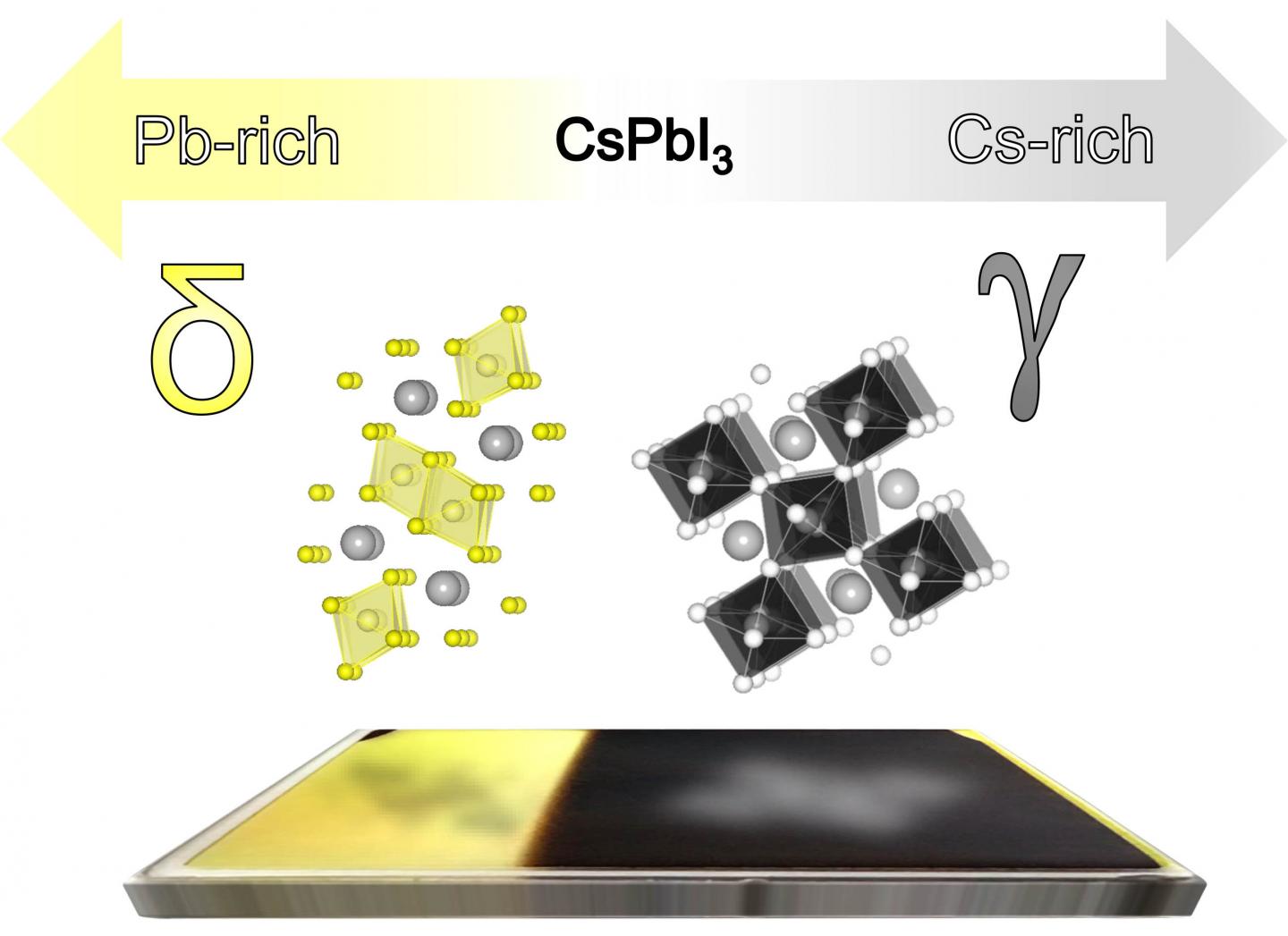
Completely inorganic perovskite semiconductors such as CsPbI3 have the same crystalline structure as hybrid perovskites, but contain an alkali metal such as caesium instead of an organic molecule. This makes them much more stable than hybrid perovskites, but usually requires an extra production step at very high temperature – several hundred degrees Celsius. For this reason, inorganic perovskite semiconductors have thus far been difficult to integrate into thin-film solar cells that cannot withstand high temperatures. A team headed by Dr. Thomas Unold has now succeeded in producing inorganic perovskite semiconductors at moderate temperatures so that they might also be used in thin-film cells in the future.

The physicists designed an innovative experiment in which they synthesised and analysed many combinations of material within a single sample. Using co-evaporation of caesium-iodide and lead-iodide, they produced thin layers of CsPbI3, systematically varying the amounts of these elements, while the substrate-temperature was less than 60 degrees Celsius.

“A combinatorial research approach like this allows us to find optimal production parameters for new material systems much faster than with the conventional approach that typically requires 100 samples to be produced for 100 different compositions”, explains Unold. Through careful analysis during synthesis and the subsequent measurements of the optoelectronic properties, they were able to determine how the composition of the thin film affects the material properties.

Their measurements show that the structural as well as important optoelectronic properties of the material are sensitive to the ratio of caesium to lead. Thus, excess caesium promotes a stable perovskite phase with good mobility and lifetimes of the charge carriers.

In cooperation with the HZB Young Investigator Group of Prof. Steve Albrecht, these optimized CsPbI3 layers were used to demonstrate perovskite solar cells with an initial efficiency of more than 12 % and stable performance close to 11% for over 1200 hours. “We have shown that inorganic perovskite absorbers might also be suitable for use in thin-film solar cells if they can be manufactured adequately. We believe that there is great room for further improvements”, says Unold.

###

Published in Advanced Energy Materials (2019):

“Low temperature synthesis of stable CsPbI3 perovskite layers for solar cells obtained by high throughput experimentation”; Pascal Becker, José A. Márquez, Justus Just, Amran Al-Ashouri, Charles Hages, Hannes Hempel, Marko Jošt, Steve Albrecht, Ronald Frahm and Thomas Unold.

Media Contact
Thomas Unold
[email protected]

Original Source

http://www.helmholtz-berlin.de/pubbin/news_seite?nid=20447;sprache=en;seitenid=982

Related Journal Article

http://dx.doi.org/10.1002/aenm.201900555

Tags: Chemistry/Physics/Materials SciencesEnergy/Fuel (non-petroleum)Materials
Share12Tweet8Share2ShareShareShare2

Related Posts

AI and Physics Collaborate to Design Advanced Hydrogen Storage Materials

June 25, 2026

International Team Including Dresden Scientists Develops Novel Designer Proteins for Advanced Study of Living Tissue

June 25, 2026

New Study Uncovers Key Factors Driving Water Chemistry in Nanoscale Environments

June 25, 2026

Plasma Technology Extends Catalyst Lifespan in Hydrogen Production

June 24, 2026
Please login to join discussion

POPULAR NEWS

  • Saying Goodbye to PGY-6: Pediatric Fellowship Realities

    103 shares
    Share 41 Tweet 26
  • Multi-Hospital Study Reveals Long Covid Burden Is Twice as High as Current Estimates

    92 shares
    Share 36 Tweet 23
  • Detection of EDCs in Breast Milk and Infant Urine Up to Six Months Highlights Early Exposure Risks

    77 shares
    Share 31 Tweet 19
  • New Drug Candidate Developed at McMaster Shows Potential for Treating Brain Cancer

    58 shares
    Share 23 Tweet 15

About

We bring you the latest biotechnology news from best research centers and universities around the world. Check our website.

Follow us

Recent News

Tracking Lanthanide-Labeled Microplastics in Plants

POSTECH Researchers Slash Cost of Reconstituted Cell-Free Systems by 95%

AI and Physics Collaborate to Design Advanced Hydrogen Storage Materials

Subscribe to Blog via Email

Success! An email was just sent to confirm your subscription. Please find the email now and click 'Confirm' to start subscribing.

Join 82 other subscribers
  • Contact Us

Bioengineer.org © Copyright 2023 All Rights Reserved.

Welcome Back!

Login to your account below

Forgotten Password?

Retrieve your password

Please enter your username or email address to reset your password.

Log In
No Result
View All Result
  • Homepages
    • Home Page 1
    • Home Page 2
  • News
  • National
  • Business
  • Health
  • Lifestyle
  • Science

Bioengineer.org © Copyright 2023 All Rights Reserved.