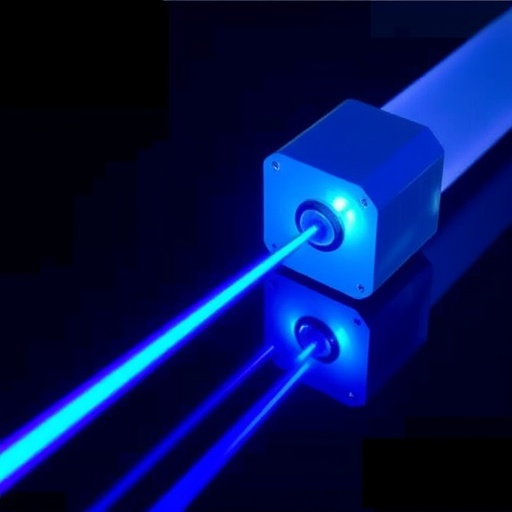
Gallium nitride (GaN)-based vertical-cavity surface-emitting lasers (VCSELs) have emerged as promising candidates for a new generation of light sources in displays, sensing technologies, and optical communication systems. Their compact size, ease of integration into arrays, and capability to emit coherent light at visible wavelengths make them highly attractive. However, one key challenge that has persisted in their development is achieving high efficiency—a crucial factor for practical applications and commercial viability.
Recent strides in semiconductor laser research have illuminated an intriguing avenue toward enhanced performance: the precise control of the laser cavity resonance or “cavity tuning.” This phenomenon involves adjusting the resonant wavelength at which the VCSEL cavity supports optical modes. Researchers now report that fine-tuning these resonance conditions dramatically influences laser performance metrics, including threshold current, output power, and, importantly, wall plug efficiency.
The mechanism behind cavity tuning hinges on the interplay between the VCSEL’s intrinsic optical properties and the engineered reflectivity of its mirrors. The cavity is defined by a pair of distributed Bragg reflectors (DBRs), which form a resonant optical cavity that amplifies light through stimulated emission. By varying parameters such as the thickness and refractive indices of these mirror layers across a wafer, the resonance wavelength shifts subtly, which in turn alters photon lifetimes and modal gain dynamics within the cavity.
In their study, the research team conducted a comprehensive, spatially-resolved characterization of VCSELs fabricated on a single wafer. This approach allowed them to correlate minute variations in cavity resonance with corresponding changes in laser output characteristics across different devices. By mapping this performance landscape, the team could precisely identify the optimal mirror loss condition—an elusive balance point where mirror reflectivity, cavity photon lifetime, and gain medium characteristics converge to minimize internal losses while maximizing light extraction efficiency.
Crucially, this study employed a combination of detailed spectral measurements and electrical characterization to extract fundamental device parameters such as differential gain coefficients, internal quantum efficiency, and mirror losses. These parameters provide a quantifiable insight into the underlying physics of the laser and enable accurate predictions of how further tuning can enhance performance.
The practical outcome of the cavity tuning methodology was the demonstration of an unprecedented wall plug efficiency of 26.4% in visible-light GaN VCSELs. Wall plug efficiency, defined as the ratio of the optical output power to the electrical input power, is a critical benchmark for energy-efficient laser operation. Achieving this level of efficiency represents a significant leap forward, narrowing the gap between theoretical potential and real-world application.
This advancement is particularly timely, given the explosive demand for compact, high-brightness visible light sources in next-generation augmented and virtual reality (AR/VR) devices, optical sensors with enhanced resolution and sensitivity, and high-speed visible light communication systems. The ability to produce efficient VCSEL arrays that operate at visible wavelengths stands to revolutionize these fields by enabling smaller, less power-hungry components with improved reliability and scalability.
The study also highlights how wafer-scale engineering and process variations can serve not just as a manufacturing hurdle but as an opportunity for systematic device optimization. By leveraging wafer-level nonuniformities, the researchers refined their understanding of the fundamental trade-offs in VCSEL design and identified design rules that maximize device yield and performance.
Importantly, this research builds on a deep understanding of GaN material properties, which include high thermal conductivity, wide bandgap, and robustness under high current densities. By integrating these material advantages with advanced cavity design, the team demonstrated that engineering at both the epitaxial and photonic levels is essential for breaking efficiency barriers in visible semiconductor lasers.
Looking forward, these findings pave the way for more explorations in active cavity control through post-fabrication adjustments, such as dielectric layer deposition or nano-patterning, to enable even finer resonance tuning. Additionally, expanding this approach to different emission wavelengths within the visible spectrum could open up tailored VCSEL solutions for specific industry needs.
Overall, the demonstrated approach delivers a powerful framework to guide the design and fabrication of GaN VCSELs that achieve high performance through precision control of their optical cavities. It represents a milestone in semiconductor photonics research with the potential to significantly impact the technology landscape of visible laser sources.
Subject of Research: GaN-based Vertical-Cavity Surface-Emitting Lasers (VCSELs) and cavity tuning for efficiency optimization
Article Title: Cavity Tuning Unlocks Record Efficiency in GaN-Based Visible-Light VCSELs
News Publication Date: Not provided
Web References: Not provided
References: Not provided
Image Credits: EurekAlert
Keywords
GaN VCSELs, cavity tuning, vertical-cavity surface-emitting laser, mirror loss, wall plug efficiency, visible light lasers, semiconductor lasers, optical communication, displays, sensing technology, distributed Bragg reflectors, laser cavity resonance
Tags: blue VCSEL laserscavity resonance tuningdistributed Bragg reflectors in lasersGaN-based VCSELslaser output power enhancementlaser threshold current reductionoptical cavity controloptical communication light sourcessemiconductor laser efficiencyvertical-cavity surface-emitting lasersvisible wavelength laserswall plug efficiency improvement