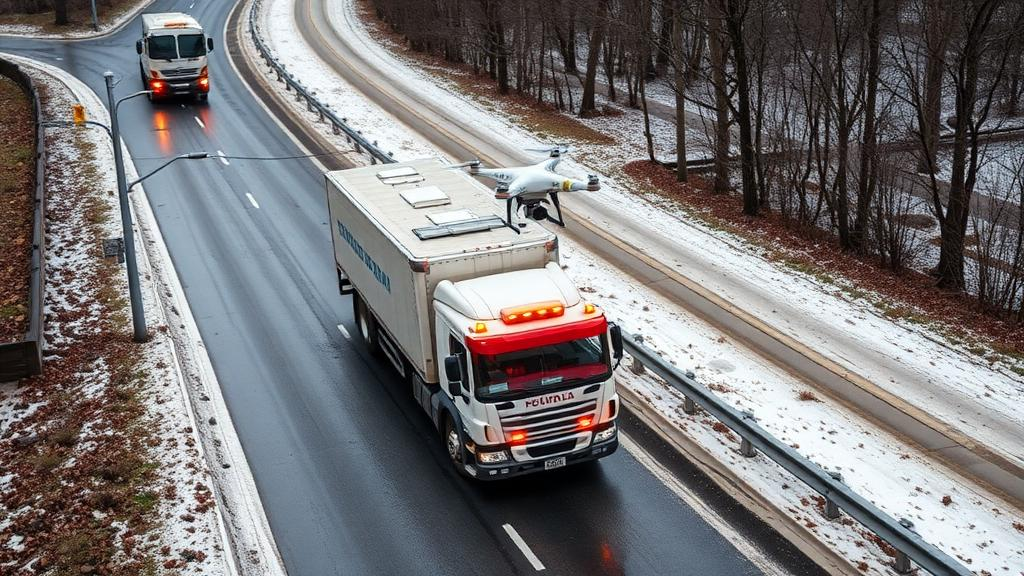
When a flood or earthquake strikes, the roads that relief trucks depend on can vanish overnight. Bridges collapse, landslides bury highways, and gridlock seals city exits, yet some of those blocked links quietly reopen within hours as crews clear debris or temporary access is opened. A new study argues that emergency planners should treat this recovery not as a fixed guess made before dispatch, but as a living belief that is revised with every field report and command-center bulletin, and that each revision should directly reshape the next move of a truck–drone delivery fleet.
Researchers at Zhengzhou Railway Vocational and Technical College, writing in the journal Discover Artificial Intelligence, have built a planning system that does exactly that. Their framework, described as a Bayesian belief-to-action policy for truck–drone emergency routing, converts sparse access observations into executable delivery decisions. In a locked set of thirty synthetic disaster instances, each with thirty demand nodes, the belief-guided policy completed every mission, while a conventional myopic planner that ignores recovery information failed to serve all demand in two of them. Across the twenty-eight instances where both policies finished, the new approach produced a better objective in twenty-seven cases, a difference the authors report as statistically significant with a Wilcoxon test p-value below ten to the minus seven.
The core insight is that post-disaster delivery is not merely a routing problem on a damaged network. It is a sequential decision problem on a network that is partially observed and progressively healing. Existing robust, distributionally robust, and stochastic humanitarian models typically freeze their assumptions about which roads are usable before execution begins. That makes them poor at exploiting the steady stream of confirmations and updates that arrive once trucks are rolling. The new policy instead maintains a discrete-time Beta-hazard belief for every recoverable access component, treating recovery as an absorbing transition from a blocked state to a passable one, much as survival analysts model events over time.
Each decision stage follows a strict cycle: observe, update belief, generate scenarios, commit action. Field confirmations come from trucks that physically traverse a component, while command-center bulletins reveal a subset of previously unknown states. These observations feed a Beta-hazard posterior that estimates, for each blocked component, the probability it will reopen by a given future stage. The posterior then generates a handful of short-horizon recovery scenarios, five in the locked configuration, each describing a possible future in which some blocked links reopen at particular times. An adaptive large neighborhood search, a well-established heuristic for rich routing subproblems, solves each scenario to produce a candidate truck–drone plan.
The crucial step is what the authors call a consensus repair rule. Rather than executing the full multi-stage plan from any single scenario, the system looks across all scenario solutions and commits only the current-stage action that receives the largest support, provided it is feasible under the access states that have actually been observed. Everything beyond the current stage is provisional and discarded. This enforces non-anticipativity: the planner never treats an unobserved future recovery as if it were already real. It simply uses likely recovery to guide which feasible action to take now, then waits for the next report before committing again.
The advantage shows up in service timing rather than cheaper movement. Under the belief-guided policy, mean logistics cost was 2845.1 with a weighted delay component of 18023.8, a delay share of roughly 85 percent. The myopic planner spent less on movement, 1993.3, but accumulated a weighted delay of 64917.0, a delay share of 96 percent. In other words, the belief-guided fleet accepted slightly higher travel expense to get urgent supplies to nodes much sooner, which is precisely the trade-off that matters when delayed service translates into avoidable deprivation for survivors.
The team was careful to test which parts of the mechanism actually carry the benefit. A frozen-hazard ablation, which keeps revealed passability for feasibility but never updates hazard counts, showed no significant incremental effect from online updating alone. Fixed spatial pooling of components into clusters offered no significant gain, and an adaptive-shrinkage variant that blends cluster and independent posteriors was significantly worse in the locked setting. A prior tuned to the instance generator’s hidden recovery profile produced the lowest mean objective but was not significantly better than the generic independent-component belief, so the authors retain it only as a best-case sensitivity bound rather than an operational default.
Cluster coupling, the idea that components sharing repair crews or terrain might recover together, is therefore treated as a testable information-sharing hypothesis rather than an assumed feature. In a separate reduced-compute diagnostic, the generator varied the true cluster-level recovery correlation, and adaptive shrinkage did protect against a random partition when signal was weak. But the authors stress that any field partition should come from GIS administrative zones, road class, elevation, flood extent, or repair-contractor responsibility, and must be validated out of sample before posterior counts are pooled across components.
The formal structure is a finite-horizon partially observed Markov decision process, or equivalently a Bayes-adaptive Markov decision process once belief parameters are appended to the state. Exact solvers for such problems are intractable at routing scale, so the policy replaces the Bellman recursion with a sample-average direct lookahead, a standard approximation in dynamic and stochastic vehicle routing. The authors also ran a certified diagnostic on five reduced six-node, one-team instances, solving a mixed-integer version with SCIP under a 0.01 percent certificate tolerance, to show that their offline full-information heuristic reference can itself be materially suboptimal, ranging from 0.03 to 64.5 percent above certified bounds. That justifies using paired comparisons with identical heuristics and seeds rather than claiming optimality gaps.
For emergency managers, the practical message is that a road report should not just update a status dashboard. It should revise a belief, generate fresh scenarios, and change the next truck–drone commitment. The framework turns confirmed access into revised executable routes while keeping drones reserved for delivery rather than reconnaissance, leaving joint sensing-and-delivery as a future extension. Next steps include road-network experiments with shared bottlenecks, repeated solver seeds to separate heuristic randomness from instance variation, calibrated decision-time budgets, and field-derived recovery data to replace synthetic generators with real restoration records.
Subject of Research: Bayesian belief-guided truck–drone routing for post-disaster emergency delivery under progressively recovering road access
Article Title: Bayesian belief-to-action planning for truck–drone emergency routing
Article References: Li, H., Li, Y., Song, X., & Li, Y. (2026). Bayesian belief-to-action planning for truck–drone emergency routing. Discover Artificial Intelligence, 6(1), Article 1283. https://doi.org/10.1007/s44163-026-02320-x
Image Credits: AI Generated
DOI: 10.1007/s44163-026-02320-x
Keywords: Bayesian belief modeling, truck–drone routing, emergency logistics, post-disaster recovery, partially observed Markov decision process, adaptive large neighborhood search, scenario-based planning, access recovery, humanitarian logistics, sequential decision-making, non-anticipative policy, drone delivery
News Source: Violet Maxwell. (October 5, 2026). Bayesian planner turns disaster road reports into truck–drone rescue routes. Scienmag.