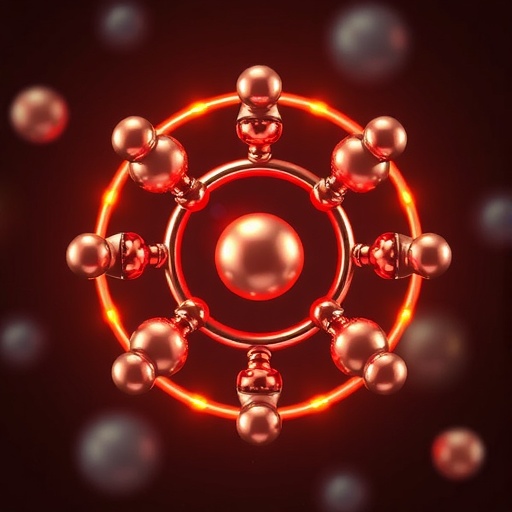
In a striking leap forward for the chemistry of heavy metals, an international team of scientists has successfully synthesized a stable, all-metal aromatic complex incorporating a three-membered ring of bismuth atoms. This discovery transcends traditional boundaries, expanding the classical concept of aromaticity, long a defining feature of organic chemistry, into the realm of heavy metallic elements. The research illuminates how stable electronic ring currents—once thought unique to carbon-based molecules—can arise and persist in purely metallic clusters, a revelation poised to transform our understanding of chemical bonding and material design.
Aromaticity, the phenomenon whereby electrons delocalize around a cyclic molecular framework to generate unusual stability and unique electronic properties, has historically been associated with organic molecules such as benzene. Benzene’s planar ring structure, composed solely of carbon atoms, hosts a sea of electrons that circulate freely under certain conditions of magnetic fields, creating what is known as ring currents. These currents imbue aromatic molecules with exceptional resilience and distinctive reactivity profiles, properties extensively exploited in chemical synthesis and industrial applications.
However, as Professor Stefanie Dehnen of the Karlsruhe Institute of Technology (KIT) elucidates, the confines of aromaticity have recently started to expand. Aside from the classic organic compounds, aromatic motifs have been identified in metal-organic complexes and heteroatomic rings, where nonmetal atoms complement carbon frameworks. The latest frontier breaks one more boundary by producing aromatic rings constituted entirely of metal atoms — a realm previously considered improbable due to the complexity of metallic bonding and electron interactions in heavy elements.
The groundbreaking nature of this research arises from the team’s meticulous synthesis and characterization of a novel inverse-sandwich complex. In this unique assembly, a triangular ring of three bismuth atoms—a heavy post-transition metal—and two uranium or thorium atoms cap the structure from above and below, respectively. This architecture fosters an intricate electronic environment where delocalized electrons generate ring currents, thereby stabilizing the metal ring akin to the resonance in organic aromatics.
X-ray crystallographic data provide unambiguous confirmation of this triangular Bi3 ring’s integrity and symmetry within the inverse-sandwich scaffold. But it is the combination of magnetic measurements, advanced spectroscopic techniques, and rigorous quantum chemical computations that truly reveals the hallmark of aromaticity: magnetically induced, stable ring currents circulating within the all-metal cluster. Such currents suggest a shared electron cloud ensnaring the metallic atoms in an energetically favorable and electronically unique bonding paradigm.
This study has been enabled by the synergistic collaboration of several leading research groups. At KIT, Dehnen’s team synthesized the bismuth-containing precursors essential for the assembly of these inverse-sandwich molecules, while Professor Florian Weigend’s group contributed critical quantum chemical insights. Computations performed by Weigend’s team elucidate the nature of the bonding interactions and provide theoretical substantiation of the aromatic ring currents observed experimentally. Together, their efforts bridge a historic divide between organic chemistry principles and metallic semiconductor materials.
Professor Dehnen remarks that these findings not only deepen the fundamental understanding of aromaticity beyond the realm of carbon but also suggest untapped potential for creating new functional materials. The stable integration of heavy-metal aromatic rings could enable advances in intermetallic compounds, nanoscale semiconductor devices, and catalysts, infusing these materials with novel electronic, magnetic, and structural properties derived from foundational quantum chemical effects.
The implications resonate profoundly in fields ranging from nanotechnology to energy conversion and quantum computing. By harnessing the unique electronic properties of heavy-metal aromatic systems, scientists envision fabricating materials with tailored conductivity, catalytic activity, or quantum coherence that outstrip currently achievable performance levels. This paves the way for innovative solutions addressing challenges from efficient energy storage to miniaturized quantum devices.
This research effort aligns with the mission of the HEiKA STAR – DEUsAroMet project, a concerted interdisciplinary initiative spearheaded by KIT and the University of Heidelberg. This collaboration aims to establish a comprehensive theoretical and experimental platform for investigating all-metal aromaticity, laying the groundwork for broad scientific exploration and practical applications. Together, the project’s participants seek to unlock the principles that govern the behavior of metallic rings with aromatic character, propelling forward the chemistry of complex metallic systems.
Beyond the breakthroughs in aromatic chemistry, the discovery also advances methodology by coupling state-of-the-art experimental characterization with high-fidelity quantum chemical modeling. This integrated approach provides unambiguous evidence of the ring currents, a task previously unattainable given the fleeting nature and reactivity of heavy-metal clusters. Such comprehensive understanding is vital for rational design of novel materials, transforming intuition-driven organometallic chemistry into predictable, targeted synthetic strategies.
The inverse-sandwich complex featuring the tri-bismuth ring with uranium or thorium caps represents a remarkable example of how atomic-scale architecture governs macroscopic properties. The concept inherently challenges the notion that aromaticity requires lighter elements or extensive π-conjugated systems. Instead, it exemplifies how electron delocalization—a fundamental quantum effect—can manifest robustly even amid the complex landscape of heavy-metal bonding.
Looking forward, the team anticipates that further investigations might reveal a broader repertoire of all-metal aromatic systems incorporating other heavy elements, varying ring sizes, and diverse geometries. Such research trajectories will likely furnish transformative insights into the electronic structures of metals at the nanoscale, potentially informing the development of new classes of superconductors, magnetic materials, or quantum dots engineered with atomistic precision.
In conclusion, the synthesis and detailed study of an all-metal aromatic system composed of a Bi3 ring encapsulated by uranium or thorium atoms marks a landmark success in chemical science. It opens an exciting vista where metal clusters no longer sit outside classical organic concepts but instead embody the profound quantum mechanics that bind electrons in aromatic cycles. This fusion of inorganic chemistry and quantum theory heralds an era of molecular innovation that promises to reshape material science and nanotechnology fundamentally.
Subject of Research: All-metal Aromaticity and Heavy-Metal Cluster Chemistry
Article Title: All-metal aromaticity of cyclo-Bi3³⁻ in diuranium and dithorium inverse-sandwich-type complexes
News Publication Date: April 20, 2026
Web References: HEiKA STAR – DEUsAroMet project
References:
Junru Ding, John A. Seed, Katrin Beuthert, Benjamin Peerless, Julia Rienmüller, Andreas Schmidt, Ashley J. Wooles, Louise S. Natrajan, Chuan-Ling Chen, Zhong-Ming Sun, Florian Weigend, Stefanie Dehnen, Jingzhen Du & Stephen T. Liddle, “All-metal aromaticity of cyclo-Bi3³⁻ in diuranium and dithorium inverse-sandwich-type complexes,” Nature Chemistry, 2026. DOI: 10.1038/s41557-026-02123-8
Image Credits: Stephen T. Liddle / University of Manchester
Keywords
All-metal aromaticity, bismuth ring, inverse-sandwich complex, uranium, thorium, ring currents, heavy-metal chemistry, nanotechnology, quantum materials, organometallic complexes, electron delocalization, intermetallic compounds
Tags: all-metal aromatic complex synthesisaromatic metal ring stabilityaromaticity beyond carbonbismuth atom arrangement in chemistrybismuth three-membered metal ringexpanding aromaticity conceptheavy element chemical bondingheavy metal aromaticityheavy metal material designmetal cluster electron delocalizationnovel aromatic metal compoundsstable electronic ring currents