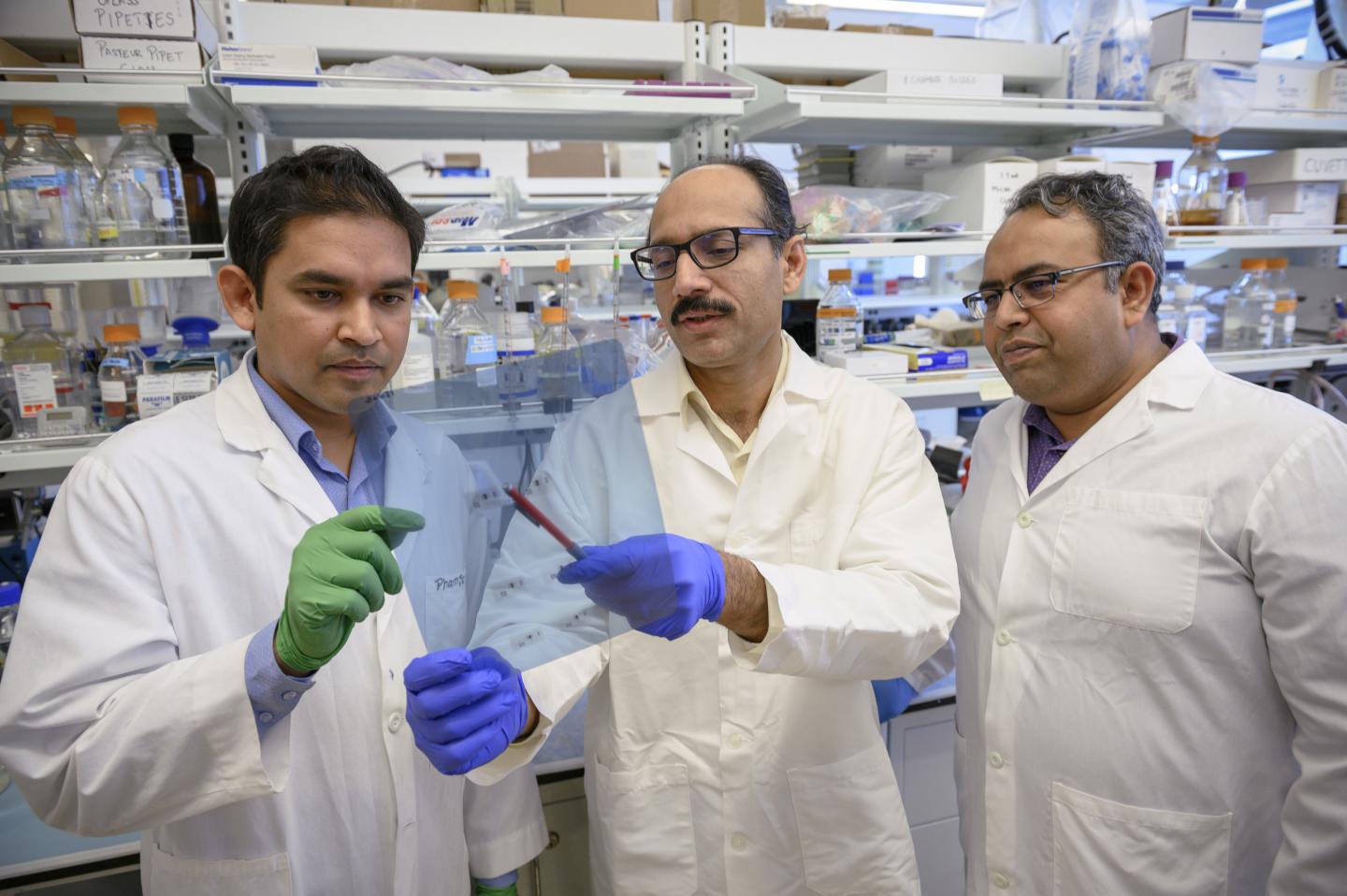
Credit: Photo by Cori Kogan, Washington State University Health Sciences Spokane
SPOKANE, Wash. – New research led by scientists at Washington State University has found that a protein known as GBP5 appears to play a key role in suppressing inflammation in rheumatoid arthritis, a potentially debilitating disease in which the immune system mistakenly attacks the body’s own joint tissues.
Published in the journal Arthritis & Rheumatology, the discovery could someday lead to new treatments to slow or halt the progress of the disease, which affects an estimated 1.5 million Americans. The researchers said it may also have applications in other inflammatory diseases.
First author Mahamudul Haque first stumbled upon GBP5 back in 2015, when he was working toward a Ph.D. in pharmaceutical sciences in WSU’s College of Pharmacy and Pharmaceutical Sciences. Now a postdoctoral research associate in the WSU Elson S. Floyd College of Medicine, Haque had been tasked with comparing the expression of different genes in joint tissue from rheumatoid arthritis patients and non-diseased joint tissue. Among the thousands of genes included in his analysis, one gene stood out in particular because its expression level was several times greater in rheumatoid arthritis tissue. That gene was guanylate binding protein 5 (GBP5), which helps produce the GBP5 protein.
“That caught our attention and interest,” said senior author Salah-Uddin Ahmed, a professor in the College of Pharmacy and Pharmaceutical Sciences who oversaw the work.
As far as Ahmed and Haque could tell, no other studies had looked at the role of GBP5 in rheumatoid arthritis or other auto-immune diseases, so they decided to take on the task.
The inflammation seen in rheumatoid arthritis causes painful swelling of joint tissues that can result in bone loss and deformed joints. Previous research conducted by Ahmed and his team has suggested that this inflammation is driven primarily by a cytokine protein known as interleukin-1 beta (IL-1 beta). To find out what role GBP5 plays, the researchers designed a series of experiments using rheumatoid arthritis synovial fibroblasts, a type of cell located in the tissue that lines joints and is known to play a role in inflammation and joint destruction. When they manipulated the cells to stop producing GBP5 and then added IL-1 beta to induce inflammation, they saw much higher levels of inflammation in cells that lacked GBP5 versus in non-manipulated cells. What’s more, when they increased levels of GBP5 in those same cells, inflammation triggered by IL-1 beta went down.
“Our initial thought had been that the GBP5 protein played a role in causing the disease, but as we worked to decipher the mechanism of GBP5 in rheumatoid arthritis we found that it was induced in response to inflammation and was trying to cut back inflammation before it goes out of control,” Ahmed said.
In addition, their research revealed how GBP5 interacts with interferon gamma, another cytokine that has been shown to fight inflammation under certain circumstances. When they silenced the GBP5 gene, the researchers found that it reduced interferon gamma’s ability to fight the inflammation triggered by IL-1 beta. This suggests that, on top of having its own anti-inflammatory effect, GBP5 also supports the anti-inflammatory function of interferon gamma.
Finally, the researchers confirmed their findings in a rodent model of rheumatoid arthritis, which showed that joint inflammation and bone loss increased when the GBP5 gene was turned off.
Ahmed said he and his team are conducting additional research to confirm that their findings hold up in other pre-clinical models of rheumatoid arthritis. Pending further, clinical studies to test this concept in rheumatoid arthritis patients at different stages of the disease, Ahmed said their findings could someday lead to the development of new combination therapies that could boost GBP5 levels to reduce inflammation and bone loss.
“What we would like to understand is, if we introduced this protein very early during the onset of rheumatoid arthritis, could we reverse or suppress the course of the disease?” Ahmed said.
Haque also suggested that researchers should take a closer look at the role of GBP5 in other conditions that involve inflammation. This includes other types of arthritis, such as gout and osteoarthritis.
###
In addition to Haque and Ahmed, authors on the paper include Anil K. Singh–an assistant research professor in the Ahmed lab at WSU –and Madhu Ouseph, a pathologist who was at the Stanford University School of Medicine and is now at Weill Cornell Medical College.
Funding for the study came from the National Institute of Arthritis and Musculoskeletal and Skin Diseases of the National Institutes of Health under award number R01AR072615 and from internal funds provided by Washington State University. Support for the initial findings that laid the groundwork for this study came from the Rheumatology Research Foundation.
Media Contact
Salah-Uddin Ahmed
[email protected]
Original Source
https:/
Related Journal Article
http://dx.