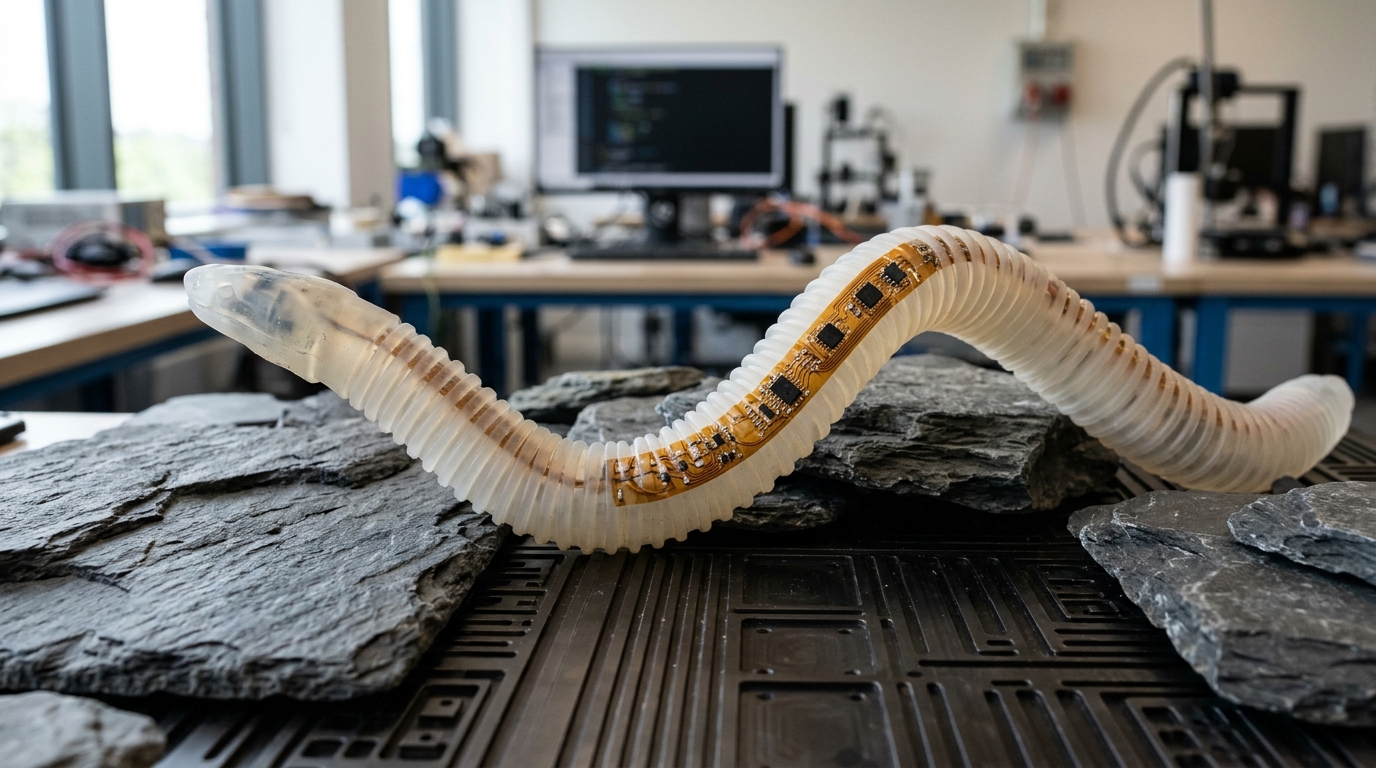
Researchers have developed an autonomous real-time shape estimation framework for cable-driven soft snake continuum robots by combining distributed micro-inertial sensors with a parabolic deformation model. Flexible continuum robots offer substantial promise for navigating confined, hazardous, or unstructured spaces such as collapsed search zones, narrow industrial pipelines, and delicate surgical environments. However, their lack of rigid joints creates profound state-estimation challenges, as conventional geometric models fail to capture complex deflections caused by gravity, contact forces, and external loads. Addressing this bottleneck, Minghui Zhang and Wenhui Wu engineered a modular snake robot comprising five serialized flexible arm segments actuated by internal tension cables and tracked by ten embedded micro-inertial measurement units. Unlike external optical cameras that suffer from severe occlusion in dark voids, or optical fiber systems that depend on bulky processing equipment, this self-contained architecture processes internal sensor signals directly. By fusing raw inertial measurements through Kalman filtering and reconstructing continuous backbone curves via parabolic geometry, the platform achieves an average root-mean-square shape reconstruction error of 7.67 millimeters during planar locomotion.
The mechanical architecture of the robotic system consists of five identical flexible modules connected in series, each functioning as an autonomous unit integrating actuation, perception, and local processing. Each module is constructed around a central flexible spine consisting of a uniform helical tension spring, which provides structural compliance while resisting mechanical buckling. Motion is generated by three stepper motors housed within each module, which differentially pull three uniformly spaced internal steel cables to produce omnidirectional bending and controllable axial contraction. To facilitate rapid sensing without overwhelming the central processor, the platform utilizes a distributed electronic control framework linked via a Controller Area Network bus. Embedded sub-controllers inside each module handle high-frequency sensor acquisition, local attitude calculation, and motor stepping routines. The master controller collects updated kinematic datasets from all five modules at five hertz, performing continuous coordinate transformations and concatenating discrete segments into a unified spatial profile. This hierarchical organization distributes intensive computation across individual nodes, maximizing overall system scalability, fault tolerance, and responsiveness.
Accurate spatial reconstruction begins with the processing of kinematic data collected by micro-inertial measurement units positioned at the midpoint and endpoint of each flexible module. Each unit incorporates a three-axis gyroscope and a three-axis accelerometer to record angular velocities and translational accelerations subject to drift, constant biases, and Gaussian measurement noise. Module rotations are modeled using a successive Z-Y-X spatial rotation sequence, yielding the respective yaw, pitch, and roll angles that define the orientation transformation matrix. To eliminate dynamic measurement noise and accurately separate gravitational acceleration from motion-induced acceleration, the authors implemented a discrete Kalman filter operating at a sampling period of 0.001 seconds. The filter integrates gyroscopic angular rates with accelerometer-derived tilt vectors, utilizing pre-calibrated error covariance matrices to update state estimates iteratively. This filtering stage produces robust, noise-filtered attitude angles, designated as theta prime for the midpoint and theta double prime for the module endpoint, establishing the spatial boundary conditions necessary for continuous geometric curve synthesis.
Conventional continuum robotics literature heavily relies on piecewise constant-curvature assumptions, which approximate bending segments as perfect circular arcs of uniform radius. While computationally simple, constant-curvature models diverge substantially from reality because flexible spring backbones experience variable bending moments when subjected to external gravity, friction, and environmental loading. To resolve this discrepancy, the researchers conceptualized the spring spine as an inextensible Euler-Bernoulli beam characterized by constant equivalent flexural stiffness. Because the internal triple-cable actuation produces balanced, transversely symmetric tension without generating net transverse shear along the arm, the internal bending moment remains approximately uniform across small deflections. Integrating the governing beam flexure differential equation under small-deflection approximations produces a quadratic parabolic profile rather than a circular arc. Theoretical error analysis reveals that for an allowable five percent geometric error margin, the maximum admissible end tangent angle is 10.31 degrees. For an unbent module length of 114.5 millimeters, this boundary defines an admissible curvature upper limit of approximately 1.59 inverse meters.
In practical engineering applications, physical manufacturing imperfections, assembly tolerances, and non-uniform tension distributions prevent the spring from maintaining an ideal, perfectly symmetrical parabolic deflection. When the maximum parabolic amplitude shifts toward the module endpoint, a midpoint-mounted sensor underestimates the true deflection angle; conversely, when the amplitude shifts toward the base, the sensor overestimates it. To neutralize these systematic deviations, the investigators formulated a sensor position offset compensation strategy. The physical displacement of the midpoint sensor along the curved spine is represented as a measurable assembly offset combined with an empirical logarithmic term governed by real-time spring contraction. Rather than relying on repetitive trial-and-error tuning, the initial assembly offset is measured precisely using laser ranging, while the logarithmic scaling coefficient is established through a two-stage calibration routine. Offline batch regression across five identical modules yielded an average baseline coefficient of 1.518, bounded within an admissible interval of 1.415 to 1.621, achieving maximum relative prediction errors below 0.22 percent.
During prolonged continuous locomotion, mechanical fatigue, spring creep, and cable relaxation induce gradual parameter drift that degrades shape reconstruction accuracy over time. To ensure enduring operational stability, the embedded software incorporates a lightweight online drift-adaptive tuning algorithm. While the endpoint sensor is assumed to remain aligned with the distal face to provide an uncompensated reference, the midpoint angle prediction is continuously evaluated against live measurements. When parameter drift occurs, a normalized least-mean-square update dynamically adjusts the scaling coefficient based on numerical sensitivities calculated through central finite differences. To prevent jitter and unnecessary updates from random sensor noise, adaptation remains frozen until the root-mean-square residual of a 100-sample sliding window exceeds a triple-sigma threshold of 0.294 degrees. Once triggered, the algorithm rapidly guides the residual below a convergence threshold of 0.147 degrees, where the adaptation freezes again. Experimental evaluations over prolonged runs verified two complete trigger-convergence-freeze cycles, maintaining bounded estimation errors without requiring human intervention or exceeding parameter bounds.
Static benchmark evaluations were performed using an experimental apparatus comprising three mutually perpendicular vernier calipers equipped with laser generators capable of recording endpoint spatial coordinates at 0.02-millimeter precision. Controlled static loading tests on an isolated 114.5-millimeter module clearly demonstrated the superiority of the parabolic formulation over traditional constant-curvature modeling across masses ranging from 100 to 500 grams. Under unladen conditions, the standalone flexible module achieved a maximum endpoint positioning error below 3.5 percent. Under a 100-gram load, the parabolic model prediction error was 3.08 millimeters, whereas constant-curvature error reached 9.77 millimeters. When subjected to a substantial 500-gram payload, passive spring deformation caused the constant-curvature estimation error to escalate drastically to 56.57 millimeters. In contrast, the parabolic model accurately captured passive bending, restricting error to just 11.38 millimeters. Testing across five distinct arm prototypes verified that the parabolic approach provided enhanced positioning precision under nearly all structural aspect ratios, losing its advantage only when module diameter was extremely small.
Dynamic performance assessments evaluated whether the module maintained structural stability and accurate tracking during continuous 360-degree omnidirectional rotation about its vertical axis under unladen and loaded states. Mounting a 200-gram tip mass caused the flexible spine to contract from an initial length of 114.5 millimeters to 104.5 millimeters, yet the module executed smooth rotations without exhibiting sudden structural buckling or morphological bifurcation. Embedded timing benchmarks confirmed that the computational pipeline meets stringent real-time requirements. On the local microcontroller, single-step estimation latency averaged 8 milliseconds with a maximum recorded delay of 12 milliseconds, remaining well below the 20-millisecond window required for 50-hertz real-time execution. Furthermore, transient convergence time following sudden posture changes averaged 21 milliseconds with a peak of 32 milliseconds, spanning roughly one to two control cycles. These computational benchmarks demonstrate that the algorithm completes full three-dimensional curve calculations before subsequent sensor frames arrive, providing the dynamic responsiveness essential for closed-loop shape control under external disturbance.
Full-scale multi-module locomotion trials validated complete three-dimensional shape synthesis during active planar locomotion and non-ideal obstacle navigation. When the five-module robot executed planar serpentine movement, the master controller processed consolidated kinematic packets at 20 hertz. In small-amplitude undulating gaits tailored for narrow passages, the average root-mean-square shape error fell to 5.3 millimeters, reflecting a 44.9 percent error reduction compared to large-amplitude turning gaits where peak error reached 15.7 millimeters at maximum lateral deflection. To evaluate resilience against physical environmental interference, the snake robot was tasked with crossing rigid obstacles, introducing severe external friction and contact forces across an eight-stage sequence. Strong localized extrusion during obstacle engagement caused brief inertial sensor drift, generating peak root-mean-square errors of 19.4 millimeters and 16.5 millimeters. However, the integrated online compensation algorithm preserved overall tracking fidelity, yielding an average obstacle-crossing error of 10.86 millimeters and proving that the platform retains acceptable accuracy despite harsh contact disturbances.
The distributed micro-inertial sensing framework offers distinct operational benefits over alternative continuum robot perception strategies. Unlike external optical cameras that are readily incapacitated by physical obstructions, dust, or complete darkness, internal inertial sensors maintain continuous tracking inside confined, occluded environments. Additionally, unlike data-driven neural network models that require massive experimental datasets and exhibit unpredictable generalization when encountering novel loads, the physics-based parabolic model provides transparent geometric interpretability without training overhead. Nevertheless, the authors highlighted clear physical limitations: the parabolic assumption applies strictly to quasi-static, small-to-medium bending amplitudes, degrading under severe mechanical shocks or extreme angular deflections. Furthermore, existing validations were conducted exclusively on rigid laboratory substrates rather than granular soils or muddy terrain. Future research will explore hybrid parabolic-catenary formulations capable of modeling severe loading conditions, alongside visual-inertial fusion and autonomous gait planning to support robotic exploration across collapsed ruins, deep pipelines, and extreme extraterrestrial environments.
Subject of Research: Real-time three-dimensional shape estimation for cable-driven soft snake robots
Article Title: Real-time shape estimation of a wire-driven soft snake-like robot based on micro-inertial sensors
Article References: Zhang, M., & Wu, W. (2026). Real-time shape estimation of a wire-driven soft snake-like robot based on micro-inertial sensors. Mechanical Sciences, 17(2), 983-1001. https://doi.org/10.5194/ms-17-983-2026
Image Credits: AI Generated
Keywords: soft robotics, snake robots, shape estimation, inertial measurement units, continuum robots, parabolic modeling, Kalman filtering, closed-loop control, Real-time, shape, estimation, wire-driven
News Source: Denise Maddox. (November 7, 2026). Inertial Sensors Enable Real-Time 3D Shape Tracking for Soft Snake Robots. Scienmag.